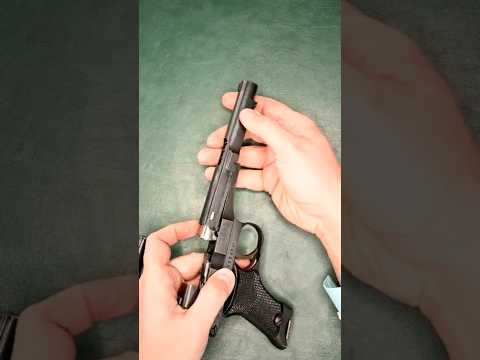
SITES Spectre: Think of it as an SMG, not a pistol

Published on February 8, 2018
Duration: 22:04

This guide details the field stripping procedure for the SITES Spectre HC Pistol, a unique 9mm firearm originally designed as an SMG. The process involves removing a single captive pin to separate the upper receiver from the polymer grip, allowing access to the internal components like the bolt, linear hammer, and nested recoil springs. Proper safety precautions are paramount during disassembly.

Quick Summary

The SITES Spectre HC Pistol, originally conceived as an SMG, is distinguished by its extremely narrow 35mm profile and innovative quad-stack magazine, offering capacities of 30 or 50 rounds. It features a closed-bolt action and ambidextrous controls, including a decocker for a double-action first shot.

Chapters

  1. 00:00Introduction and Company History
  2. 01:15Design Philosophy and Features
  3. 02:55US Import History
  4. 03:33Technical Specifications and Controls
  5. 05:28Closed Bolt Mechanism
  6. 07:45Disassembly and Internal Components
  7. 12:49Construction and Trigger Assessment
  8. 14:29Company Legacy and Variants

Frequently Asked Questions

What makes the SITES Spectre pistol unique?

The SITES Spectre is unique due to its extremely narrow profile (35mm), innovative quad-stack magazine for high capacity (30-50 rounds), and its design origins as a submachine gun adapted into a semi-automatic pistol and carbine.

How is the SITES Spectre disassembled for cleaning?

Field stripping involves removing a single captive pin at the rear of the receiver. This allows the upper receiver to be separated from the polymer grip, granting access to the bolt, linear hammer, and nested recoil springs.

What calibers was the SITES Spectre produced in?

While most commonly found in 9x19mm Parabellum, variants of the SITES Spectre were also produced in .40 S&W, 9x21mm IMI, and .45 ACP. It was sometimes marketed as the 'Falcon' in Europe.

Why was the SITES Spectre banned from import into the US?

The SITES Spectre was classified as an 'assault pistol' under the 1994 US Assault Weapons Ban due to features like its barrel shroud and forward magazine well, leading to the cessation of its import in 1993.

More Gunsmithing & DIY Videos You Might Like

More from Forgotten Weapons

View all →