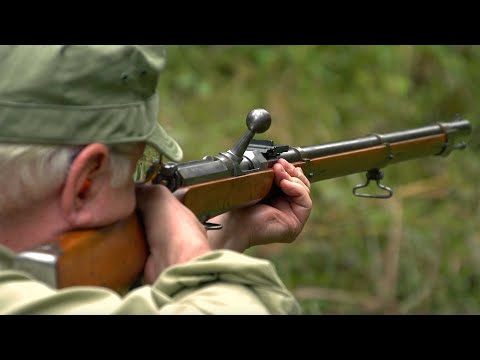
This video provides a detailed historical and technical overview of the French Chassepot rifle, highlighting its development as a response to the Prussian Dreyse needle gun. It explains the Chassepot's advancements in breach-loading technology, its unique combustible cartridge system, and its improved gas seal mechanism compared to its predecessor. The discussion also touches upon its military service and eventual conversion to the Gra rifle.
This entry details the revolutionary Dreyse Needle Rifle, the first bolt-action, breech-loading cartridge firearm. It explains the unique operation involving a long needle firing pin that penetrates the powder charge to ignite a primer at the rear of the cartridge. The guide highlights its tactical advantages, such as faster loading and firing from cover, and its historical significance, particularly its role in Prussian military dominance through the Franco-Prussian War. Expert insights from NRA Publications and American Rifleman editors are incorporated.
This guide details the operation of the Werder Model 1869 rifle, focusing on its unique 'backwards trigger' mechanism. Firearms expert Jonathan Ferguson explains how pushing the front lever drops the breech block and activates a strong extractor, facilitating rapid manual reloading. The guide emphasizes safety and the specific steps for loading and operating this historical firearm.
This video provides an in-depth look at the French "snuff box" breech-loader, specifically the 1853/67 Tabatière rifle, presented by firearms expert Jonathan Ferguson of the Royal Armouries. It details the conversion process from the original 1853 smoothbore musket to a breech-loading system, highlighting its distinctive features, caliber, and comparison to contemporary firearms like the British Snyder and French Chassepot. The expert also discusses its historical context within the Franco-Prussian War and its logistical implications for the French military.
This video delves into the history and technical development of the French Chassepot rifle, contrasting it with the Prussian Dreyse needle gun. It highlights the Chassepot's innovations in breech sealing and increased muzzle velocity, explaining how these advancements aimed to give France a tactical edge. The narrative emphasizes the competitive arms race between France and Prussia leading up to the Franco-Prussian War.
This video provides an in-depth look at the French Mle 1866 Chassepot rifle, a significant needle-fire firearm of the 19th century. It details its design by Antoine Chassepot, its adoption by the French military, and its production across various French arsenals and international contractors. The presentation highlights the Chassepot's mechanical operation, its innovative rubber obturator for gas sealing, and its superior performance compared to the Prussian Dreyse rifle during the Franco-Prussian War. The expert analysis emphasizes the rifle's historical context and technical advancements.
This video explores the historical significance of the Glade of the Armistice in Compiègne, France, the site where both the World War I and French World War II armistices were signed. It details the events surrounding these signings, the destruction and subsequent rebuilding of the memorial, and the symbolic importance of the location. The content focuses on historical events and their impact rather than specific firearms instruction.
This video offers a detailed book review of "The Modèle 1866 Chassepot" by Guy & Leonard A-R-West. The book comprehensively covers the development, mechanics, ammunition, production, markings, and historical impact of the Chassepot needle-fire rifle. It highlights the Chassepot's technological superiority over the Prussian Dreyse rifles during the Franco-Prussian War and mentions its later conversion to 11mm Mauser cartridges. The review notes the book's use of photographs and hand drawings for illustration, as well as firsthand soldier commentary, and provides purchasing information. The book is a 145-page softcover in color, published in the UK.
This Q&A session covers a wide range of firearms topics, from the least pleasant guns to shoot (Liberator, pistol-grip 12 gauge) to favorite showcased firearms (Howa Type 100). Discussions delve into cartridge development (6.5mm vs. 30 caliber, 280 British, 8x33mm Kurz, 41 AE, 38 Rimfire), firearm design principles (cylinder gap, blowback actions, hexagonal barrels, suppressors), military designations, and historical conflicts where rifle technology played a significant role (Austro-Prussian War). The host also touches on practical advice for two-gun shooting in restrictive states and personal collection goals.
This video provides a demonstration of a reproduction Reffye Mitrailleuse, a French volley gun from the 1860s. Expert insights cover its 13mm caliber, crank-operated breech loading mechanism, and its limited effectiveness during the Franco-Prussian War. The demonstration focuses on the firing sequence and the mechanical operation of the weapon.
You've reached the end! 10 videos loaded.
Gun Laws by State
Read firearms regulations for all 50 states + D.C.
Find Gun Dealers
Search licensed FFL dealers near you.