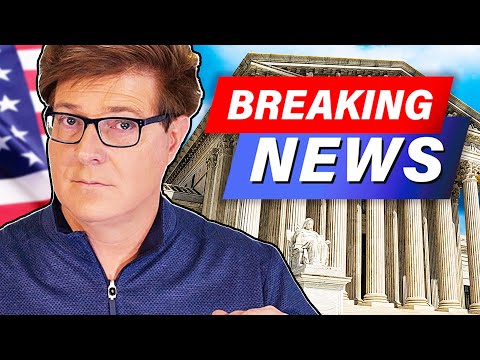
This video provides an expert analysis of the Supreme Court's unanimous 9-0 decision in Case v. Montana, addressing warrantless home entry and its implications for firearm confiscation. The speaker, identified as an authority on Second Amendment law, breaks down the case's background, legal arguments, and potential future impacts on gun owners' rights.
The US Supreme Court declined to hear cases challenging Maryland's assault weapon ban and Rhode Island's magazine ban. This decision, with only Justices Thomas, Alito, and Gorsuch reportedly voting to accept review, indicates a lack of interest from the majority of the court in addressing these Second Amendment issues. Justice Kavanaugh's concurring memorandum suggests the court is deferring these matters to lower courts and may revisit them in future terms.
This video discusses the oral arguments in Mexico v. Smith & Wesson before the U.S. Supreme Court, focusing on the legal arguments concerning the Protection of Lawful Commerce in Arms Act (PLCAA). It highlights the arguments from both the government of Mexico and the gun manufacturers, particularly concerning aiding and abetting liability and proximate cause. The analysis delves into the complex chain of causation alleged by Mexico and the defense's counterarguments, including the role of intervening criminal acts.
This analysis of the Supreme Court case Garland v. VanDerStok, as presented by Colion Noir, details Justice Alito's effective use of food analogies to challenge the ATF's classification of unfinished firearm parts as 'ghost guns.' The discussion highlights the legal arguments concerning statutory authority and the ordinary meaning of 'firearm,' emphasizing the potential impact of judicial appointments on Second Amendment rights.
This video discusses a significant development in the Supreme Court's bump stock case, Cargill. The author highlights that Justice Brett Kavanaugh's recent decision in a separate case, Bank of America, narrows down the justices likely to author the Cargill opinion to Justices Thomas, Alito, Barrett, and Gorsuch. This is viewed as positive news for Second Amendment advocates, particularly noting Justice Barrett's prior engagement with the issue and Justice Gorsuch's expertise in statutory interpretation and holding regulators accountable.
This expert-level analysis from Armed Scholar breaks down the Supreme Court's unanimous 9-0 decision in Trump v. Anderson, clarifying that states cannot disqualify federal candidates under Section 3 of the 14th Amendment. While not directly a firearms case, the ruling has significant implications for the Second Amendment community's ability to influence elections and support pro-2A candidates, referencing Trump's mixed record and his role in appointing pro-2A justices leading to the Bruen decision.
A federal appellate court has declared a major federal gun control law, 18 USC 922(g)(8), unconstitutional under the Second Amendment, citing the NYSRPA v. Bruen standard. The ruling, from the US Court of Appeals for the Fifth Circuit, specifically addresses the prohibition of firearm possession for individuals subject to civil restraining orders. This decision has significant implications for future cases and the interpretation of 'the people' in relation to constitutional rights.
This video delves into the reasons behind the Supreme Court's prolonged absence from hearing significant Second Amendment cases since Heller v. DC (2008) and McDonald v. Chicago (2010). The analysis focuses on the crucial role of Supreme Court justices' appointments and their impact on the Court's willingness to take up gun rights cases. It highlights how shifts in the Court's composition, particularly the replacement of swing votes like Justice Kennedy, and the addition of conservative justices like Kavanaugh and Barrett, have influenced the legal landscape and potentially paved the way for future Second Amendment cases such as Bruen.
This video explains the NYSRPA v. Bruen Supreme Court case, focusing on the potential impact on the right to carry firearms outside the home. It analyzes the Supreme Court justices' likely leanings and the key legal tests, such as the 'text, history, and tradition' approach versus 'balancing tests,' that will be central to the decision. The analysis highlights the importance of oral arguments and the questions posed by swing justices Kavanaugh and Roberts.
You've reached the end! 9 videos loaded.
Gun Laws by State
Read firearms regulations for all 50 states + D.C.
Find Gun Dealers
Search licensed FFL dealers near you.