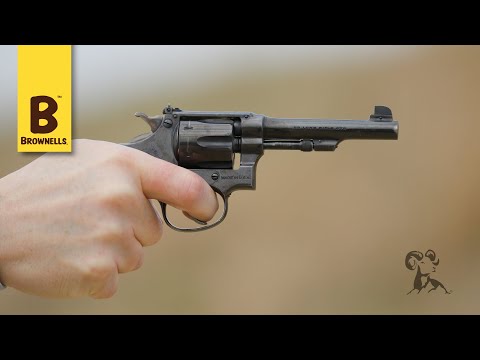
This product spotlight features the new .22 LR Colt King Cobra revolver, a significant release as the first new Colt .22 LR revolver since 1988 and the first 10-shot revolver in Colt's history. Colt Vice-President Paul Spitale discusses its features, including a Python-style barrel, interchangeable front sights, leaf-spring driven action for a smooth trigger pull, and enhanced frame strength. The video highlights its potential value with an MSRP under $1,000.
This video delves into the Smith & Wesson Model 63 Kit Gun, a stainless steel evolution of the classic .22/.32 Kit Gun. Introduced in 1977, this J-frame revolver offered improved elemental resistance for outdoor enthusiasts. The description details its chambering in .22 Long Rifle with a 6-shot cylinder, available in square or round butt configurations, highlighting its handy, compact, and accurate shooting characteristics. It also touches upon the later revised Model 63 from 2008 with an internal safety lock, contrasting it with earlier collector-favored versions. The video showcases a well-maintained early 1990s Model 63 featuring wood grips and adjustable sights.
This video from Brownells Gun Tech™ Keith Ford delves into the unique Winchester Model 55 single-shot automatic .22 rimfire rifle from 1958. The description highlights its unusual operation: a manual cocking handle, automatic ejection of spent casings from the underside, and bolt lock-back after firing, all while functioning as a single-shot firearm. The rifle is noted for its compact design and its role in introducing young people to shooting sports. Approximately 47,000 were produced before production ceased in 1961. The video also clarifies that this is distinct from the Winchester Model 1894 variant also known as the Model 55.
This video provides an expert-level overview of the M1894 Swedish Mauser carbine, presented by Keith Ford from Brownells. It delves into the rifle's historical adoption by the Swedish military in 1894, its production timeline until 1933, and specific details of a 1903 model, including its naval district markings. The presentation highlights the unique 'cock-on-closing' bolt action, the three-position safety, and the rear ladder sights. Ford also explains the purpose of the muzzle extension on imported models, designed to comply with barrel length regulations.
This video delves into the intricacies of Mk 12 SPR (Special Purpose Rifle) clones, presented by subject matter expert Keith Ford. It details the historical development, technical specifications, and variations of the Mod 0, Mod 1, and Mod H models, emphasizing their role in bridging the gap between carbines and heavier sniper platforms. The discussion highlights the importance of specific ammunition like the Mk 262 Mod 1 77-grain bullet for achieving optimal performance out to 850 yards.
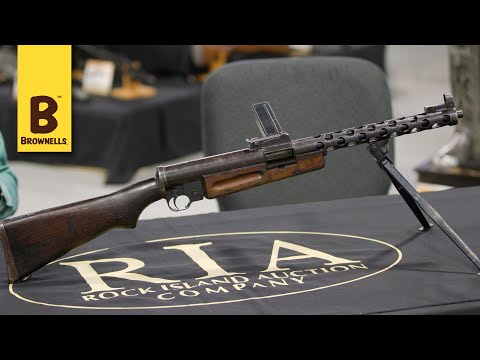
This video from the "From the Vault" series features Keith Ford and Caleb Savant from Brownells Gun Tech™ examining a rare Czech ZK-383 submachine gun at Rock Island Auction Co. The ZK-383, chambered in 9mm Luger, was designed in the 1930s as a light squad automatic weapon. The video highlights its simple barrel swap and easy cleaning process. It also details the ingenious mechanism for changing the rate of fire between 450 and 750 rounds per minute, as well as the unique side-mounted, tilted magazine that aids feeding and ejection. The discussion touches upon the ZK-383's production history from 1938 to 1948/49, its use by the Nazi Waffen-SS, and exports to Bulgaria. The three variants—standard, police (ZK-383-P), and bipod-less (ZK-383-H)—are also mentioned, emphasizing the firearm's solid engineering and smooth operation.
This video features Keith Ford from Brownells Gun Tech examining the Czechoslovak CZ 82 pistol. He highlights its similarities and differences with the Russian Makarov, noting the CZ 82's chambering in 9x18mm Makarov, double-stack 12-round magazine, polygonal rifling, and ambidextrous controls. The video details its blowback operation, DA/SA trigger, fixed barrel, and unique disassembly via a swing-down triggerguard. It also touches on the CZ 82's military service in Czechoslovakia and its current status in Slovakia and the Czech Republic. The CZ 83, its commercial export variant, and its ATF "Curio and Relic" classification are also discussed.
This "From the Vault" video from Brownells Gun Tech™ features Keith Ford showcasing his vintage Smith & Wesson 22/32 Kit Gun. The video delves into the history of this compact .22 LR revolver, tracing its origins back to the 22/32 Heavy-Frame Target model of 1911. Ford highlights the 1934 introduction of the shorter-barreled "Kit Gun" variant, designed for portability in everyday kits. He discusses its significance during the Great Depression as a tool for hunting and fishing, and provides specific details on identifying features of a pre-war model manufactured in 1941. The video also touches upon its redesignation as the Model 34 in 1957, its move to the J-frame, and the subsequent development of the Model 63 and current Model 317 Kit Gun variants.
This video features Brownells Gun Tech™ and firearm historian Keith Ford showcasing the Czech Vz 61 Škorpion machine pistol. The Vz 61 is a blowback-operated firearm chambered in .32 ACP, distinct from the modern CZ Scorpion Evo 3. The presenter highlights its skeletal folding stock, AR-15-like trigger group, and AR-180-style dual recoil springs. While the standard model is select-fire, Keith's example is semi-auto only. The Vz 61's historical service with Czechoslovakian forces and its use by various groups like the PLO, Red Army Faction, and IRA are discussed. Its Yugoslavian license-produced variant, the Zastava M84, is also mentioned. The video suggests that attaching a stock can enhance the shooting experience, even with the less powerful .32 ACP round, and notes the ATF Form 1 and SBR tax stamp process.
This video from the Brownells Gun Tech™ vault features Keith Ford showcasing his rare Japanese Arisaka Type 2 Paratrooper rifle. He explains that this takedown variant of the Type 99 infantry rifle was developed to address the logistical issues encountered during the 1942 Sumatra airborne assault, where paratroopers were separated from their bulky rifles. The Type 2 utilizes a captured screw/wedge system for its takedown mechanism. Approximately 20,000 were manufactured, but most never saw service due to a lack of further large airborne operations. The rifle, though not aesthetically refined, is described as a robust and functional design. Due to its rarity and historical significance, the Arisaka Type 2 has become a valuable collector's item, with Keith's example being in excellent condition, though its Imperial chrysanthemum stamp has been defaced to signify removal from service.
This video from Brownells Gun Tech features firearm historian Keith Ford showcasing the Nagant M1895 revolver. The presentation highlights its unique gas-sealed system, which allows for suppressor attachment, a feature not typically found on revolvers. Ford also discusses its origin in Belgium and subsequent production in Russia, its longevity in service, and its somewhat complex single-action-like ejection process. The "dirty secret" of its trigger pull is also mentioned.
This video provides a clear and concise demonstration of how to install the Magpul ESK (Enhanced Safety Kit) selector on an H&K MP5-pattern firearm. Brownells Gun Tech Keith Ford guides viewers through the process, starting with a safety check, disassembling the lower receiver, removing the factory selector, installing the ESK components, and reassembling the firearm. He also highlights specific compatibility notes, stating the ESK will not fit Navy/FBI lowers or the H&K SP5 due to trigger pack differences. The video emphasizes the ambidextrous benefits of the ESK, allowing for safety manipulation without shifting grip.
Gun Laws by State
Read firearms regulations for all 50 states + D.C.
Find Gun Dealers
Search licensed FFL dealers near you.