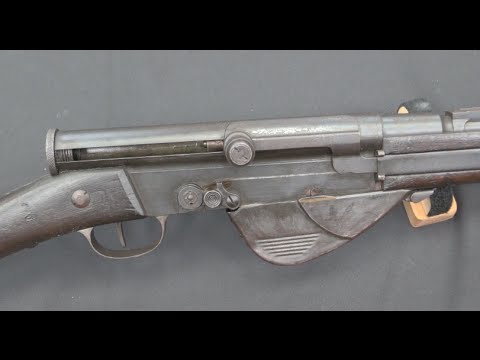
This video showcases new import firearms, specifically the French MAS 49/56 and MAS 36/51 rifles. It highlights these historical military rifles, likely focusing on their design, features, and potential appeal to collectors and enthusiasts. The content is derived from the title and provided hashtags, indicating a focus on these specific models and their French origin.
This entry details the disassembly of the MAS Mle 1948 prototype SMG, focusing on its unique lever-delayed blowback mechanism and internal components. Expert Ian McCollum highlights the process of removing the grip frame and fire control group, and explains the two-part bolt assembly with its integrated firing pin safety. The video also touches upon the historical context and development of this French submachine gun series.
This video provides an expert overview of the French Model 1935A and 1935S pistols, delving into their historical adoption by the French Army, design by Charles Petter and MAS, and manufacturing by SACM. The authoritative presentation highlights key technical specifications like the 7.65mm French Long caliber and 8-round capacity, while also addressing practical concerns regarding ammunition reliability and modern alternatives.
This guide details the unique cylinder swing-out and simultaneous ejection mechanism of the Lebel Modèle 1892 revolver, a significant piece of French firearms history. The video, presented by Misha with high authority, highlights its design features and historical context as the standard sidearm for French officers during WWI.
This guide details modifications observed on FAMAS Commando prototypes, focusing on ergonomic and mechanical adjustments for a compact bullpup design. Expert Ian McCollum highlights variations in handguard configurations, experimental sighting systems, and the critical modification of a lightened bolt carrier to maintain cycling reliability with a shorter barrel. The analysis underscores the unique nature of these prototypes, which were never officially issued in this configuration.
This video from Forgotten Weapons, hosted by Ian McCollum, details two Ethiopian Gras carbines, highlighting Ethiopia's unique historical position and the specific modifications and markings on these firearms. McCollum, a recognized expert, provides deep historical context and technical analysis of the rifles' origins and service.
This guide details the Lebel R35 carbine, a conversion of the obsolete Lebel rifle into a shorter carbine for French second-line troops in the 1930s. It covers the carbine's technical specifications, production details, modifications, and provides crucial advice on safe ammunition selection, drawing on expert insights from Ian McCollum of Forgotten Weapons.
This guide details the field stripping process for the French RSC-1918 rifle, an improvement over the RSC-1917. It highlights simplified disassembly for easier cleaning, especially crucial with corrosive WWI ammunition. The process involves removing the gas plug, nose cap, and handguard, with the piston and spring accessible from the front. The guide also notes the reinforced magazine cover latch on the 1918 model.
This video provides an expert-level guide to the Berthier M34 rifle, detailing its conversion to the 7.5mm rimless cartridge. It covers the historical context, technical specifications, production details, and a demonstration of field stripping. The presenter, Ian McCollum, showcases the rifle's unique features and markings, offering deep insights into French small arms development.
This guide details the field stripping process for the French RSC Model 1917 semi-automatic rifle, as demonstrated by Ian McCollum of Forgotten Weapons. It covers the basic disassembly steps, including removing the rear end cap and bolt assembly, and highlights key features like the rotating bolt and gas system. The video emphasizes the importance of proper handling and understanding the rifle's mechanics.
You've reached the end! 10 videos loaded.
Gun Laws by State
Read firearms regulations for all 50 states + D.C.
Find Gun Dealers
Search licensed FFL dealers near you.