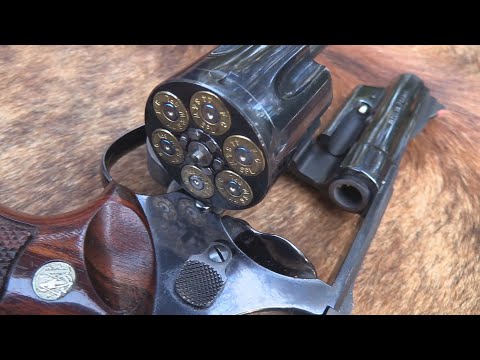
This guide, drawing on the expertise of Hickok45, explores the historical significance and modern necessity of pinned barrels on revolvers. It details how to identify these features on vintage models like the Smith & Wesson Model 29 and contrasts them with contemporary designs. The content emphasizes understanding manufacturing evolution and assessing whether older features remain critical for current firearm reliability.
This video compares an older Smith & Wesson Model 66-1 with a newer Model 66.8, evaluating design differences in areas like trigger stops, sights, firing pins, cylinders, barrels, and overall fit and finish. The analysis concludes that while older models may have superior aesthetic finishing, newer designs offer functional improvements in areas such as reliability and modularity, making them better overall firearms.
This video features a detailed review of a 1988 Smith & Wesson Model 19-5 revolver, highlighting its condition, features, and historical context. The presenter expresses a deep appreciation for revolvers, comparing the Model 19-5 to other iconic firearms like the Colt Python and Ruger GP100, and discussing the evolution of revolver manufacturing.
This video provides a comparative review of two vintage Smith & Wesson Model 60 J-frame revolvers: a "no dash" model from circa 1980-1981 chambered in .38 Special and a more modern Model 60-14 chambered in .357 Magnum. The presenter highlights key differences including pinned barrels, firing pin location, sight types, and the presence of the internal lock on the newer model. Both revolvers are discussed as effective concealed carry options.
This review focuses on a vintage 1980s Smith & Wesson Model 60 'no dash' revolver, identified as a new favorite by the reviewer. The expert firearm collector highlights key vintage features such as the pinned barrel, hammer-mounted firing pin, and original wooden grips. The revolver's history of ownership in Concord, Massachusetts, adds to its provenance.
This video provides an in-depth look at two Chinese Type 56 SKS carbines from Arsenal 296. The presenter details the historical context and specific features of an early 'letter series' model (likely 1960) and a later Norinco-stamped model (potentially 1973 or 1963). Key distinctions like milled vs. stamped trigger guards, one-piece vs. two-piece gas tubes, and bolt/bayonet lug lightning cuts are highlighted, offering valuable insights for SKS collectors and enthusiasts.
This guide demonstrates the proper technique for loading a Smith & Wesson Model 629 revolver with .44 Magnum jacketed hollow point (JHP) rounds using a speedloader. It emphasizes safe firearm handling and highlights the specific features of this vintage S&W model, such as its pinned barrel and recessed cylinder, as noted by an enthusiast collector.
This video reviews a 1968-1969 Smith & Wesson Model 36 'no dash' J-frame revolver with a round butt and 'banana' grips. The presenter highlights its excellent condition, noting minimal wear suggesting it was carried frequently but shot infrequently. The review touches on its historical significance as an early iteration of the Model 36 and its appeal as a classic snub-nose revolver.
This video provides a comprehensive, step-by-step guide to the full disassembly and cleaning of a Smith & Wesson Model 10 revolver. The instructor, with significant experience, details the process, including removing the side plate, mainspring, trigger assembly, and cylinder. It also covers cleaning techniques, bluing touch-up, and reassembly, emphasizing the importance of proper tools and methodical work. The guide is suitable for intermediate gun owners looking to perform detailed maintenance on their revolvers.
This review covers the Smith & Wesson Model 15-2 revolver chambered in .38 Special. The firearm, estimated to be from 1965-1966, features a pinned barrel and a four-inch barrel length, which the reviewer prefers for its aesthetics and handling. The gun is described as 100% functional with excellent bluing, showing minor wear consistent with holster carry. The reviewer replaced the original grips with Ultamount rosewood grips.
This video from Brownells, featuring Caleb and Steve, delves into the debate of whether older Smith & Wesson revolvers are superior to newer ones. The expert assessment highlights that while older models are excellent for collecting due to their historical features and build quality, newer revolvers often offer better performance for hard use and shooting. Advancements in materials, heat treatment, and manufacturing processes like MIM (though improved over early iterations) make modern S&W revolvers robust and accurate, particularly with features like tighter cylinder throats and the 'Endurance Package' on .44 Magnums. The conclusion is that both old and new S&W revolvers have their merits, with the choice depending on whether the primary purpose is collecting or frequent shooting.
This guide synthesizes expert instruction from hickok45 on handling and shooting the Smith & Wesson Model 29-2 .44 Magnum. It covers the firearm's classic features, the nuances of shooting .44 Special versus .44 Magnum, and the impact of barrel length on performance. The advice emphasizes safe handling and understanding the historical context of these iconic revolvers.
Gun Laws by State
Read firearms regulations for all 50 states + D.C.
Find Gun Dealers
Search licensed FFL dealers near you.