This presentation details the establishment and operation of the Continental Arsenal at Springfield, Massachusetts, prior to 1794. It highlights the critical roles of individuals like Ezekiel Cheever, Henry Knox, David Mason, and Joseph Eayrs in organizing ordnance supply, manufacturing, and logistics during the American Revolution. The arsenal served as a central repository and manufacturing hub for artillery, small arms, and various military accoutrements, overcoming significant challenges related to supply shortages and management.
This video provides an expert-level overview of the rare Model 1875 Officer's Pattern Trapdoor Springfield, a high-end sporting rifle produced by Springfield Arsenal. It details unique features like extensive engraving, a Beach folding front sight, a tang aperture sight, a removable pistol grip, and a sophisticated single set trigger mechanism. The presentation highlights the craftsmanship and historical context of this specialized firearm.
This guide details the operation of the set trigger mechanism on the Model 1875 Officer's Pattern Trapdoor Springfield, as demonstrated by Ian McCollum. The set trigger allows for an exceptionally light pull after being engaged by pushing the trigger forward. Proper safety precautions are paramount when handling any firearm.
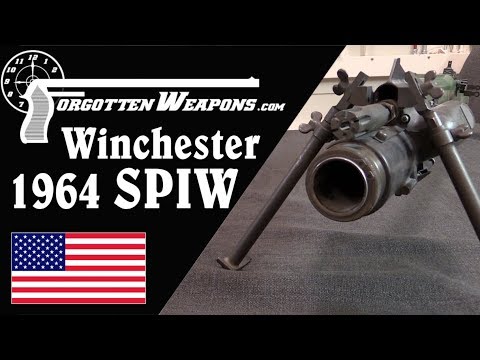
This entry details the Winchester 1964 SPIW, a prototype infantry weapon developed for a 1962 US military program. It highlights the weapon's unique flechette ammunition, integrated 40mm blow-forward grenade launcher, and soft recoil system. The analysis draws on expert commentary from Ian McCollum, emphasizing the historical context and technical challenges that ultimately led to the SPIW's abandonment.
This guide details the disassembly and maintenance of the White Prototype LMG, based on insights from Ian McCollum. It highlights the use of the gas port cap as a multi-tool for disassembly and emphasizes the importance of safety checks. The video provides a high-level overview of the internal mechanisms, including the open-bolt action and gas system, suitable for intermediate enthusiasts interested in historical firearm mechanics.
This video examines the Ward-Burton bolt-action rifle, an early US Army experimental firearm chambered in 50-70. Approximately 1,001 rifles and several hundred carbines were manufactured at Springfield Arsenal for the 1871 trials. The rifle features an interrupted thread locking mechanism with a 90-degree throw and a simple bolt-on design. Despite its mechanical simplicity, the Ward-Burton was not adopted due to unfamiliarity with bolt-action mechanisms among military commanders and some mechanical issues with early production quality, including parts breakage. The rifle was issued to units like the 13th Infantry during the Yellowstone Expedition, where reports of accidental discharges due to unfamiliarity contributed to its lack of adoption.
You've reached the end! 6 videos loaded.
Gun Laws by State
Read firearms regulations for all 50 states + D.C.
Find Gun Dealers
Search licensed FFL dealers near you.