This video announces the book 'Forged in Snow: Finnish Small Arms 1917-2025' by Ian McCollum of Headstamp Publishing. The book is a comprehensive collector's reference covering Finnish-manufactured or modified firearms, including detailed histories, variants, and markings. Various editions and pledge levels are available through a Kickstarter campaign, with stretch goals for additional content and physical items.
This video provides an expert-level overview of the rare Latvian Charger-Loading Lee Enfield (CLLE) Cavalry Carbine, presented by Ian McCollum. It details the carbine's unique history, procurement by Latvia, technical specifications, and distinctive markings, including those from BSA and Tikkakoski. The presentation highlights the rifle's modifications and its service life, emphasizing its rarity today.
In a humorous 'Magic Gunsmithing Box' experiment, Ian McCollum demonstrates the transformation of a Luger P08 into a Tikkakoski-barreled Luger, and then into a Finnish Lahti L-35 pistol. This lighthearted segment highlights historical firearm variations and the unique heritage of Finnish firearms, showcasing expert knowledge of firearm history and components.
This guide details the disassembly of the rare Tank Suomi M31 SMG, focusing on the removal of its specialized barrel shroud designed for armored vehicle mounts. It covers the quick-detach mechanism and the modular concept for bail-out scenarios. The information is presented with the authority of Ian McCollum, an expert in historical firearms.
This guide details the installation and removal of the bipod and barrel shroud on a commercial export Suomi M31 SMG, as demonstrated by Ian McCollum. It highlights the modular nature of the Tikkakoski commercial configurations and the quick-detach barrel shroud mechanism. McCollum's expertise in historical firearms ensures accurate procedural guidance.
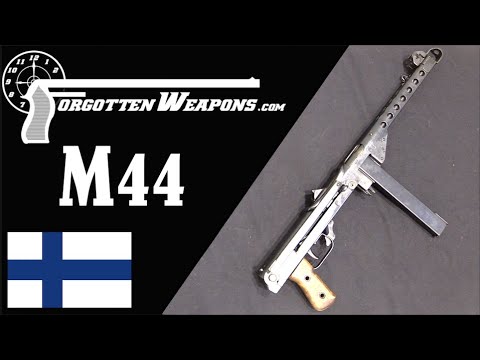
This guide details the field stripping process for the Finnish M44 submachine gun, a Soviet PPS-43 copy. It highlights the simple blowback action and the unique pivot-based disassembly. The video features Ian McCollum demonstrating the process, emphasizing its mechanical simplicity.
This review covers the Finnish m/27rv Cavalry Carbine, a rare variant of the Mosin-Nagant. Produced by Tikkakoski between 1933-1934, it features a shortened barrel, a distinctive bent bolt handle influenced by the Kar98AZ, and a unique stock modification for bolt manipulation. The carbine saw service in the Winter and Continuation Wars, with most surviving examples exported to the US.
This guide details the installation and operational use of the M43 Salakari mount for the Finnish Maxim gun. Developed by Lt. Lauri Salakari, this lightweight mount significantly enhances mobility for assault troops. It features removable skis for snow or dirt use and offers 360-degree rotation, weighing only 4.1 kg compared to standard tripods. The mount attaches via standard Maxim points and was produced in limited numbers, highlighting its historical significance and tactical advantage.
This video provides an expert-level review of the Danish M1941 Suomi, a licensed variant of the Finnish KP-31 submachine gun. Ian McCollum details its historical context, production by Madsen and Hovea, and key differences from the original Finnish model, including unique markings and stock ergonomics. The review highlights its scarcity and significance as a collector's item, drawing on detailed technical specifications and historical production data.
This guide provides an overview of identifying and maintaining Finnish Luger variants, including the M/23 and wartime-modified 9mm models. It highlights key markings, caliber differences, and common modifications encountered on these historical firearms. Expert insights from Ian McCollum of Forgotten Weapons are incorporated, emphasizing the unique service history and technical aspects of Finnish Lugers.
The Suomi m/31, designed by Aimo Lahti, is a highly reliable Finnish submachine gun known for its exceptional machining and accuracy. Despite its heavy weight and high 900 RPM rate of fire, its design features like a non-reciprocating charging handle and a pneumatic venting system contribute to its controllability. It saw extensive use in WWII and remained in service for decades, with various magazine types and a later muzzle brake variant.
You've reached the end! 11 videos loaded.
Gun Laws by State
Read firearms regulations for all 50 states + D.C.
Find Gun Dealers
Search licensed FFL dealers near you.