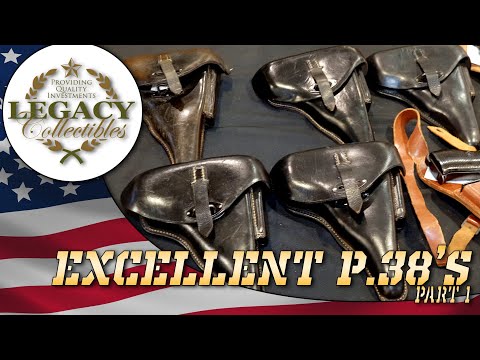
Excellent Collection of P.38's (part 2)

Published on April 18, 2024
Duration: 16:07

This video showcases an extensive collection of Walther P38 pistols, detailing variations from early production to late-war models. The presenter, an experienced collector, highlights specific features like caliber differences, proof marks, grip types, and finish variations (dual-tone, phosphate). The video also covers associated accessories such as holsters, magazines, and belt buckles, providing insights into their rarity and historical context.


Quick Summary

The Walther P38 pistol saw numerous variations throughout its production. Rare examples include the 7.65mm caliber variant, which never entered full production, and police-issued models marked with a 'Police Eagle.' Late-war P38s from 1945 often feature 'Cog Hammers' and dual-tone finishes, reflecting evolving manufacturing processes.

Chapters

  1. 00:00Introduction & Rare 7.65mm P38
  2. 01:46Late Production P38s (1943)
  3. 03:02P38 Rig with Belt Buckle
  4. 04:03Mauser P38 byf 44 Dual Tone
  5. 05:33Rare FN Slide Mauser P38 Dual Tone
  6. 07:07Rare Police Eagle L P38 with Soft Shell Holster
  7. 10:481945 P38s: C Block & Dual Tone
  8. 12:311945 Mismatched P38 (GI Bringback)
  9. 13:52Spreewerk P38 with Russian X Mark
  10. 15:13Consignment & Selling Information

Frequently Asked Questions

What makes the 7.65mm P38 so rare?

The 7.65mm P38 is exceptionally rare because it never entered full production. It's believed only about a hundred were made, often using older 9mm stencils that were then etched for the 7.65mm caliber. These are highly prized by collectors.

How can you identify a late-war P38 from 1945?

Late-war 1945 P38s, especially those in the 'C' block, often feature 'Cog Hammers' with larger, less refined serrations. They also tend to have more phosphate parts and may exhibit dual-tone finishes. Some may have been assembled by GIs or show signs of Soviet occupation.

What is a 'dual-tone' P38?

A dual-tone P38 typically has a phosphate finish on the slide and frame, combined with a blued barrel. This finish variation became more common in later production years, particularly around 1944 and 1945, as manufacturing processes evolved.

What is the significance of a 'Police Eagle' marking on a P38?

A 'Police Eagle' marking, often with shorter wings than standard military proofs, indicates the P38 was issued to German police forces. These pistols, especially those from Mauser ('byf') and without a suffix, are considered rare and valuable collector's items.

More Reviews Videos You Might Like

More from Legacy Collectibles

View all →