

Common Use: The Math, the Law, and the 24 Million AR-15s in American Hands
Over 24 million AR-15-style rifles are in American hands. The platform's 1956 patent expired in 1977, spawning a multi-billion-dollar modular economy. Here's the full story — from Eugene Stoner's prototype to the Supreme Court's common use doctrine.
Twenty-four million. That's how many AR-15-style rifles are in American hands, according to the National Shooting Sports Foundation's 2022 estimate. Some studies put it north of 28 million. In 2020 alone, 2.8 million entered the market — roughly one in five firearms sold that year.
And yet. Depending on who you ask, the AR-15 is either the most practical rifle platform ever designed or a weapon of war that has no place in civilian hands.
Both sides are arguing about something most of them don't fully understand. The AR-15 isn't a single rifle. It's a modular system — a set of specifications that lets one receiver become a dozen different guns depending on what you bolt to the top of it. That's the reason 24 million Americans own one. That's the reason the legal fights around it are so complicated. And that's the reason it's not going anywhere.
We pulled from over 1,400 expert videos from independent channels — Forgotten Weapons, Garand Thumb, Military Arms Channel, InRangeTV, and dozens more — and cross-referenced Supreme Court opinions, ATF manufacturing data, and FBI crime statistics. Here's the story nobody's telling you completely.
The History: From ArmaLite to 24 Million
Eugene Stoner didn't set out to build America's most controversial rifle. He was trying to make it lighter.
In 1954, Stoner became chief engineer at ArmaLite, a small division of Fairchild Engine and Airplane Corporation in Hollywood, California. By 1955 he'd completed the AR-10, a select-fire infantry rifle in 7.62x51mm NATO that weighed a full pound less than the M14 it was designed to replace. The Army wasn't interested. Too unconventional. Too light. Too different from what the Ordnance Corps wanted to build.
Then came Project Salvo — a 1955 Army experiment testing whether small-caliber, high-velocity cartridges could improve hit probability over the traditional .30-caliber battle round. General Willard Wyman issued a requirement in 1957: a select-fire .22-caliber rifle under six pounds with M1 Carbine terminal ballistics and helmet penetration at 500 yards. Stoner scaled the AR-10 down to fire a cartridge called .222 Remington Special — later standardized as .223 Remington — and the AR-15 was born.
The prototype was radical. A 25-round straight magazine. A top-mounted charging handle within the carry handle. A pencil-profile barrel that would become the platform's signature. ArmaLite filed Patent US 2,951,424 on August 14, 1956, covering the "Gas operated bolt and carrier system" — the internal piston design at the core of everything that followed.
The Air Force loved it. Special Forces in Vietnam loved it. But ArmaLite's parent company, Fairchild, was bleeding money. In 1959, a deal brokered by Cooper-McDonald saw Colt purchase the AR-15 and AR-10 rights for $75,000 plus royalties.
"ArmaLite's parent company, Fairchild, faced financial difficulties and sought to sell the AR-15 rights. In 1959, Colt purchased the rights for $75,000 plus royalties." — Ian McCollum, Forgotten Weapons Watch at 1:24 →
Colt manufactured the first batch of 300 rifles — the "Colt ArmaLite AR-15 Model 01" — in December 1959. By January 1962 the U.S. military had adopted it. In December 1963, it was designated the M16. By 1964 it was in full production for military service.
And in that same year, 1964, Colt made the decision that changed everything. They introduced a semi-automatic-only version of the AR-15 for the civilian and law enforcement markets. One trigger pull, one round. No burst. No full-auto. A fundamentally different weapon than the M16 — sharing a platform, but not a function.
The Patent Expires — and the Market Explodes
Colt's patent was granted on September 6, 1960. Under the 17-year patent term of that era, it entered the public domain on September 6, 1977. But here's the detail most people miss: Colt retained the "AR-15" trademark. It still holds it today. Every other manufacturer had to market their version as "AR-15-style" or under a different model name — Bushmaster XM-15, Smith & Wesson M&P15, Palmetto State Armory PA-15.
That trademark distinction didn't slow anything down. Bushmaster eventually overtook Colt in civilian AR-15 sales. Dozens of manufacturers jumped in. The platform was open.
Then came the 1994 Federal Assault Weapons Ban. For 10 years, it restricted manufacturing and sale of semi-automatic firearms with certain cosmetic features — pistol grips, flash suppressors, folding stocks, threaded barrels. Existing rifles were grandfathered. The ban didn't cover functionality. It covered appearance.
On September 13, 2004, the ban expired under its sunset provision. And the market didn't just recover. It detonated.
The Manufacturing Ramp
Bureau of Alcohol, Tobacco, Firearms and Explosives (ATF) manufacturing data tells the story in numbers:
| Year | Pistols | Rifles | Misc. Firearms | Total |
|---|---|---|---|---|
| 2004 | 728,511 | 1,325,138 | 19,508 | 3,099,025 |
| 2008 | 1,609,381 | 1,734,536 | 92,564 | 4,498,944 |
| 2012 | 3,487,883 | 3,168,206 | 306,154 | 8,574,034 |
| 2016 | 4,720,075 | 4,239,335 | 833,123 | 11,497,441 |
| 2020 | 5,509,183 | 2,760,392 | 1,324,743 | 11,064,078 |
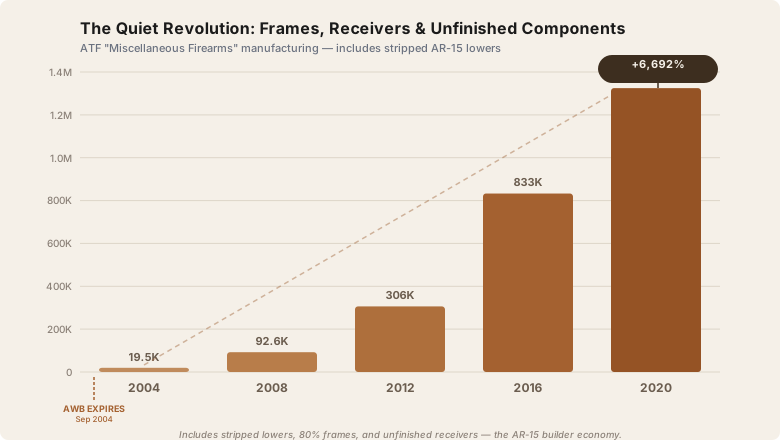
That "Miscellaneous Firearms" column is the quiet revolution. It includes frames and receivers — stripped AR-15 lowers that buyers assemble themselves. That category surged 4,281% between 2000 and 2020. The builder culture didn't just grow. It became a significant share of the entire firearms market.
The Lego Thesis: Why the AR-15 Won
Every rifle platform is a tool. The AR-15 is a toolbox.
Two takedown pins. That's all that holds the upper and lower receiver together. Push them out, separate the halves, and you've just turned a 5.56 NATO rifle into a platform that accepts any upper assembly you can bolt on. A .300 Blackout upper for suppressed home defense. A 6.5 Grendel upper for deer hunting. A .22 LR conversion kit for training your kids. A 9mm blowback upper for cheap range time. Same lower receiver. Same trigger. Same muscle memory.
No other rifle platform on Earth has this.
"Despite comfort and efficiency differences, the core AR-15 platform remains fundamentally similar across three decades of evolution." — Dirty Civilian Watch at 19:11 →
The AK has its own modularity, but it's built around a monolithic receiver that doesn't separate the same way — and decades of import bans have constrained what's available in the US. The SCAR is modular in theory but costs $3,000+ before you start accessorizing. The Tavor and AUG are bullpups with limited aftermarket depth. None of them have the ecosystem.
And the ecosystem is staggering. A single Brownells catalog lists over 760 individual AR-15 components. Aero Precision, Ballistic Advantage, Geissele, JP Enterprises, Radian Weapons, Forward Controls Design — hundreds of manufacturers building parts that all interface because the industry follows mil-spec dimensions. Uppers, lowers, barrels, triggers, handguards, bolt carrier groups, buffers, muzzle devices, furniture, optics mounts. Every piece interchangeable.
A former SEAL Team Six commander builds his go-to setup with an EOTech Vudu 1-10x low-power variable optic (LPVO), an Aimpoint ACRO P-2 on a 12 o'clock mount, a SureFire RC2 suppressor, and a B5 Bravo stock with battery storage in the wings. Companies like Sons of Liberty Gun Works push the platform further with interlocking billet receivers and 11.5-inch barrels tuned for suppressed performance. A first-time buyer builds a functional rifle from Palmetto State Armory for $400. Same platform. Same takedown pins. Same manual of arms.
That's the Lego thesis. The AR-15 won because it's the only rifle platform where your first build teaches you the skills to build every subsequent one. And there's always a subsequent one.
One Platform, Every Use Case
Home Defense
Mark "Coch" Cochiolo — retired Navy SEAL, Tactical Hyve — runs a .300 Blackout with 200- to 220-grain subsonic rounds through a suppressor for home defense. His reasoning: better terminal performance than 5.56 at indoor distances, significantly reduced blast and flash, and hearing protection for everyone in the house. For suppressor selection, see the complete 2026 buying guide.
His setup: 1,000+ lumen weapon light, SIG Romeo 5 "shake awake" red dot (always on when you pick it up), color-coded tape on magazines to prevent mixing 5.56 and .300 BLK (a potentially catastrophic mistake). He also keeps a 9mm CMMG radial-delayed-blowback upper for training — cheaper ammo, same manual of arms, same lower receiver.
At the other end of the spectrum, Administrative Results made the point that sticks: "The 'best' AR-15 for home defense depends on familiarity, training, and legal preparedness — not solely the rifle's cost or features." Watch at 21:18 → A $400 PSA is perfectly functional. A $4,000 Daniel Defense is nicer to shoot. Both go bang when you pull the trigger.
⚠️ California buyers: AR-15 configurations in California require either a featureless build (fin grip, fixed stock, no flash hider) or a fixed magazine. Reno May's breakdown ranks featureless first for home defense. See CA gun laws →
Hunting
The idea that an AR-15 is "not a hunting rifle" hasn't been true for decades. Military Arms Channel took a 6.5 Grendel BCI Defense AR-15 on an Axis deer hunt. At 500 yards, the 6.5 Grendel retains 1,691 fps and 781 ft-lbs of energy — compared to 5.56 M193 at the same distance: 1,444 fps and just 254 ft-lbs. The 123-grain Hornady Black ELD-Match passed through both lungs after hitting a rib, expanding significantly.
In straight-wall-cartridge states — Ohio, Iowa, Indiana, Michigan — the AR-15 in .350 Legend or .450 Bushmaster is the only semi-auto option that meets legal requirements. Same lower receiver as your 5.56 target rifle. Different upper. Different magazine. Legal deer gun.
Competition and Precision
Jerry Miculek put six rounds through an AR-15 in 1.08 seconds — split times of 0.10 to 0.14 seconds between shots. That's not just fast hands. That's a platform with manageable recoil, a consistent trigger reset, and a manual of arms that rewards practice.
The competition AR-15 world runs from 3-gun builds with lightweight barrels and compensators to precision rifles pushing 6.5 Creedmoor past 1,000 yards on AR-10 platforms. Preston Moore's consistency test showed Daniel Defense 16-inch barrels holding 2.21 to 2.65 MOA with Federal Gold Medal 77-grain Sierra MatchKing — factory ammo, not hand-loads. Watch the full test →
The $400 Test
Here's the data point that matters most for the "common use" argument. Garand Thumb ran a $400 Palmetto State Armory Freedom Rifle through a torture test. Results:
- At 2,000 rounds (suppressed, full-auto): approximately 1 minute of angle (MOA) accuracy
- At 4,000 rounds: 1.1 MOA — the barrel was still excellent
- At 5,000 rounds: extractor spring failure — the most common high-heat failure point, a $3 part
- After replacement: back in service, still hitting steel at 550 to 580 yards
A rifle that costs less than a car payment survived 5,000 rounds of abuse with one consumable part failure. That's not a novelty. That's engineering.
The Numbers: Common Use Is a Mathematical Fact
The statistics aren't ambiguous. They're overwhelming.
Circulation
The National Shooting Sports Foundation (NSSF) estimated over 24 million Modern Sporting Rifles in U.S. circulation as of 2022. The 4th Circuit's 2024 Bianchi v. Brown dissent cited studies estimating between 16 million and 24.6 million Americans own or have owned an AR-style rifle — with 28 million units in circulation as of 2021.
For context: 30% of U.S. adults personally own a firearm (Pew Research Center). Among gun owners, 62% own a rifle. The Bianchi dissent cited approximately 160 million pistol and rifle magazines with a capacity of 11 rounds or more in consumer possession between 1990 and 2018.
Crime Data
Here's where the conversation gets uncomfortable for both sides.
The FBI's 2019 Expanded Homicide Data — the last year with fully reliable weapon-type breakdowns before the National Incident-Based Reporting System (NIBRS) transition — tells a story that doesn't fit any political narrative cleanly:
| Weapon Type | 2019 Murders |
|---|---|
| Total | 13,927 |
| Handguns | 6,368 |
| Rifles (all types, not just AR-15s) | 364 |
| Shotguns | 200 |
| Knives or cutting instruments | 1,476 |
| Blunt objects (clubs, hammers) | 397 |
| Personal weapons (hands, fists, feet) | 600 |
Rifles — every rifle, not just AR-15s — accounted for 364 murders. Knives killed four times as many people. Hands and fists killed nearly twice as many. The 10-year aggregate from 2013 to 2022 confirms the pattern: rifles average 356 murders per year, consistently 2% to 3% of total homicides.
This is not a dismissal of the harm those 364 deaths represent. Every one of them mattered. But statistical context matters too — especially when policy is being written. And the data is clear: rifles of any kind are used in a small fraction of American homicides. Handguns dominate at 62% of firearm murders where the type is known.
The Koper Study
In 2004, the National Institute of Justice commissioned a study on the 1994 Assault Weapons Ban's effectiveness. Christopher S. Koper, Daniel J. Woods, and Jeffrey A. Roth at the University of Pennsylvania's Jerry Lee Center of Criminology concluded:
"No significant evidence that either the assault weapons ban or the magazine limit had reduced gun murders... If the ban was renewed, the effects on gun violence would likely be small and perhaps too small for reliable measurement, because rifles in general, including rifles referred to as 'assault rifles' or 'assault weapons,' are rarely used in gun crimes."
That's not an NRA talking point. That's the Department of Justice's own commissioned research.
The Legal Fights: Common Use vs. Combat Function
The legal battles over the AR-15 have produced some of the most consequential Second Amendment jurisprudence since the Bill of Rights was ratified. Two frameworks are colliding in federal courts right now, and the outcome will determine whether 24 million Americans are retroactively holding contraband.
The Common Use Doctrine
The phrase "in common use at the time" first appeared in United States v. Miller (1939) — a case about a sawed-off shotgun. The Court held that the Second Amendment only protects weapons bearing "some reasonable relationship to the preservation or efficiency of a well regulated militia." Because no evidence was presented that a short-barreled shotgun had militia utility, the Court declined to protect it. For nearly 70 years, lower courts read Miller as tying the right exclusively to militia service.
In 2008, District of Columbia v. Heller rewrote the framework. Justice Scalia reinterpreted Miller's "common use" language — stripping the militia requirement and establishing an individual right to keep and bear arms for self-defense in the home. He established the test that every subsequent assault weapon case has turned on:
The Second Amendment protects arms "typically possessed by law-abiding citizens for lawful purposes."
The Court drew a line. The Amendment doesn't protect "dangerous and unusual weapons" — short-barreled shotguns, machine guns, destructive devices. But for a weapon to fall outside protection, it must be both dangerous and unusual. If it's dangerous but in common use for lawful purposes, a categorical ban violates the Second Amendment.
Then came the case that proved the doctrine wasn't limited to firearms. In 2016, a Massachusetts woman named Jaime Caetano was convicted for carrying a stun gun she'd acquired to protect herself from an abusive ex-boyfriend. The state's highest court upheld the conviction, reasoning that stun guns didn't exist at the founding and therefore weren't protected.
The Supreme Court reversed unanimously. Caetano v. Massachusetts held that protection "extends, prima facie, to all instruments that constitute bearable arms, even those that were not in existence at the time of the founding." If a stun gun — a weapon that didn't exist until the 1960s — is a constitutionally protected arm, then the age of the AR-15's design is legally irrelevant.
The Court noted that "hundreds of thousands" of stun guns had been sold to private citizens across 45 states. If hundreds of thousands meets the "common use" threshold, it's difficult to argue that 28 million AR-15s do not.
In 2022, NYSRPA v. Bruen established the text, history, and tradition framework — requiring courts to look at historical analogues when evaluating firearms regulations, rather than balancing tests that weigh government interest against individual rights.
State Bans: The Current Map
Eleven states plus the District of Columbia have enacted broad assault weapon bans: California, Connecticut, Delaware, Hawaii (pistols only), Illinois, Maryland, Massachusetts, New Jersey, New York, Rhode Island (effective 2026), and Washington. Colorado, Minnesota, and Virginia have enacted limited restrictions — age requirements or safety mandates that fall short of a general ban.
The strongest state laws use a "one-feature test." In California and Illinois, a semi-automatic firearm is classified as an assault weapon if it has a detachable magazine and at least one military-style feature — pistol grip, flash suppressor, folding stock, grenade launcher mount. This is why California AR-15 owners run featureless builds with fin grips and fixed stocks: remove the features, keep the rifle.
Bianchi v. Brown: The Case That Matters Most
On August 6, 2024, the Fourth Circuit Court of Appeals sat en banc — all 15 judges — to decide Bianchi v. Brown, a challenge to Maryland's assault weapon ban. The result was a 10–5 split that produced two of the most important opinions in modern firearms law.
The majority, written by Judge Wilkinson, upheld the ban. The core argument: AR-15s are "military-style weapons designed for sustained combat operations" that possess "phenomenal lethality." Their features are "ill-suited and disproportionate to the need for self-defense." The government, Wilkinson wrote, has a "basic obligation" to ensure safety by regulating what the majority called "primary instruments of mass killing."
That's the strongest judicial argument against AR-15 ownership currently on the books. Ignoring it doesn't make it go away — and understanding the other side's best argument is the only way to evaluate it honestly.
The dissent, written by Judge Richardson and joined by four colleagues, went straight at the majority's framework. Richardson argued the majority "sidesteps" the Constitution to "concoct a threshold inquiry divorced from the right's historic scope."
The dissent's key arguments:
"Rifles are instruments that can be borne and used to harm others... Nor does it matter that these rifles, unlike those at the Founding, are semiautomatic. That feature only enhances their ability to 'cast at or strike another' in 'offence' or 'defence' — the defining characteristics of 'Arms.'"
"The AR-15 is a civilian, not military, weapon. No army in the world uses a service rifle that is only semiautomatic."
"Millions of Americans have chosen to equip themselves with semiautomatic rifles, like the AR-15, for various lawful purposes. So Appellees have failed to prove that these weapons are 'unusual' such that they can be constitutionally outlawed."
Richardson warned that the majority's logic creates a test where the government can ban any weapon by arguing it's "just too good at being a weapon" — that the majority would "bend [the] right like a willow branch to accommodate societal interests it deems more important."
The dissent cited the numbers: 28 million AR-style rifles in circulation, 16 to 24.6 million American owners, 2.8 million entering the market in 2020 alone. If that doesn't meet the definition of "common use," what does?
As of March 2026, the Supreme Court has not taken cert on Bianchi. But related assault weapon challenges are waiting: Viramontes v. Cook County and Schoenthal v. Raoul, both challenging Illinois's Protect Illinois Communities Act, have pending petitions. Oregon's Measure 114 — a permit-to-purchase and magazine ban — remains enjoined by state courts, with the Oregon Supreme Court weighing constitutionality after oral arguments in late 2025.
The question isn't whether the Court will take an assault weapon ban case. It's when.
The 1994 Ban: What It Actually Banned
The Federal Assault Weapons Ban gets cited constantly, but few people know what it actually restricted. The ban prohibited manufacturing and transferring semi-automatic firearms with certain cosmetic features: pistol grips, bayonet lugs, flash suppressors, folding stocks, threaded barrels, grenade launcher mounts. It also capped magazine capacity at 10 rounds for new production.
What it didn't ban: semi-automatic operation. Any rifle that fired one round per trigger pull remained legal as long as it didn't have the listed features. The functionality was identical. A Ruger Mini-14 with a wood stock fired the same 5.56 round at the same rate as a "banned" AR-15 — it just looked different.
Ian McCollum at Forgotten Weapons examined how manufacturers adapted. Olympic Arms built the OA96 pistol with a fixed 30-round magazine — because the ATF's definition of an "assault pistol" required a detachable magazine. Remove that feature, and the barrel shroud and flash hider were legal again. The ban incentivized creativity, not compliance.
Reliability: What Expert Testing Actually Shows
Modern testing has consistently shown the AR-15 platform to be among the most reliable rifles available. In independent torture tests — mud, freezing, sustained fire — the AR-15 outperformed expectations and held its own against every major competitor. Both the AR-15 and AK platforms are reliable enough for any realistic civilian use case — which is the standard that actually matters for the "common use" legal argument. Read the full AR-15 vs AK-47 reliability breakdown →
Why It's Not Going Anywhere
Here's the uncomfortable reality that both sides of the debate need to accept.
The installed base is permanent. Even if every manufacturer stopped production tomorrow, there are 24 to 28 million AR-15-style rifles already in civilian hands. There is no historical precedent for confiscating that volume of a constitutionally protected item. Australia's 1996 buyback — the most aggressive in modern history — collected approximately 640,000 prohibited firearms out of an estimated 1.5 million targeted weapons, roughly 43% of the prohibited category (ANAO Audit Report). That took 12 months, $304 million in owner compensation, and a 0.2% national tax increase in a country of 18 million people. The United States adds more AR-15s to civilian hands every three months than Australia collected in that entire year.
The aftermarket economy depends on it. Hundreds of manufacturers — not just firearms companies, but optics makers, accessory designers, machine shops, coating services, trigger manufacturers, barrel makers — have built their entire business around a single platform's mil-spec interface. This is a multi-billion-dollar ecosystem with thousands of jobs. It doesn't disappear with a signature.
Military standardization continues. The British Army adopted the KS-1 (designated L403A1) — an AR-15-pattern rifle — for Army Special Operations and the Royal Marines in 2025. The U.S. military's Next Generation Squad Weapon (NGSW) program selected the SIG SPEAR in 6.8x51mm as the M4's eventual replacement, but it's heavier, bulkier, and limited to 20-round magazines. As Garand Thumb noted, questions about its suitability for general infantry persist. The M4 platform isn't going away for decades.
The constitutional argument is strengthening. Post-Bruen, the common use test increasingly favors a platform with 28 million units in circulation. The dissent in Bianchi laid out the mathematical case. The Supreme Court hasn't taken an assault weapon ban case yet — but every year the installed base grows, the "unusual" argument gets harder to make.
And the builder culture is self-perpetuating. First-time AR-15 buyers don't just buy a rifle. They learn to build one. They watch the videos — over 4,000 AR-15-related expert reviews on our platform alone — buy the tools, swap the parts, and teach their friends. Then they build another one in a different caliber. The platform reproduces its own user base.
The Bottom Line
The AR-15 is not a weapon of war. It's not a toy. It's not a political statement — though people use it as one.
It's a 70-year-old modular rifle platform that 24 million Americans have configured for home defense, hunting, competition, training, and building. The patent expired in 1977. The federal ban expired in 2004. The installed base has nearly tripled in the two decades since.
The courts are still sorting out what "common use" means when applied to a specific platform. The dissent in Bianchi says 28 million units settles the question. The majority says functionality matters more than headcount. The Supreme Court is going to have to decide. Until it does, the AR-15 remains what it's been since Colt started selling the semi-auto version in 1964: the most adaptable, most supported, and most legally contested rifle in America.
That's not an opinion. That's the math.
Sources & Research
Every claim in this article links back to the expert who made it. Go check our work.
Expert Videos
External Sources
- ↗United States v. Miller, 307 U.S. 174 (1939)
- ↗District of Columbia v. Heller, 554 U.S. 570 (2008)
- ↗Caetano v. Massachusetts, 577 U.S. 411 (2016)
- ↗NYSRPA v. Bruen, 597 U.S. 1 (2022)
- ↗Bianchi v. Brown — 4th Circuit en banc (2024)
- ↗US Patent 2,951,424 — Gas Operated Bolt and Carrier System
- ↗FBI Expanded Homicide Data Table 8 (2019)
- ↗Koper, Woods & Roth — Updated Assessment of the Federal AWB (NIJ, 2004)
- ↗ATF Firearms Commerce in the United States: Annual Statistical Update
- ↗Pew Research Center — Key Facts About Americans and Guns
- ↗NSSF — Commonly Owned: Over 24 Million MSRs in Circulation
- ↗Australian National Audit Office — The Gun Buy-Back Scheme (Report No. 25, 1997-98)
We analyzed over 1,400 expert videos from independent channels — competitive shooters, defensive instructors, military veterans, and firearms historians — and cross-referenced Supreme Court opinions, ATF manufacturing data, FBI crime statistics, and DOJ-commissioned research.