

9mm Luger: The Complete Guide
9mm Luger is the most carried handgun caliber on earth — and modern hollow points have closed the gap with .45 ACP to half an inch of gel penetration. The FBI switched back in 2014. Here's the data that convinced them, the 5 loads that meet the standard, and what the experts actually carry.
More people have been shot with 9mm than any other handgun cartridge in history. It's the standard for 70+ countries, every branch of U.S. law enforcement that matters, and 60% of the American carry market. And yet the debate never dies: is it enough?
The people who actually test this stuff — gel labs, FBI researchers, competitive shooters running 50,000 rounds a year — landed on the same answer.
The Quick Take
The 9mm Luger pushes a 124-grain bullet at 1,150 fps from a standard 4-inch barrel — roughly 364 ft-lbs of muzzle energy. That sounds modest next to .45 ACP's 230-grain slug. But here's what the gel data actually shows: Federal HST 147gr out of a 3.5-inch barrel penetrates 15.2 inches and expands to 0.61 inches. Winchester Ranger T-Series 147gr hits 16.5 inches and expands to 0.74 inches — more than double the original bullet diameter. Both fall squarely in the FBI's 12-18 inch penetration window.
The FBI switched back to 9mm from .40 S&W in 2014 after concluding that modern hollow point technology had closed the terminal performance gap. Massad Ayoob — one of the most widely cited defensive firearms instructors in the country — confirmed the shift plainly: 9mm gives you higher capacity and lower recoil with effectively equivalent terminal performance. The trade-off math changed. The caliber wars ended, at least for the people who read the data.
We cross-referenced gel data from Lucky Gunner's independent lab, barrel-length velocity curves from BBTI, and expert analysis from dozens of channels — Garand Thumb, Massad Ayoob, Banana Ballistics, Military Arms Channel, and more — to build the most complete 9mm reference on the internet. The round you're most likely already carrying is more capable than most people give it credit for.
9mm Ammo Test: Expansion and Penetration
History & Development
Georg Luger didn't invent the 9mm from scratch. He necked up his own 7.65x21mm Parabellum cartridge — itself designed for the Luger P08 pistol — to accept a 9mm (.355-inch) bullet. The result was a higher-energy round that the German Navy adopted in 1904 and the German Army followed in 1908.
The cartridge's real genius was dimensional. At 19.15mm case length and 29.69mm overall length, it was short enough to cycle reliably in a semi-automatic action while carrying enough powder to push past 1,100 fps. That balance between size and performance is why it fit into every semi-auto pistol design that followed — from the Browning Hi-Power in 1935 to the Glock 17 in 1982.
The Hollow Point Revolution
For its first 60 years, the 9mm had a legitimate weakness: terminal performance with ball ammunition was poor. Full metal jacket 9mm punched clean through soft tissue without expanding, creating narrow wound channels and dangerous over-penetration. Garand Thumb demonstrated this in controlled torso-analog testing — FMJ rounds passed straight through with minimal energy transfer.
That changed in the 1960s when Super Vel introduced commercial hollow point ammunition. As Massad Ayoob explained during a conversation with Bill Wilson, Super Vel hollow points were the first loads that made 9mm a credible defensive round. The bullet would mushroom on impact, transferring energy into the target instead of passing through it.
The FBI Detour
The 1986 FBI Miami shootout exposed 9mm FMJ's limitations in brutal fashion. Two suspects absorbed multiple hits and kept fighting. The Bureau concluded it needed more terminal performance and adopted the 10mm Auto in 1989 — then quickly discovered agents couldn't handle the recoil. The FBI's path from 10mm to .40 S&W is one of the most consequential detours in firearms history. Smith & Wesson shortened the 10mm case, reduced the charge, and created the .40 S&W.
Law enforcement ran .40 S&W for two decades. Then modern 9mm hollow points caught up. By 2014, the FBI had seen enough gel data to switch back. The reasoning was simple: 9mm matched .40 in terminal effect, held more rounds per magazine, produced less recoil for faster follow-ups, and cost less to train with.
NATO standardized 9mm in 1982 under STANAG 4090. Over 70 countries issue it to their military. And Ayoob noted another trend — experienced .45 shooters migrating to 9mm as arthritis sets in, because the lower recoil lets them maintain the proficiency that actually saves lives.
Massad Ayoob and Bill Wilson on 9mm vs .45
Ballistics Profile
The 9mm Luger operates at a SAAMI maximum average pressure of 35,000 psi — identical to .40 S&W and just 2,500 psi below the 10mm Auto. +P loads push to 38,500 psi. In practical terms, a standard 124-grain load exits a 4-inch barrel at 1,050-1,150 fps. A +P version of the same bullet adds 50-100 fps.
The numbers that matter aren't velocity in isolation. They're velocity at the barrel length you actually carry.
Caliber
9mm Luger
9x19mm Parabellum
Common Bullet Weights
115 / 124 / 147 gr
SAAMI Max Pressure
35,000 psi
+P rated: 38,500 psi
Terminal Performance vs FBI Protocol
Penetration depth in ballistic gel. Green zone = FBI 12-18" standard.
Federal HST 124gr
Lucky Gunner · 4-layer denim
Federal HST 147gr
Lucky Gunner · 4-layer denim
Speer Gold Dot 124gr
Lucky Gunner · 4-layer denim
Hornady Crit Duty 135gr
Lucky Gunner · 4-layer denim
Win Ranger T 147gr
Lucky Gunner · 4-layer denim
Barrel Length vs Velocity
How barrel length affects muzzle velocity across common handgun sizes.
What Barrel Length Means for You
The velocity chart above tells a story most people miss. Between a 2-inch snub barrel and a 5-inch full-size, Federal Hydra-Shok 124gr gains 215 fps — a 24% increase. But look at the curve shape: most of the gain happens between 2 and 4 inches. Going from a 4-inch compact to a 5-inch full-size adds only 54 fps. That's a marginal gain for a significantly larger gun.
The practical takeaway: a 3-inch subcompact barrel gives up roughly 170 fps compared to a 5-inch full-size — about 15% velocity loss. That's enough to matter for hollow point expansion, which is why your ammo choice should match your barrel length. Loads designed for short barrels — like the Speer Gold Dot Short Barrel line — are optimized to expand at the lower velocities a subcompact produces. Banana Ballistics tested 9mm across pistol and rifle barrel lengths, recording 1,202 fps from a pistol versus 1,365 fps from a rifle barrel with 115gr ammo.
9mm Pistol vs Rifle Barrel: Velocity and Penetration
Terminal Performance
Terminal performance is where the caliber wars either live or die — and where 9mm's modern reputation was built. The FBI standard is straightforward: a defensive handgun bullet should penetrate 12 to 18 inches of calibrated ballistic gelatin (10% ordnance gel calibrated to match soft tissue density) after passing through four layers of denim. Lucky Gunner's Johann Boden explained the protocol: gel blocks are calibrated so that a BB at a specific velocity penetrates to a precise depth, ensuring consistency across tests.
The FBI Window
Look at the terminal performance chart above. All five loads tested by Lucky Gunner from a 3.5-inch barrel fall within or near the FBI's 12-18 inch window. Winchester Ranger T-Series 147gr stands out with 0.74-inch expansion — more than double the original 0.355-inch bullet diameter. Federal HST in both 124gr and 147gr expand to 0.61 inches. Every one of these loads was designed to dump energy into the target rather than pass through it.
Garand Thumb tested Federal HST 124gr +P in controlled gel and documented massive expansion from the +P loading. The mushroomed bullet looked like a copper flower. That kind of expansion is exactly what hollow point design is supposed to achieve — and it's what FMJ ball ammunition cannot do.
BIG MAN with GUN walked through the FBI protocol in detail: the 12-18 inch recommendation exists because bullets need enough penetration to reach vital structures from any angle of entry, including shots that must traverse an arm before reaching the torso.
9mm vs .45 ACP — The Data
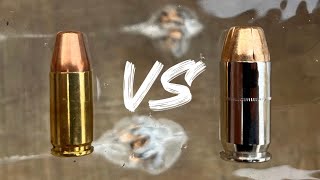
This is the comparison everyone asks about. Banana Ballistics ran 9mm HST 147gr against .45 ACP in calibrated gel and the results were almost embarrassingly close: 9mm penetrated 13.25 inches versus .45 ACP at 12.75 inches. Half an inch. That's the gap between the two most argued calibers in American firearms history.
In barrier testing, the gap inverted. Banana Ballistics scored 9mm winning 75 to 25 against .45 ACP through barriers — drywall, sheet metal, auto glass. The 9mm's higher velocity helped hollow points retain enough energy to expand after punching through intermediate material.
Garand Thumb's assessment after extensive torso-analog testing was blunt: with modern ammunition, the difference between 9mm and .45 is marginal. Lucky Gunner's Boden went further — excess handgun energy is washed away by tissue elasticity, meaning the theoretical energy advantage of larger calibers doesn't translate proportionally to wound effect.
9mm vs .45 ACP: Gel Test Comparison
Barrier Performance
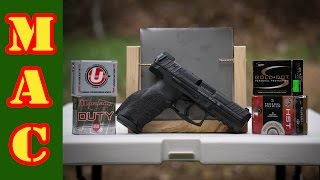
MAC (Tim) ran extensive barrier tests through drywall and sheet metal using an H&K VP9. The results matter if you're thinking about home defense or vehicle scenarios. Hornady Critical Duty 135gr +P penetrated 20.0 inches through drywall — deep but controlled. Federal HST 124gr went 16.0 inches through drywall but failed to expand through sheet metal, going 26.0 inches. Speer Gold Dot 147gr over-penetrated sheet metal at 32+ inches.
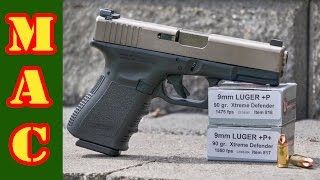
The standout: Underwood Xtreme Defender 90gr +P was the most consistent performer across barriers, penetrating 19.5 inches through drywall and 22.5 inches through sheet metal. The monolithic copper fluted design doesn't rely on expansion — it creates a permanent wound cavity through fluid dynamics. MAC tested it head-to-head against HST and documented 21.5 inches of penetration with a 2-inch wound cavity.
Recoil & Shootability
This is where 9mm wins the argument for most shooters — not in the gel lab, but on the range and under stress.
Banana Ballistics measured muzzle flip across common service calibers and confirmed what competitive shooters already knew: 9mm produces the least muzzle flip of any common service caliber. Less muzzle flip means faster sight re-acquisition. Faster sight re-acquisition means faster accurate follow-up shots. And faster accurate follow-up shots matter more than marginal caliber differences.
Massad Ayoob made the capacity argument explicit: against multiple opponents, higher capacity isn't a luxury — it's a survival factor. A Glock 19 holds 15+1 rounds of 9mm. A 1911 in .45 ACP holds 7+1. If your scenario involves more than one threat — or if you miss under stress (and you will miss under stress) — those extra rounds aren't hypothetical.
Every expert we reviewed landed on the same conclusion through different paths. Garand Thumb: shot placement is the most critical factor. BIG MAN with GUN: shot placement and practice are what matter most. Lucky Gunner: caliber is secondary to bullet design and proficiency. Banana Ballistics: despite finding .40 slightly better in gel, prefers 9mm for the capacity advantage.
The logic chain is simple: cheaper ammo means more practice. More practice means better shot placement. Better shot placement matters more than caliber. Therefore 9mm — by being the cheapest major defensive caliber to train with — produces better practical outcomes for most shooters.
9mm vs .40 vs .45: Muzzle Flip and Recoil Comparison
Best Platforms
The 9mm's biggest practical advantage isn't ballistic — it's selection. Ayoob noted 200+ factory 9mm options from major manufacturers, and cheaper production costs that translate to more affordable training. Whatever your hand size, budget, or intended use, there's a 9mm built for it.
Here are 12 of the best platforms chambered in 9mm, organized by role. Each links to our full Gear Deep Dive guide with specs, accuracy data, and ammo recommendations.
Compact (Everyday Carry)
- Glock 19 (4.02" barrel) — The default recommendation. 15+1 capacity, the deepest aftermarket in firearms, and near-absolute reliability. It's the Honda Civic of handguns, and that's the highest compliment.
- S&W M&P 2.0 Compact (4.0" barrel) — Better stock trigger and ergonomics than the Glock 19. The aggressive texturing is divisive but effective.
- CZ P-10C (4.02" barrel) — The best stock trigger in the compact striker-fired segment. Lower bore axis than the Glock gives it a flatter shooting impulse.
- Walther PDP (4.0" barrel) — The trigger everyone raves about. Performance Duty Trigger lives up to the name, and the factory optics mounting system is the best in the business. Guide coming soon.
- Sig P320 Compact (3.9" barrel) — Modular fire control unit lets you swap grip modules and slides. The military's M17/M18 in compact form. Guide coming soon.
Subcompact (Deep Concealment)
- Sig P365 (3.1" barrel) — The gun that started the micro-compact revolution. 10+1 in a package smaller than most single-stack .380s.
- Springfield Hellcat Pro (3.7" barrel) — 15+1 in a subcompact frame. The capacity-to-size ratio is absurd.
- Glock 43X (3.41" barrel) — Glock's answer to the P365. Slim frame with 10+1 stock capacity, expandable to 15+1 with Shield Arms S15 magazines.
- S&W Shield Plus (3.1" barrel) — 13+1 in a slim package with one of the better stock micro-compact triggers. Guide coming soon.
- Glock 48 (4.17" barrel) — The Glock 43X with a longer slide. Better sight radius and velocity in the same slim profile. Guide coming soon.
Budget-Friendly
- Canik MC9 Prime (3.16" barrel) — Turkish-made micro-compact with a trigger that embarrasses guns costing twice as much. Ships with multiple backstraps and optic plates.
- Taurus G3C (3.2" barrel) — The budget 9mm that actually works. Street price under $250, and the current generation has largely shed Taurus's historical reliability concerns. Guide coming soon.
Ammo Selection
With 9mm, ammo choice matters more than the gun. A $500 pistol loaded with proven hollow points will outperform a $2,000 race gun loaded with FMJ in every defensive metric that counts. Here's what to buy and why.
Self-Defense Loads
These are the loads that consistently meet or exceed the FBI protocol in independent testing. Buy one. Train with it enough to confirm it cycles reliably in your gun (200 rounds minimum). Then carry it.
- Federal HST 124gr (~$1.50–$2.00/round as of March 2026) — The gold standard. 18.3 inches penetration, 0.61-inch expansion through 4-layer denim. Available in standard and +P.
- Federal HST 147gr (~$1.50–$2.00/round as of March 2026) — Slightly less penetration (15.2 inches), same expansion, less felt recoil. The subsonic velocity makes it an excellent suppressor load.
- Speer Gold Dot 124gr (~$1.50–$2.00/round as of March 2026) — The law enforcement workhorse. 18.1 inches and 0.54-inch expansion. Bonded core resists jacket separation.
- Hornady Critical Duty 135gr (~$1.40–$1.60/round as of March 2026) — Designed for barrier penetration. The FlexLock bullet resists clogging through drywall and auto glass. 19.0 inches is deep — know your background.
- Winchester Ranger T-Series 147gr (~$1.50–$2.00/round as of March 2026) — The expansion king. 0.74-inch expanded diameter is the widest in this group. 16.5 inches puts it in the sweet spot of the FBI window.
Range & Training
Stop buying self-defense ammo for practice. You don't need $1.50+/round hollow points to work on fundamentals. Save the premium stuff for carry rotation and reliability testing.
- Winchester White Box FMJ 115gr (~$0.28–$0.40/round as of March 2026) — The default range ammo. Brass-cased, reliable, available everywhere.
- Federal American Eagle FMJ 124gr (~$0.30–$0.40/round as of March 2026) — Same weight as most defensive loads, so the recoil impulse approximates what you'll feel with your carry ammo.
- Speer Lawman TMJ 147gr (~$0.45–$0.56/round as of March 2026) — Total metal jacket reduces airborne lead at indoor ranges. Matches the weight and recoil of 147gr defensive loads.
+P and Specialty
These loads push beyond standard pressure. Confirm your firearm is +P rated before using them.
- Federal HST +P 124gr (~$1.40–$1.60/round as of March 2026) — Standard HST performance with an extra 50-100 fps. Worth it from short barrels where you need every bit of velocity for reliable expansion.
- Underwood Xtreme Defender +P 90gr (~$1.50–$2.00/round as of March 2026) — The unconventional pick. Monolithic copper, no expansion needed — the fluted design creates the wound cavity mechanically. Most consistent performer across all barrier types in MAC's testing.
- Buffalo Bore TAC-XP +P+ 115gr (~$2.00+/round as of March 2026) — Hot-loaded Barnes all-copper bullet. +P+ pressure means higher velocity but also more wear on your gun. Not all firearms are rated for +P+.
Ammo prices fluctuate with supply and demand. Ranges above reflect pricing as of March 2026. Check AmmoSeek for current market prices.
FMJ Over-Penetration Warning
Garand Thumb demonstrated in controlled testing that 9mm FMJ rounds pass completely through soft tissue analogs with enough residual energy to cause harm beyond the target. For home defense, carry hollow points — not ball ammunition. FMJ is for the range.
Ballistic Gel Testing: How It Works and What It Means
Law & Compliance
The 9mm itself is legal in all 50 states. But magazine capacity, ammunition type, and purchase requirements vary significantly. Know your state's rules before you buy.
Magazine Capacity Restrictions
Several states cap magazine capacity, which directly affects how many rounds your 9mm pistol can hold:
| State | Mag Limit | Notes |
|---|---|---|
| California | 10 rounds | Plus handgun roster, ammo background check |
| New York | 10 rounds | SAFE Act |
| New Jersey | 10 rounds | Hollow-point restrictions (see below) |
| Connecticut | 10 rounds | |
| Massachusetts | 10 rounds | Approved firearms roster |
| Maryland | 10 rounds | |
| Hawaii | 10 rounds | |
| Washington | 10 rounds | |
| Colorado | 15 rounds |
A Glock 19's standard 15-round magazine is illegal to purchase or possess in most of these states. The Glock 48 and P365 with 10-round flush-fit magazines are compliant options — but check current laws, because these change.
Critical State Callouts
New Jersey: Hollow-Point Restrictions
New Jersey restricts hollow-point ammunition possession outside your home, range, and direct transit between them. You can buy hollow points. You can keep them at home. You can shoot them at a licensed range. But carrying them outside those contexts — even with a carry permit — enters legal gray area. Check NJ's current firearms laws →
California: Handgun Roster + Ammo Background Checks
California maintains an approved handgun roster that excludes most modern 9mm pistols (including all Gen 5 Glocks) due to microstamping requirements. Off-roster guns are available through private party transfer at inflated prices. Additionally, all ammunition purchases require a background check through a licensed dealer. 10-round magazine limit applies. Check CA's current firearms laws →
Massachusetts: Approved Firearms Roster
Massachusetts maintains its own approved firearms roster separate from California's. Many popular 9mm pistols are not on the roster. The state also enforces a 10-round magazine capacity limit. Dealers cannot sell non-roster handguns, though private ownership of off-roster firearms acquired legally is generally permitted. Check MA's current firearms laws →
Suppressor Considerations
9mm is one of the most popular suppressor calibers. TFB TV's James Reeves rated the Dead Air Odessa 9 as the number-one 9mm suppressor. Subsonic 147gr loads (under ~1,050 fps from most barrel lengths) eliminate the supersonic crack, making them the go-to choice for suppressed 9mm.
Suppressors are legal in 42 states but require NFA registration and a $200 tax stamp. Check your state's suppressor laws →
Find an FFL near you to handle your transfer — tell them Cache sent you.
The Bottom Line
The 9mm Luger won the caliber war. Not because it's the most powerful handgun cartridge. Not because it does everything best. But because modern bullet technology eliminated its only real weakness — terminal performance — while preserving every advantage it always had: capacity, controllability, affordability, and the widest selection of platforms on earth.
If you carry for self-defense, load Federal HST or Speer Gold Dot and train until you can put five rounds in a 4-inch circle at 7 yards under time pressure. The bullet will do its job. Your job is to put it where it needs to go. Every expert in our research — from Garand Thumb to Massad Ayoob to Lucky Gunner's lab — arrived at the same conclusion: shot placement beats caliber, every time.
That said, 9mm isn't the answer for every application. If you're looking at woods carry, bear country, or maximum barrier penetration, the .45 ACP and 10mm Auto occupy roles that 9mm doesn't try to fill. Bigger holes from bigger bullets still matter when expansion isn't the primary terminal mechanism. For the full data breakdown, see our 9mm vs .45 ACP head-to-head comparison →.
But for what 90% of gun owners actually do — carry concealed, defend their home, train on a budget, and shoot recreationally — the 9mm Luger is the round. It has been since 2014 when the FBI said so. The data hasn't changed. Neither has the answer.
Find a 9mm dealer near you → | Check your state's laws → | Ask Cache about 9mm →
Expert Video Library
Terminal Performance & Gel Testing



Barrier & Specialty Testing


Caliber Comparisons


Resources & Further Reading
Ballistics Tools
- JBM Ballistics Calculator — Free online trajectory and drift calculator for 9mm and other handgun cartridges.
- AmmoSeek — Live 9mm Price Tracker — Real-time price comparison across online retailers for 9mm ammunition.
Ammunition Manufacturers
- Federal HST Product Line — Factory specs and available SKUs for the Federal HST hollow point series in 9mm.
- Speer Gold Dot Product Line — Speer's bonded-core hollow point line, including the Short Barrel variant optimized for subcompact pistols.
- Hornady Critical Duty — Hornady's barrier-blind defensive load with FlexLock bullet technology.
Legal Resources
- Handgunlaw.us — State-by-State Laws — Detailed carry law summaries for all 50 states, updated regularly by volunteer attorneys.
- USCCA Reciprocity Map — Interactive map showing concealed carry permit reciprocity between states.
- Giffords Law Center — State Gun Law Database — Searchable database of state-level firearms regulations including magazine limits and ammunition restrictions.
Reference
- Wikipedia — 9x19mm Parabellum — Cartridge history, adoption timeline, and technical specifications with extensive sourcing.
Sources & Research
Every claim in this article links back to the expert who made it. Go check our work.
Expert Videos
External Sources
Cross-referenced gel test data from Lucky Gunner Labs, barrel length velocity data from Ballistics By The Inch, and expert analysis from Garand Thumb, Massad Ayoob, Banana Ballistics, Military Arms Channel, and Lucky Gunner across dozens of independently published video reviews.