

9mm vs .45 ACP: Which Is Better in 2026?
9mm beats .45 ACP for most shooters — cheaper to train with, higher capacity, and modern hollow points have closed the terminal performance gap to half an inch of penetration. Here's the data on where .45 still wins.
The 9mm vs .45 ACP debate has been running for over a century. It outlived both World Wars, the FBI's detour through .40 S&W, and the introduction of every new caliber that was supposed to make both obsolete. And the answer has never been clearer than it is right now — because we finally have the gel data to settle it.
The Short Answer
For most shooters, 9mm Luger is the better choice. Modern hollow points have closed the terminal performance gap to approximately half an inch of penetration in calibrated gel. You get nearly double the magazine capacity, less recoil, faster follow-up shots, and practice ammo that costs 30-40% less per round. The FBI, most U.S. law enforcement agencies, and the U.S. military all chose 9mm — and they had the data to prove it.
.45 ACP wins in exactly two scenarios: suppressed shooting (every standard 230gr load is inherently subsonic) and maximum wound channel diameter (Winchester Ranger T-Series expands to a full 1.00 inch — no 9mm load comes close). If either of those matters to you, the .45 earns its keep. For everyone else, the math favors 9mm.
History & Context
This debate exists because of a war and a bullet failure. In 1899, U.S. soldiers in the Philippines discovered that .38 Long Colt couldn't stop charging Moro warriors. The Army commissioned John Browning to build a bigger round. He gave them the .45 ACP in 1905 — a fat, heavy, slow-moving slug designed to end fights with one hit. The M1911 pistol that carried it served as the standard U.S. military sidearm for 74 years.
The 9mm had been around since 1902 — Georg Luger's design for the German Navy — but it took a different path. NATO standardized it in 1982. Law enforcement adopted it for capacity. And then hollow point technology changed everything.
In 2014, the FBI switched back to 9mm from .40 S&W after concluding that modern hollow points had closed the terminal performance gap with larger calibers. Massad Ayoob — one of the most cited defensive firearms instructors in the country — explained the reasoning plainly: 9mm gives you higher capacity and lower recoil with effectively equivalent terminal performance. The trade-off math changed.
But "equivalent" and "identical" aren't the same word. Here's what the two rounds actually look like side by side — proportional to SAAMI specifications:
Cartridge Size Comparison
Proportional outlines from SAAMI specifications. Rendered at 4x actual size.
9mm Luger
1.169" OAL
0.355" dia · Case: 0.754"
124 gr · 35,000 psi
.45 ACP
1.275" OAL
0.452" dia · Case: 0.898"
230 gr · 21,000 psi
Actual Size
Rendered at 1:1 scale using CSS inch units. Hold a round up to your screen.
9mm Luger
1.169" OAL
.45 ACP
1.275" OAL
The .45 is wider and heavier. The 9mm runs at nearly double the pressure. That pressure difference is why 9mm achieves higher velocity from a smaller package — and why .45 ACP is inherently subsonic. Now let's see what that means in gel.
Ballistics Head-to-Head
Banana Ballistics ran the definitive head-to-head comparison — same gel blocks, same protocol, same denim barriers. The result: 9mm HST 147gr penetrated 13.25 inches versus .45 ACP at 12.75 inches. Half an inch. That's the gap between the two most argued calibers in American firearms history.
vs
124 / 147 gr
Bullet Weights
185 / 230 gr
35,000 psi
Max Pressure
21,000 psi
0.355" (9.0mm)
Bullet Diameter
0.452" (11.5mm)
Terminal Performance — Head to Head
Penetration depth in ballistic gel. Green zone = FBI 12-18" standard. Circles show expanded diameter at actual size.
9mm Luger
Federal HST 124gr
Lucky Gunner
Federal HST 147gr
Lucky Gunner
Win Ranger T 147gr
Lucky Gunner
.45 ACP
Federal HST 230gr
Lucky Gunner
Speer Gold Dot 230gr
Lucky Gunner
Win Ranger T 230gr
Lucky Gunner
Barrel Length vs Velocity — Overlaid
Same barrel lengths, different calibers. Data from BBTI.
Use-Case Verdicts
Concealed Carry
9mm LugerHigher capacity, less recoil, lighter guns. P365 gives 10+1 in 17.8 oz.
Home Defense
TieBoth meet FBI standard with modern hollow points. Capacity vs wound channel.
Suppressed
.45 ACPEvery 230gr load is inherently subsonic. No special ammo needed.
Range & Training
9mm Luger30-40% cheaper per round. 1,000+ extra rounds per year at same budget.
Competition
9mm LugerLess recoil, faster splits, higher capacity, fewer reloads.
1911 Platform
.45 ACPThe gun was designed for this cartridge. The authentic experience.
The penetration numbers are almost embarrassingly close. Federal HST 147gr in 9mm: 15.2 inches and 0.61-inch expansion. Federal HST 230gr in .45 ACP: 14.0 inches and 0.85-inch expansion. Both land in the FBI's 12-18 inch window. The 9mm actually penetrates deeper. The .45 expands wider. Lucky Gunner's Johann Boden explained why the penetration difference matters less than you'd think — excess handgun energy is absorbed by tissue elasticity, meaning the theoretical energy advantage doesn't translate proportionally to wound effect.
Where .45 genuinely wins the gel test: Winchester Ranger T-Series 230gr expands to a full 1.00 inch — nearly triple the unfired bullet diameter and 35% wider than the best 9mm expansion (Ranger T 147gr at 0.74 inches). That's a real difference in wound channel diameter. Garand Thumb showed it visually — .45 ACP creates an obviously larger wound channel in meat targets.
Barrier Performance
Through barriers — drywall, sheet metal, auto glass — the story inverts. Banana Ballistics scored 9mm winning 75 to 25 against .45 ACP through barriers. The 9mm's higher velocity helps hollow points retain enough energy to expand after punching through intermediate material. The .45's slower speed means more energy lost to the barrier, leaving less for the bullet's job.
Garand Thumb's assessment after extensive torso-analog testing was blunt: with modern ammunition, the difference between 9mm and .45 is marginal.
Banana Ballistics: 9mm vs .45 ACP Gel Test Head-to-Head
Recoil & Shootability
This is where the debate should end for most people — not in the gel lab, but on the range and under stress.
Banana Ballistics measured muzzle flip across common service calibers and confirmed 9mm produces the least muzzle flip of any common service caliber. Less muzzle flip means faster sight re-acquisition. Faster re-acquisition means faster accurate follow-up shots. And under defensive stress, you will need follow-up shots — trained law enforcement officers hit their target roughly 30% of the time in real-world shootings.
The .45 ACP's recoil is different in character — a slow, rolling push rather than the sharper snap of 9mm. Some shooters actually prefer that feel. But preference and combat performance are different things. Bill Wilson — a man who built Wilson Combat on the .45 ACP 1911 — said it plainly: "I've been a .45 guy my whole life, but I'm carrying a 9mm now." His friend Ken Hackathorn — founding member of IPSC — developed arthritis from decades of .45 and .44 Magnum shooting. When lifelong .45 advocates switch to 9mm because their hands can't take the punishment anymore, it tells you something about cumulative recoil effects.
The 1911 platform partially mitigates this disadvantage. A steel-frame Government model at 39 ounces absorbs significantly more recoil than a polymer compact. But a Glock 19 at 23 ounces with 15+1 of 9mm is still faster for follow-up shots than a 1911 at 39 ounces with 7+1 of .45 — because physics doesn't care about platform weight when the cartridge generates twice the recoil impulse.
Banana Ballistics: 9mm vs .40 vs .45 Muzzle Flip Comparison
Capacity & Platform Options
This is where 9mm's advantage isn't debatable — it's arithmetic.
| Platform | 9mm Capacity | .45 ACP Capacity |
|---|---|---|
| Full-size duty | 17+1 (Glock 17) | 13+1 (Glock 21) |
| Compact carry | 15+1 (Glock 19) | 7+1 (1911 Commander) |
| Subcompact | 10+1 (Sig P365) | 6+1 (Glock 36) |
| Available platforms | 200+ factory models | ~50 factory models |
One place .45 ACP wins on capacity: magazine compliance. A standard 1911 magazine holds 7-8 rounds — naturally compliant with every state's magazine capacity restrictions, including California's 10-round limit and New York's SAFE Act. A Glock 19's 15-round magazine is illegal to purchase in nine states. The .45 ACP 1911 never has this problem.
That said, Massad Ayoob made the capacity argument explicit: against multiple opponents, higher capacity isn't a luxury — it's a survival factor. A Glock 19 holds 15+1. A 1911 Commander holds 7+1. If your scenario involves more than one threat — or if you miss under stress, and you will miss under stress — those eight extra rounds aren't hypothetical.
The platform diversity gap is even wider. Ayoob noted 200+ factory 9mm options from major manufacturers. The .45 ACP market is a fraction of that — dominated by 1911 variants and a handful of polymer options (Glock 21, FNX-45, HK45). The micro-compact revolution that produced the Sig P365, Hellcat Pro, and Glock 43X never happened for .45 ACP. The cartridge is too large for that form factor.
Cost & Availability
Training ammo is where the caliber choice compounds. 9mm FMJ runs roughly $0.28–$0.40/round as of March 2026. .45 ACP FMJ runs $0.40–$0.55/round — about 40-50% more. Defensive hollow points cost roughly the same in both calibers ($1.50–$2.00/round as of March 2026).
That practice ammo gap matters more than the dollar amount suggests. A shooter spending $100/month gets approximately 285 rounds of 9mm versus 200 rounds of .45 ACP. That's 85 fewer rounds of trigger time per month — over 1,000 fewer rounds per year. And more practice means better shot placement. Better shot placement matters more than caliber. Therefore 9mm — by being cheaper to train with — produces better practical outcomes for most shooters.
Ayoob and Wilson both noted cheaper production costs translate to more affordable training. Wilson went further — modern 9mm 1911s are actually more reliable than their .45 counterparts because the higher-pressure cartridge cycles the action more crisply.
Ammo prices fluctuate with supply and demand. Ranges above reflect pricing as of March 2026. Check AmmoSeek for current market prices.
Use-Case Verdicts
Concealed Carry: 9mm
Higher capacity, less recoil, lighter guns. A Sig P365 gives you 10+1 of 9mm in 17.8 ounces. No .45 ACP pistol comes close to that size-to-capacity ratio. The Hellcat Pro pushes it to 15+1 in a subcompact frame — matching a full-size 1911's total round count in a gun half the size.
Home Defense: Tie
Both calibers meet the FBI penetration standard with modern hollow points. The .45's larger wound channel provides a marginal advantage, but the 9mm's higher capacity gives you more margin for error in a high-stress scenario. Tactical Rifleman's Pete — a retired Special Forces operator — called it essentially even for defensive use: .45 creates a larger wound cavity, 9mm penetrates deeper, and both fall within acceptable limits.
Suppressed Shooting: .45 ACP
This isn't close. Every standard 230gr .45 ACP load is inherently subsonic at 830-850 fps — well below the 1,125 fps speed of sound. No special ammo needed. Buy the cheapest 230gr FMJ you can find and it's suppressor-ready. With 9mm, you need specific 147gr subsonic loads, and even those are borderline from longer barrels. If you own a suppressor, .45 ACP is the practical choice.
Range & Training: 9mm
30-40% cheaper per round means 30-40% more trigger time at the same budget. That compounds into thousands of extra rounds per year. The CZ P-10C and Canik MC9 Prime offer outstanding 9mm range guns at accessible prices.
Competition: 9mm
Less recoil means faster splits. Higher capacity means fewer reloads. Every competitive advantage points to 9mm — which is why it dominates USPSA and IDPA production divisions. The .45 ACP has a niche in Single Stack division, but even there, many competitors choose .40 S&W or 9mm Major.
1911 Platform: .45 ACP
The M1911 was designed for .45 ACP. The cartridge and the platform are inseparable. If you want the 1911 experience — the trigger, the grip angle, the history — .45 ACP is the authentic choice. 9mm 1911s exist and Wilson says they're more reliable, but the .45 ACP 1911 is an American icon for a reason.
The Verdict
9mm wins. Not because .45 ACP is bad — it isn't. It's a proven, effective defensive cartridge that has been stopping fights since before either World War. But the math has changed. Modern 9mm hollow points closed the terminal performance gap. The penetration difference is half an inch. The capacity difference is nearly double. The recoil difference makes accurate follow-up shots measurably faster. And the cost difference means thousands of extra rounds of practice per year.
When Bill Wilson — a man who has built, tested, and carried more .45 ACP 1911s than almost anyone alive — says he now carries a 9mm, the caliber wars are over for the general population. The FBI agreed in 2014. The data hasn't changed.
The .45 ACP keeps its crown for suppressed shooting and for anyone who wants the biggest wound channel a common handgun cartridge can produce. If you're building a suppressor host or you're a 1911 die-hard who trains enough to manage the recoil, the .45 is a legitimate choice — not a compromise. But for everyone else, the 9mm Luger is the answer.
A .45 that you shoot well is better than a 9mm that you don't. But a 9mm that you can afford to practice with is better than a .45 that stays in the safe because ammo costs $0.55/round. Spend the money you save on ammo at the range — that training will save your life before any caliber choice does.
Read the full 9mm Luger guide → | Read the full .45 ACP guide → | Find an FFL near you → — tell them Cache sent you.
Bill Wilson: Why I Switched from .45 to 9mm
Expert Video Library
Head-to-Head Gel Tests
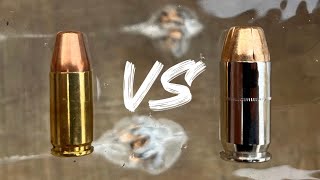


Caliber Comparison & Analysis




Recoil & Shootability


Sources & Research
Every claim in this article links back to the expert who made it. Go check our work.
Expert Videos
External Sources
Head-to-head gel test data from Banana Ballistics and Lucky Gunner Labs, barrel-length velocity curves from Ballistics By The Inch, recoil measurements from Banana Ballistics, and expert analysis from Garand Thumb, Massad Ayoob, Bill Wilson, Tactical Rifleman, and 1ShotTV across independently published video reviews.