

Glock 19 Gen 5: Complete Guide
The Glock 19 Gen 5 is the most recommended first handgun across 100 expert reviews — and the most criticized. Near-absolute reliability and the deepest aftermarket of any pistol, but the trigger and sights need replacing on day one. Here's why experts still say buy it anyway.
The Short Answer
The Glock 19 is the Honda Civic of handguns. That's not an insult — it's the highest compliment you can pay a tool. It's boring, it's everywhere, and the aftermarket turns it into anything you want. If you're buying your first pistol and you want the safest possible bet, this is it. If you want excitement, look elsewhere — but you'll probably end up back here anyway.
Here's what 100 expert reviews actually agree on — competitive shooters, defensive instructors, gunsmiths, and professional reviewers who've put tens of thousands of rounds through this platform. Every claim below is backed by timestamped video evidence and verified external sources you can check yourself.
Brief History
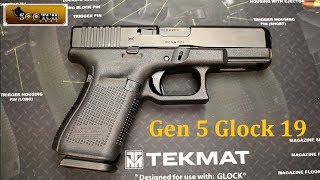
Gaston Glock's polymer-framed pistol scandalized the firearms industry in 1982. The Glock 19 arrived six years later as a compact variant of the full-size G17 — same reliability, shorter grip, concealable enough for plainclothes carry. Gen 3 (1998) added the accessory rail and finger grooves that defined the platform for a decade. Gen 4 (2010) brought modular backstraps and a dual recoil spring. Gen 5 (2017) borrowed from Glock's military MHS trial submission: the Marksman Barrel, ambidextrous controls, no finger grooves, and a flared magwell. The G19X crossover followed in 2018 — a full-size frame mated to a compact slide in coyote tan, originally designed for the military contract Glock didn't win. The Gen 5 MOS landed in 2019, finally giving the platform a factory optics-ready slide.
Then late 2025: the Gen 6. The most significant redesign since Gen 5 — rounded grip shape, extended beavertail, RTF6 texture, a factory flat-face trigger, and direct-mount optics without adapter plates. Alongside it, Glock rolled out the V-Series anti-switch redesign across the lineup — raised channels and a redesigned backplate to prevent illegal full-auto switch installation. Functionally identical for legal owners.
Specs at a Glance
| Caliber | 9x19mm |
| Capacity | 15+1 (10+1 restricted states) |
| Barrel Length | 4.02 inches |
| Overall Length | 7.28 inches |
| Height | 5.04 inches |
| Width | 1.34 inches |
| Weight (Unloaded) | 23.81 oz |
| Frame | Polymer |
| Action | Striker-fired |
| MSRP | $599 |
| Street Price | $479–$620 |
| Optics Ready | Yes |
| Manual Safety | No |
| Threaded Barrel Option | Yes |
23.81 ounces unloaded. 30.16 loaded. That's a pound and change of 9mm that disappears under a flannel shirt and holds 15+1 rounds. The 4.02-inch barrel is long enough to be accurate at 25 yards, short enough that you aren't printing when you bend over to tie your shoes.
Variants & Generations
Not all Glock 19s are created equal. Here's what changed and when:
| Gen | Year | What Changed |
|---|---|---|
| Gen 1 | 1988 | The original compact. Pebble-texture grip. Ultra-rare today. |
| Gen 2 | 1988+ | Aggressive checkering on front and back straps, captive recoil spring. |
| Gen 3 | 1998 | Universal Glock Rail, finger grooves, thumb rests. Only gen on the CA roster. |
| Gen 4 | 2010 | Modular backstraps, dual recoil spring, enlarged reversible mag release. |
| Gen 5 | 2017 | Finger grooves gone, Marksman Barrel, ambidextrous slide stop, nDLC finish, flared magwell. |
| Gen 5 MOS | 2019 | Factory optics-ready slide cut. |
| Gen 6 | Late 2025 | Rounded grip, extended beavertail, RTF6 texture, flat-face trigger, direct-mount optics. |
What to buy right now:
- First gun / EDC on a budget → Standard Gen 5 (~$539 street). The proven choice.
- Premium EDC / best ergonomics → Gen 6 (~$600–$650 est.). Better grip, better trigger, direct optic mount. If you're buying new and can find one, this is the move.
- Red dot ready (Gen 5) → Gen 5 MOS (~$800). Factory optic cut if you can't find a Gen 6 yet.
- Duty / nightstand → G19X (~$550). The full-size frame gives you more grip to control recoil.
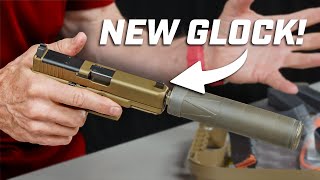
- Suppressor host → G19X MOS (~$650). Threaded barrel and suppressor-height sights from the factory.
One thing Hickok45 debunked: the "Gen 5 slide is heavier" rumor. He weighed them — 24.0 oz vs 23.75 oz for Gen 4. A quarter ounce. Watch at 1:52 →
And from Lenny Magill at GlockStore — the G19 and G47 are modular. Swapping a G19 slide onto a G47 frame creates a G45 configuration. Same guide rod. Watch at 0:07 →
Interchangeability warning: Gen 5 internals are NOT drop-in compatible with Gen 4 frames. The ambidextrous slide stop and trigger redesign mean slides and many internal components don't cross generations. Gen 6 compatibility with Gen 5 parts is not yet confirmed in community testing — buy with that in mind if you're planning to upgrade later.
V-Series note: Post-2025 Glock 19s (and other models) include V-Series anti-switch modifications — raised channels in the striker assembly and a redesigned backplate. This prevents installation of illegal full-auto conversion switches. If you're a legal owner, the gun functions identically. The change is invisible in normal use.
How It Shoots
The trigger is the most honest thing about this gun — it's adequate. sootch00 put it on a trigger scale: 6 pounds, 4.5 ounces with some stacking before the break. Watch at 7:24 →
Hickok45 called it smoother than Gen 4 but still "creepy" compared to the cleaner break of his older Gen 2. That's Glock's trigger in a nutshell — it's safe, it's consistent, and it's the first thing aftermarket companies fix. Watch at 12:34 →
For context: the CZ P10C that everyone compares it to measures 4 pounds, 13.3 ounces with a crisper wall. Nearly a pound and a half lighter. Watch sootch00's comparison at 1:34 →
The Gen 6 addresses the trigger complaint with a factory flat-face trigger. No community trigger data yet — the Gen 6 is too new for independent reviewers to have put serious rounds through it — but the flat face alone should reduce perceived pull weight and improve the break feel. If the Gen 5 trigger is the reason you're hesitating, the Gen 6 may be worth waiting for.
The Glock Marksman Barrel — with its modified polygonal rifling and recessed target crown — is a genuine improvement over Gen 4. Hickok45 ran 200+ rounds through his Gen 5 with zero malfunctions and accuracy consistent with the platform's reputation. Watch at 1:52 →
Pew Pew Tactical pushed 3,500+ rounds through theirs and reported the same result: reliable.
The nDLC (Diamond-Like Carbon) slide finish is harder and more corrosion-resistant than the old Tenifer. The flared magwell speeds up reloads. And the removal of finger grooves — still polarizing years later — means the grip fits more hand shapes without modification.
FrenchGunGuy's range footage shows what you'll actually see: controlled muzzle flip, fast follow-up shots on steel. Manageable 9mm recoil in a compact frame.
Carrying It
30.16 ounces loaded. Not micro-compact territory — you won't forget it's there. But millions of people carry the Glock 19 daily because it hits the sweet spot: enough gun to shoot well, small enough to conceal with a decent holster and the right wardrobe.
At 1.34 inches wide, it's not the thinnest option. A SIG P365 at 1.0 inch vanishes more completely. But the G19 gives you 15+1 instead of 10+1, a longer sight radius, and a grip you can actually get all your fingers around.
sootch00 confirmed something useful for holster shoppers: the G19 Gen 5 and CZ P10C fit the same holsters. Same footprint. Watch at 3:15 →
The holster ecosystem is the real advantage here. Every holster maker in the country builds for the Glock 19 first. Tier 1 Concealed, T.REX Arms Sidecar, Dark Star Gear Orion, Tenicor Certum — you'll never wait for a holster to be "in stock for your model." Hegshot87 includes it in his "best first carry guns" breakdown. Watch at 3:44 →
Reliability & Known Issues
The platform reputation is earned. It works. That's the story.
Hickok45 ran 200+ rounds in his Gen 5 test with zero stoppages. Pew Pew Tactical hit 3,500+ rounds with the same result. Lucas Botkin at T.REX ARMS has 25,000+ rounds on his personal G19 Gen 4 — stock recoil springs, stock barrel. He replaced the slide at 20,000 rounds with another stock slide and kept going. Watch at 1:06 →
That's the boring truth about Glock reliability. It's boring because it works.
But. The brass-to-face issue is real — and Glock has never officially acknowledged it.
Gen 3 and Gen 4 Glock 19s (with the 336 and 30274 ejectors) have a documented pattern of ejecting spent brass back toward the shooter's face. It's not dangerous in the way a catastrophic failure is dangerous, but it's annoying, it's distracting, and for shooters wearing eye protection that doesn't seal (most range glasses), it's a hot brass burn waiting to happen.
The ejector evolution tells the story: 336 (Gen 3) → 30274 (Gen 4) → 47021 (Gen 5). The Gen 5's 47021 ejector is considered "largely fixed" by the community. If you're buying new, you're fine. If you own a Gen 3 or Gen 4 with BTF, the community-standard fix is swapping to the 30274 or 47021 ejector housing. Adiga Armory's walkthrough is the definitive guide.
FBI 17M/19M recall: Early Glock 17M and 19M variants — the FBI contract models, not standard consumer guns — had a voluntary recall after failures during dry-fire training. If you're buying on the secondary market and see "17M" or "19M" markings, be aware this is a law enforcement contract model with a different history than the standard Gen 5.
One more gotcha worth knowing: metal aftermarket magazine catches combined with polymer Glock magazines can erode the magazine lips over time, eventually causing drop-free failures. Stick with the stock magazine release unless you have a specific reason to swap.
Aftermarket & Upgrades
The aftermarket is why people buy Glocks. No other pistol on earth has this many options.
First upgrades (year one — ~$250–$400 total)
Sights first. The stock plastic sights are the number one complaint about every Glock ever made. Ameriglo Bold (~$80), Trijicon HD XR (~$130), or Truglo TFX Pro (~$60) are the most recommended across expert reviews. If you're mounting a red dot on an MOS, do it now and skip iron sights entirely.
Weapon light. Streamlight TLR-7A (~$125) sits flush with the muzzle and is the community standard for concealed carry lights. Streamlight TLR-1 HL (~$152) for a duty-size option with 1,000 lumens. SureFire X300 Ultra (~$245) if you want the duty standard.
Holster. Budget $60–$150. Dark Star Gear Orion (~$80–$100), N8 Tactical (~$50–$70), or Tier 1 Concealed / T.REX Arms Sidecar (~$100–$150) for appendix carry.
Enthusiast builds ($500–$1,500+ on top of the gun)
- Triggers: Glock Performance Trigger (under $100), Overwatch Precision TAC (~$100–$130), Timney Alpha (~$150), or Taran Tactical spring kits (~$30–$50 for a lighter pull without replacing the whole trigger).
- Barrels: Lone Wolf ($120–$180) or ZEV Technologies ($200–$300) for threaded suppressor use. Radian Afterburner + Ramjet combo ($390) if you want a barrel and compensator in one package.
- Slides: ZEV Citadel ($350–$500), Agency Arms ($400–$600), or Lone Wolf Dusk/Timberwolf custom slides. C&H Precision also does slide milling services if you'd rather modify your existing slide.
- MOS optic plate: C&H Precision V4 (~$75). The factory Glock MOS plates flex under recoil — the C&H plate has direct recoil lugs and steel construction. It's the community standard fix. The Holosun SCS mounts directly to the MOS cut with no plate needed — lowest profile option. Watch Lenny Magill's take at 15:00 →
Gen 6 aftermarket note: Gen 6 parts compatibility with Gen 5 aftermarket components is not yet confirmed in community testing. If you're buying a Gen 6, hold off on slide and trigger upgrades until the aftermarket catches up — which it will, because it's Glock.
What the experts actually say about upgrades
Lucas Botkin's advice is blunt: "Prioritize training and ammo over expensive gun modifications." His personal G19 runs stock internals with 25,000+ rounds on them. He advises against tungsten guide rods — they wear out faster, cost more, and provide no measurable benefit. Watch at 1:06 →
TFB TV boiled it down to three accessories. Just three. Watch at 2:12 →
Law & Compliance
The Glock 19 is legal in all 50 states — but the magazines aren't.
The standard 15-round magazine runs afoul of capacity restrictions in multiple states. And in California, the Gen 5 itself has roster complications.
⚠️ California buyers: The Glock 19 Gen 5 (and Gen 6) is NOT on the CA DOJ certified handgun roster. Only Gen 3 models are roster-listed due to the microstamping requirement (2013). You can legally own a Gen 5 via Private Party Transfer or LEO exemption — but expect to pay $800–$1,200+ over retail. Pending legislation AB 1127 could change the roster rules. See California gun laws →
⚠️ New York buyers: The SAFE Act limits magazines to 10 rounds. The original 7-round loading restriction was struck down as unconstitutional, but the 10-round magazine limit stands. Standard 15-round G19 magazines are illegal to possess. Purchase 10-round magazines. See New York gun laws →
⚠️ New Jersey buyers: 10-round magazine limit. Standard G19 magazines are prohibited. Dealers sell NJ-compliant 10-round versions. See New Jersey gun laws →
⚠️ Connecticut buyers: 10-round magazine limit. Standard magazines are restricted. Pre-ban exemptions may apply — check with your FFL. See Connecticut gun laws →
⚠️ Massachusetts buyers: 10-round magazine limit. Pre-ban magazines grandfathered. New-production standard-capacity magazines are prohibited. See Massachusetts gun laws →
⚠️ Maryland buyers: 10-round magazine limit. Standard G19 magazines cannot be sold by Maryland dealers. You may legally possess them if purchased out of state (current law — verify before traveling). See Maryland gun laws →
⚠️ Hawaii buyers: 10-round handgun magazine limit. Standard magazines are prohibited. See Hawaii gun laws →
⚠️ Washington buyers: 10-round magazine limit as of 2022. Standard G19 magazines cannot be sold or transferred within the state. See Washington gun laws →
⚠️ D.C. buyers: 10-round magazine limit. Standard G19 magazines are prohibited. See D.C. gun laws →
⚠️ Oregon buyers: 10-round magazine limit (Measure 114). Standard G19 magazines are restricted. See Oregon gun laws →
⚠️ Rhode Island buyers: 10-round magazine limit. Standard G19 magazines are prohibited. See Rhode Island gun laws →
⚠️ Colorado buyers: 15-round magazine limit. The standard G19 magazine holds exactly 15 — it's legal. But any aftermarket extended magazines (17, 19, 24, 33-round) are not. See Colorado gun laws →
⚠️ Illinois buyers: 15-round handgun magazine limit. The standard G19 magazine is legal. Extended rifle magazines over 10 rounds are restricted separately. See Illinois gun laws →
⚠️ Vermont buyers: 15-round handgun magazine limit. The standard G19 magazine is legal at exactly 15 rounds. See Vermont gun laws →
⚠️ Delaware buyers: 17-round magazine limit. The standard 15-round G19 magazine is legal. Extended magazines over 17 rounds are not. See Delaware gun laws →
Laws vary by state and change. Before purchasing, confirm current regulations with a licensed dealer near you. Find your local FFL → — and tell them Cache sent you.
Pricing & Where to Buy
Street price: ~$539 for a standard Gen 5. The Gen 5 MOS runs ~$800. Gen 6 is estimated at $600–$650 but supply is still catching up to demand.
What's a deal: Under $500 for a new standard Gen 5 is a solid buy. Under $400 means used or police trade-in — check round count, check the finish wear on the barrel hood and slide rails, and make sure the ejector number matches a Gen 5 (47021).
California premium: Gen 3 Glock 19s command $600+ due to roster exclusivity. Off-roster Gen 5s via PPT run $800–$1,200+.
Context: The S&W M&P 2.0 Compact streets for $380–$480 with metal sights included. The CZ P10C runs about $477. Both are objectively better value on paper. The Glock tax is real — you're paying for the ecosystem, the resale value, and the fact that every holster and every aftermarket part exists for this gun first.
Find a licensed FFL near you →
Browse current consignment listings →
How It Compares
Tier: Full-size / Compact 9mm
| Glock 19 Gen 5 | Sig P320 Compact | S&W M&P 2.0 Compact | |
|---|---|---|---|
| Street Price | ~$539 | $500–$650 | $380–$480 |
| Capacity | 15+1 | 15+1 | 15+1 |
| Weight (unloaded) | 23.81 oz | 25.8 oz | 24.0 oz |
| Barrel Length | 4.02 in | 3.9 in | 4.0 in |
| Trigger Pull | ~5.6 lbs, some stacking | ~6.5 lbs, flat face option | Better out of box |
| Aftermarket | Deepest of any pistol | Growing, modular chassis | Limited vs Glock |
| Best For | Ecosystem depth, resale, holster fit | Modularity (swap grips/calibers) | Value — better trigger + sights included |
Sig P320: Better modularity — you can swap grip modules, calibers, and slide lengths on a single serialized fire control unit (FCU). That's genuinely cool. But the aftermarket ecosystem is years behind Glock, and the voluntary trigger recall in 2017 still follows the P320's reputation in some circles.
S&W M&P 2.0 Compact: The best value in this tier. Better trigger out of the box, better grip texture, and metal sights included — all for $100–$150 less than the Glock. Hegshot87 called it the winner on pure value. Watch at 17:47 →
But here's what the M&P doesn't have: the aftermarket. Need a specific holster for a specific light with a specific optic? The Glock has it. The M&P might. That ecosystem gap is real and it compounds over time.
The CZ P10C deserves a mention even though it's not in the fixed comparison tier. That trigger — 4 pounds, 13.3 ounces — embarrasses the Glock. If you care more about how the gun shoots than how many holsters you can buy for it, the P10C is worth handling.
Who Should Buy It
First-time buyer: Buy it. Largest aftermarket, most holsters, most instructors teach on it. If you can find a Gen 6, the improved ergonomics and flat-face trigger make it even better as a first gun. Budget $100 for better sights (or skip if Gen 6 with direct-mount optic) and $125 for a weapon light. Done.
Concealed carry: Buy it — but try a P365 or Hellcat first if you're small-framed. The G19 conceals well for its size class but it's not a micro-compact. If you're 5'6" and 140 pounds carrying appendix under a t-shirt, the math is harder.
Range / training: Buy it. It's the platform most classes are built around. Botkin's 25,000-round G19 tells the story — the gun outlasts the shooter's interest in counting rounds.
Competition: Skip it for dedicated competition. Look at a CZ Shadow 2 or Staccato. But a Glock 19 with an aftermarket trigger and a Holosun 507C is a solid production-class starter gun, and everything you learn on it transfers.
The Verdict
The Glock 19 is the most recommended handgun in firearms for a reason — and that reason is boring. It works. It fits everything. It has more parts, more holsters, and more instructional content available than any other pistol on earth.
The trigger is mediocre. The stock sights are bad. It's not the cheapest option in its class. The grip angle is love-it-or-hate-it. None of that matters.
Buy it. Spend the $100 you saved by not agonizing over the decision on Ameriglo Bold sights and a box of Federal HST. Then go shoot.
Video Library
First Look & Overview


Shooting Impressions & Range Tests


Concealed Carry & EDC


Upgrades & Modifications



Cleaning & Maintenance

Common Problems & Fixes

Comparisons



Sources & Research
Every claim in this article links back to the expert who made it. Go check our work.
Expert Videos
Official & Reference
History & Journalism
Legal
Ballistics & Ammo
Community & Issues
Aftermarket & Retail
We analyzed 100 expert reviews from independent channels — competitive shooters, defensive instructors, gunsmiths, and professional reviewers — and cross-referenced their findings with 32 authoritative external sources including manufacturer documentation, NRA journals, FBI ballistic data, Lucky Gunner gel tests, state law databases, and community reference guides. Every claim is backed by timestamped video evidence and verified external sources you can check yourself.