

.357 Magnum: The Complete Guide
.357 Magnum produces 583 ft-lbs from a 4-inch revolver — nearly double .38 Special — but loses 42% of its velocity from a 2-inch snub. The most barrel-sensitive handgun cartridge demands the right gun and the right load. Gel data, BBTI velocity curves from snub to lever-action, and 10 platform picks.
The .357 Magnum exists because gangsters wore body armor before body armor was cool. In 1934, cops needed a round that could punch through car doors and early ballistic vests. Elmer Keith gave them a .38 Special case loaded to its breaking point — and 91 years later, nothing has replaced it.
It defends homes, takes deer from lever-action rifles, shoots cheap .38 Special at the range, and rides in the pockets of people who've been carrying revolvers longer than some gun owners have been alive.
The Quick Take
The .357 Magnum pushes a 125-grain JHP at 1,450 fps from a 4-inch barrel — roughly 583 ft-lbs of muzzle energy. That's nearly double what 9mm Luger produces from the same barrel length. Federal 125gr JHP penetrates 12.0 inches in calibrated gel through 4-layer denim and expands to 0.65 inches. Double Tap Gold Dot 125gr goes 12.75 inches with 0.69-inch expansion. Both land in the FBI's 12-18 inch window.
We pulled data from over a dozen expert channels — chronograph testers, gel labs, lever-action specialists, and caliber comparison shooters — and cross-referenced it with BBTI barrel-length data and Lucky Gunner's ballistic gel results to build a reference that covers what this cartridge actually does at every barrel length and in every role.
But here's the number that defines .357 Mag: barrel length changes everything. From a 2-inch snub, that same Federal 125gr JHP drops to 949 fps — a 42% velocity loss compared to 6-inch barrels (Ballistics by the Inch data). From a 16-inch lever-action rifle, it screams past 2,005 fps. No other common handgun cartridge is this sensitive to barrel length, and no other cartridge turns a $700 lever gun into a legitimate deer rifle.
The .357 Magnum's other trick is backwards compatibility. Every .357 Mag revolver fires .38 Special — cheaper, quieter, softer-recoiling ammo for practice. Train with .38 at $0.35-$0.50 per round as of March 2026. Carry .357 Mag for serious work. No other caliber gives you that cost-saving dual-ammo capability.
Mrgunsngear: .357 Mag Chronograph Test — Snub vs Full-Size
History & Development
In 1934, the problem was simple. Law enforcement needed a handgun round that could defeat car doors and primitive body armor. The .38 Special — a fine cartridge at 800 fps — couldn't do it. Elmer Keith, Phillip B. Sharpe, and Colonel Douglas B. Wesson of Smith & Wesson collaborated on a solution: take the .38 Special case, lengthen it by 1/8 inch to prevent dangerous chambering in weaker revolvers, and load it to pressures that would have destroyed a standard .38.
Keith had been doing this informally for years — handloading .38 Special to eye-watering pressures in S&W's overbuilt .38-44 "Heavy Duty" revolvers, which were built on the larger .44-caliber frame. The .357 Magnum formalized what Keith already knew: a .357-inch bullet at 1,500+ fps from a strong revolver was a fight-stopper.
The "Registered Magnum"
The first revolver chambered for the new cartridge was the S&W Model 27 "Registered Magnum" in 1935. It was a hand-finished, large-frame revolver with a price tag that made it a luxury item. But highway patrol and state police departments didn't care about the price — they cared about the 125-grain JHP's ability to punch through car doors and stop fleeing suspects. The .357 Magnum earned a reputation as a "manstopper" that persists to this day.
The Lever-Action Revelation
The .357 Magnum found a second life that its designers never anticipated: lever-action rifles. From a 16-18 inch barrel, velocity nearly doubles compared to a snub-nose revolver. Banana Ballistics tested a 158gr XTP from a 17.4-inch Henry lever-action and recorded 1,779 fps producing 1,111 ft-lbs of energy — rivaling the .30-30 Winchester. A Marlin 1894 or Henry Big Boy chambered in .357 Mag gives you a deer-capable rifle that shares ammunition with your carry revolver. That kind of logistics simplicity matters in the real world.
Banana Ballistics: .357 Mag Lever-Action Ballistics Test
Ballistics Profile
The .357 Magnum operates at a SAAMI maximum average pressure of 35,000 psi — identical to 9mm Luger and substantially higher than .45 ACP's 21,000 psi. That high pressure driving a .357-inch bullet produces velocity numbers that dwarf other revolver calibers and compete with semi-auto magnums like the 10mm Auto.
But .357 Mag's ballistics story is really a barrel-length story. No other common caliber loses — or gains — this much performance based on barrel length.
Caliber
.357 Magnum
.357 S&W Magnum
Common Bullet Weights
125 / 158 / 180 gr
SAAMI Max Pressure
35,000 psi
Terminal Performance vs FBI Protocol
Penetration depth in ballistic gel. Green zone = FBI 12-18" standard.
Federal Classic JHP 125gr
Lucky Gunner · 4-layer denim
Double Tap Gold Dot 125gr
Lucky Gunner · 4-layer denim
Win Silvertip 145gr
Lucky Gunner · 4-layer denim
Atomic Bonded 158gr
Lucky Gunner · 4-layer denim
Rem LSWC 158gr
Lucky Gunner · 4-layer denim
Barrel Length vs Velocity
How barrel length affects muzzle velocity across common handgun sizes.
What Barrel Length Means for .357 Mag
Look at the velocity chart above. Federal 125gr JHP gains 753 fps going from a 2-inch snub to a 6-inch barrel — a 79% increase. That's massive. Compare that to 9mm Luger, which gains 24% over the same range, or .45 ACP, which gains only 19%. The .357 Magnum is the most barrel-length-sensitive common cartridge, period.
The practical breakdown by platform:
- 2-inch J-frame snub (S&W 340, Ruger LCR): 858-949 fps — you're giving up nearly half the cartridge's potential, but you're still getting double the energy of .38 Special from the same barrel
- 3-inch compact (S&W 686+ 3"): 1,102-1,255 fps — the sweet spot for carry. You recover most of the velocity the snub loses.
- 4-inch service (Ruger GP100, S&W 686): 1,293-1,511 fps — the performance standard. Most published ballistics data uses this barrel length.
- 6-inch target/hunting (Colt Python, S&W 686 6"): 1,465-1,702 fps — maximum revolver performance
- 16-inch lever-action (Marlin 1894, Henry Big Boy): 1,717-2,005 fps (BBTI) — nearly doubles snub velocity and enters rifle energy territory
Mrgunsngear confirmed this spread with real-world chronograph data: Federal 130gr Hydra-Shok clocked 1,124 fps from a 1.875-inch S&W 642 versus 1,536 fps from a 5-inch S&W 686 — a 36.7% velocity gain just from barrel length. The heavier 180-grain Swift A-Frame showed a similar pattern: 952 fps from the snub versus 1,263 fps from the full-size.
Banana Ballistics: .357 Mag vs 9mm vs .38 Special — Energy Comparison
Terminal Performance
Terminal performance is where the .357 Magnum separates itself from every other mainstream revolver cartridge — and where it competes with calibers that come in much larger packages.
The FBI Window
The FBI protocol standard is simple: 12-18 inches of penetration in calibrated ballistic gel through 4-layer denim. Look at the terminal performance chart above. Four of the five loads tested by Lucky Gunner meet the standard. The only failure — Remington 158gr Lead Semi-Wadcutter — massively over-penetrated at 27.5 inches with almost no expansion (0.36 inches). That's a load designed for target shooting, not defense, and it illustrates exactly why hollow point selection matters.
The standout performer is Atomic Bonded Match 158gr: 15.0 inches of penetration with 0.71-inch expansion and near-100% weight retention. That's a bullet that stays together, goes deep, and opens wide. For a revolver cartridge, that's exceptional terminal performance.
Banana Ballistics ran a direct comparison and found .357 Magnum produced 517 ft-lbs versus 9mm's 376 ft-lbs versus .38 Special's 184 ft-lbs — and generated the most significant wound channel and highest energy transfer of the three. The energy advantage is not subtle. It's 37% more than 9mm and nearly triple .38 Special.
Gel Test Deep Dive
Kentucky Ballistics ran .357 Mag through clear gel and documented the results in detail. The 158gr XTP produced 25.5 inches of penetration with 0.523-inch expansion and 136.7 grains of retained weight. The 125gr XTP showed better terminal behavior for defensive use: approximately 17 inches of penetration with 0.560-inch expansion and 110.6 grains retained. The lighter, faster bullet expanded more aggressively — typical of magnum velocities driving hollow point expansion.
Kentucky Ballistics: .357 Mag Gel Penetration Test
The Snub-Nose Terminal Performance Question
Here's what nobody tells you about .357 Mag from a snub: even at 949 fps from a 2-inch barrel, the .357 Magnum still produces roughly double the energy of .38 Special. The claim that ".357 is no better than .38 from a snub" is empirically wrong by a factor of two. Mrgunsngear's chronograph data confirms it — .357 Mag provides nearly double .38 Special energy even from snub barrels. The muzzle blast and recoil are brutal from a lightweight snub, but the terminal effect is categorically superior.
That said, hollow point performance from short barrels is velocity-dependent. At 949 fps, some .357 Mag JHPs may not expand reliably — the hydraulic pressure at impact drops with velocity. The 125-grain loads from Federal and Speer Gold Dot are the safest choices for snub-nose carry because they're designed to open at lower velocities.
.357 Mag vs 10mm Auto
Kentucky Ballistics tested .357 Mag against 10mm Auto in a direct comparison. The .357 penetrated 14 boards versus 10mm's 10 boards — superior barrier penetration from the revolver cartridge. The 10mm brings higher capacity in a semi-auto platform (15+1 versus 5-7), but the .357's per-round authority is hard to match.
Recoil & Shootability
Here's the honest assessment: .357 Magnum recoil from a lightweight snub-nose revolver is brutal. There's no polite way to say it. Mrgunsngear put it plainly — .357 Mag recoil is punishing in 11-ounce snub-nose revolvers, with extreme muzzle blast. The S&W 340 PD weighs 11.4 ounces. Full-power .357 Mag from that gun is a violent experience that leaves new shooters flinching for the rest of the session.
But here's the thing that changes the equation: you don't practice with .357 Mag. You practice with .38 Special. Every .357 Magnum revolver accepts .38 Special ammunition — lower recoil, lower noise, lower muzzle blast, lower cost. You build your fundamentals with .38 and load .357 for carry. No semi-auto caliber gives you this training-to-carry cost gradient.
From a full-size revolver — a Ruger GP100 at 40 ounces or an S&W 686 at 38 ounces — the recoil character changes dramatically. The heavy steel frame absorbs the energy. It's still a stout push compared to 9mm, but it's manageable and even enjoyable. The slow, rolling push of a magnum revolver feels different from the sharp snap of a lightweight polymer semi-auto.
Mrgunsngear's visual recoil comparison of .357 versus .38 showed the difference clearly: the muzzle rise with .357 Mag is roughly 2-3 times what you see with .38 Special from the same gun. Follow-up shots are slower. But each round carries substantially more authority on arrival.
The capacity trade-off is the real shootability question. A Ruger GP100 holds 6 rounds. An S&W 686+ holds 7. A Glock 19 in 9mm holds 15+1. Under stress, you will miss. More rounds means more chances to correct. The .357 Magnum's per-round advantage has to be weighed against having less than half the ammunition on board.
Banana Ballistics: 10mm vs .357 Mag — Ballistics Comparison
Best Platforms
The .357 Magnum's platform selection is almost entirely revolvers — plus lever-action rifles that create an entirely different capability. No published Gear Deep Dive guides exist for .357 Mag platforms yet, but here are the strongest recommendations by role.
Concealed Carry
- S&W 340 PD — Scandium-titanium J-frame, 11.4 ounces, 1.875-inch barrel. The ultimate deep-concealment revolver. Full-power .357 Mag recoil from this gun is punishing — practice with .38 Special, carry .357. Guide coming soon.
- Ruger LCR .357 — Polymer-frame snub at 17.1 ounces, 1.87-inch barrel. The friction-reducing cam trigger is the best stock revolver trigger in the snub class. Heavier than the 340 PD, which helps with recoil. Guide coming soon.
- S&W 686+ 3" — The versatility sweet spot. 7-shot L-frame with a 3-inch barrel recovers most of the velocity a snub loses (1,102-1,255 fps per BBTI) while remaining concealable under a jacket. Guide coming soon.
Home Defense
- Ruger GP100 — The tank. 4-inch stainless barrel, 6-shot, 40 ounces of steel that soaks up .357 Mag recoil. The range workhorse that doubles as a nightstand gun. Guide coming soon.
- S&W 686 — Available in 4-inch and 6-inch configurations with 6 or 7 shots. The .357 Magnum standard-bearer. Guide coming soon.
Target & Competition
- Colt Python — Relaunched in 2020, the 6-inch target barrel extracts maximum velocity (1,702 fps with 125gr per BBTI) and the Python's legendary trigger is still among the best in production revolvers. Guide coming soon.
Lever-Action Rifles
- Marlin 1894 — 18.5-inch barrel, tubular magazine, fires both .357 Mag and .38 Special. Deer-capable from rifle barrel lengths. The most practical .357 lever gun. Guide coming soon.
- Henry Big Boy — Brass receiver, 20-inch barrel, side-loading gate on newer models. Heavier than the Marlin but gorgeous, and the longer barrel pushes velocity past 2,000 fps with 125-grain loads (BBTI). Guide coming soon.
Budget (under $500)
- Taurus 605 — 5-shot, 2-inch barrel, stainless or blued. Street price around $350. Not a GP100, but it fires .357 Mag reliably and the price leaves budget for ammo. Guide coming soon.
- Ruger SP101 — Often found used under $500. 5-shot, 2.25-inch barrel, built like a small brick. Heavier than the LCR, which helps manage recoil. Guide coming soon.
Ammo Selection
Ammo selection in .357 Mag is more consequential than most calibers because barrel length changes the equation so dramatically. What works from a 6-inch revolver may underperform from a snub. And the dual-ammo capability with .38 Special means your training ammo costs a fraction of what you'd spend shooting full-power magnum loads.
Self-Defense / Carry (Short Barrels 2-3")
- Federal 125gr JHP (~$1.20-$1.60/round as of March 2026) — The classic. Even from a 2-inch barrel, BBTI records 949 fps and 250 ft-lbs. From 4 inches, it jumps to 1,511 fps and 634 ft-lbs. This load earned the .357 Mag's "manstopper" reputation.
- Speer Gold Dot 125gr (~$1.40-$1.80/round as of March 2026) — Bonded jacket resists separation through clothing barriers. Consistent expansion even at the lower velocities short barrels produce.
Self-Defense / Home (4"+ Barrels)
- Double Tap Gold Dot 125gr (~$1.50-$2.00/round as of March 2026) — 711 ft-lbs of energy, 12.75 inches of penetration in gel. The hottest commercial 125-grain load.
- Federal Classic JHP 125gr (~$1.20-$1.60/round as of March 2026) — Standard duty load. 12.0-inch penetration, 0.65-inch expansion in Lucky Gunner's gel test.
- Winchester Silvertip 145gr (~$1.40-$1.80/round as of March 2026) — Balances deep penetration (14.3 inches) with solid expansion (0.65 inches). A strong all-around choice.
Hunting (Deer-Capable)
- Buffalo Bore Hard Cast 180gr (~$2.00-$2.50/round as of March 2026) — Deep-penetrating hard-cast lead for larger game and barrier penetration. 783 ft-lbs from a revolver barrel.
- Atomic Bonded Match 158gr (~$1.80-$2.20/round as of March 2026) — Near-100% weight retention, 15.0-inch penetration, 0.71-inch expansion. The gel test champion.
Range & Training
This is the .357 Magnum's secret weapon. Train with .38 Special at a fraction of the cost.
- .38 Special FMJ/RNL (~$0.35-$0.50/round as of March 2026) — Any .38 Special range load works in your .357 Mag revolver. Lower recoil, lower noise, lower cost. This dual-ammo capability cuts training costs by 60-70% compared to shooting full-power .357 Mag exclusively.
- .38 Special 148gr Wadcutter (~$0.40-$0.55/round as of March 2026) — The precision benchmark. Extremely accurate, lowest recoil of any .38 load. Perfect for fundamentals work.
.357 Magnum defensive ammo costs roughly 20-40% more per round than 9mm defensive ammo. But the training cost picture inverts because of .38 Special compatibility — no other caliber lets you practice at $0.35-$0.50/round and carry at $1.20-$1.60/round in the same gun (as of March 2026).
Ammo prices fluctuate with supply and demand. Ranges above reflect pricing as of March 2026. Check AmmoSeek for current market prices.
Law & Compliance
The .357 Magnum cartridge is legal in all 50 states. And revolvers have a natural compliance advantage: standard capacity is 5-7 rounds, which falls under every magazine capacity restriction in the country. You'll never need to hunt for reduced-capacity magazines or worry about the legality of what came in the box.
.357 Mag-Specific Legal Considerations
The most significant legal issue for .357 Mag owners isn't capacity — it's ammunition type. New Jersey's hollow-point restriction directly undermines the .357 Magnum's terminal advantage, since the cartridge's defensive superiority depends entirely on hollow-point ammunition.
New Jersey buyers: Hollow-point ammunition is prohibited outside your home, the range, and direct transit between them (N.J.S.A. 2C:39-3(f)). This is the most impactful restriction for .357 Mag owners — full-power magnum loads without hollow points are over-penetration hazards. Some NJ carriers use non-expanding options like Underwood Xtreme Defender. New Jersey also enforces a 10-round magazine limit, but standard revolvers are naturally compliant at 5-7 rounds. See New Jersey gun laws
Colorado buyers: Magazine capacity limit of 15 rounds (HB 13-1224), but there's a significant exemption: tubular magazines on lever-action rifles are exempt. Your Marlin 1894 or Henry Big Boy in .357 Mag is unrestricted in capacity — a meaningful advantage for lever-action owners in Colorado. See Colorado gun laws
California buyers: All ammunition purchases require a point-of-sale background check (Prop 63). The handgun roster doesn't affect revolvers as severely as semi-autos, but verify your specific model is available through dealers. Magazine capacity is limited to 10 rounds — irrelevant for standard revolvers. See California gun laws
New York buyers: The SAFE Act limits magazines to 10 rounds. Standard revolvers are naturally compliant. No specific .357 Mag restrictions beyond the standard handgun permitting requirements. See New York gun laws
Hunting Caliber Minimums
If you're planning to hunt deer with .357 Mag — particularly from a lever-action rifle — check your state's hunting regulations. Some states have minimum caliber or energy requirements for rifle cartridges used on big game. From a rifle barrel, .357 Mag produces over 1,000 ft-lbs (per Banana Ballistics' lever-action data), which meets most state minimums. From a revolver barrel, energy ranges from 250-804 ft-lbs depending on barrel length — some states may not consider that sufficient.
Magazine and carry laws vary by state and change frequently. Before purchasing, confirm current regulations with a licensed dealer near you. Find your local FFL — and tell them Cache sent you.
The Bottom Line
The .357 Magnum is the best do-everything revolver cartridge on earth. Not the most powerful — the .44 Magnum and .500 S&W exist. Not the cheapest to shoot — 9mm Luger wins that category by a mile. But no other cartridge spans the gap from pocket-size snub revolver to deer-capable lever-action rifle, fires cheap practice ammo in the same guns, and hits with legitimate magnum-class terminal performance at every barrel length along the way.
If you want a revolver for self-defense, home defense, and occasional hunting — all from the same investment in ammunition and platform knowledge — .357 Mag is the answer. The dual-ammo capability with .38 Special isn't a gimmick. It's a genuine training advantage that no semi-auto caliber can match. Practice at $0.35-$0.50/round. Carry at $1.20-$1.60/round (as of March 2026). Same gun, same holster, same manual of arms.
If you're a first-time gun buyer, don't start here. Start with 9mm. Higher capacity, lower recoil, cheaper practice ammo, and modern hollow points that match most revolver calibers in gel. The .357 Magnum is for the shooter who already knows they want a revolver — or who needs a cartridge that spans platforms from pocket to rifle. That's a specific need. If it's yours, nothing else fills it as well.
Check your state's laws | Find an FFL near you | Read the 9mm Luger guide
Banana Ballistics: .357 Mag Final Verdict — Velocity and Energy Data
Expert Video Library
Ballistics Tests & Chronograph

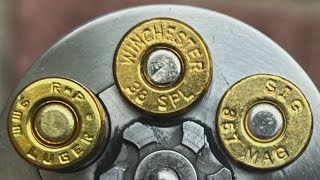

Gel Tests & Terminal Performance
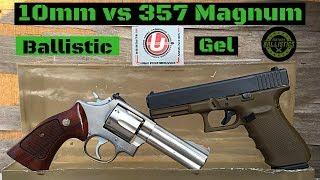
Caliber Comparisons
Recoil Comparisons
Sources & Research
Every claim in this article links back to the expert who made it. Go check our work.
Expert Videos
External Sources
Cross-referenced barrel length velocity data from Ballistics By The Inch, gel test results from Lucky Gunner Labs (4-layer denim protocol), and expert analysis from Mrgunsngear, Banana Ballistics, Kentucky Ballistics, and Lucky Gunner across dozens of independently published video reviews and chronograph tests.