

.380 ACP: The Complete Guide
.380 ACP fires a 90gr bullet at 900 fps from a pocket pistol — but most hollow points fail to expand at that velocity. Complete .380 Auto ballistics with short-barrel gel test data, the 3 defensive loads that actually work, ammo to avoid, barrel length velocity curves, and state-by-state legal restrictions.
The .380 ACP is the caliber that shouldn't work — and sometimes doesn't. Millions carry it daily because the gun that fits in your pocket beats the one sitting in your nightstand.
The problem isn't the cartridge. It's that most people are carrying the wrong ammo.
The Quick Take
The .380 ACP pushes a 90-grain bullet at around 900 fps from a typical 2.75-inch pocket pistol barrel — roughly 160 ft-lbs of muzzle energy. That's about 40% less than 9mm from a comparable barrel length. And here's the dirty secret: most .380 hollow points fail to expand from short barrels.
We pulled data from 15 expert channels — gel testers, defensive instructors, and ballistics researchers — and cross-referenced with Lucky Gunner's independent gel lab and Ballistics by the Inch barrel length testing to find out which loads actually perform.
The answer is stark: out of dozens of .380 defensive loads on the market, exactly three reliably expand from pocket-pistol barrels. Federal HST 99gr, Federal Punch 85gr, and Underwood XTP +P 90gr. Everything else is a gamble — and some popular recommendations are worse than plain ball ammunition.
History & Development
John Browning designed the .380 ACP in 1908 for the Colt Model 1903 Pocket Hammerless — a pistol built for the coat pocket, not the duty belt. The concept was simple: create a round that could cycle in a blowback-operated action, eliminating the need for a locking mechanism. Simpler mechanism meant smaller pistol. Smaller pistol meant actual concealment. Chris Baker at Lucky Gunner traced the cartridge's origin story, noting this same design philosophy still defines the .380 more than a century later.
The parent case is the .38 ACP, shortened to reduce recoil and fit a compact frame. At 21,500 psi maximum pressure — barely more than half of 9mm's 35,000 psi — the .380 was gentler to shoot and cheaper to manufacture. That pressure ceiling is also why the .380 has so little performance headroom. There's only so much you can push a round that operates at the energy floor of defensive handgun cartridges.
Military Adoption
The .380 became a standard military sidearm cartridge across Europe. Czechoslovakia, Hungary, Italy, the Netherlands, and Yugoslavia all issued it. During WWII, Germany fielded .380 through captured pistols and the Walther PPK — which would become James Bond's fictional carry gun and one of the most recognizable .380 platforms ever manufactured.
But NATO's standardization of 9x19mm in the 1960s pushed .380 out of military service almost everywhere. In the United States, the Gun Control Act of 1968 further reduced interest by restricting cheap imported pistols.
The Pocket Pistol Renaissance
Fast-forward to 2003. Kel-Tec introduced the P-3AT — 0.77 inches wide, 7.7 ounces unloaded. Then Ruger released the LCP in 2008 and the market exploded. Chris Baker documented the shift: pocket .380s weigh roughly 60% less than comparable 9mm pistols. A Ruger LCP MAX weighs 10.6 ounces. A Sig P365 weighs 17.8 ounces. That 7-ounce difference doesn't sound like much until you've carried appendix for 14 hours.
The concealed carry boom brought millions of new carriers who needed something they'd actually carry every day. For many of them, the answer was a pocket .380. And it still is — because micro-compact 9mms closed the size gap but never closed the weight gap.
Lucky Gunner: .380 ACP — The Biggest Little Caliber
Ballistics Profile
The .380 ACP operates at a SAAMI maximum average pressure of 21,500 psi — roughly 60% of 9mm's 35,000 psi. Standard loads push 90-95 grain bullets at 900-1,000 fps from test barrels. From the 2.75-inch pocket pistol barrels most people actually carry, expect 20-25% less.
The numbers on the ammunition box are measured from test barrels. The numbers that matter come from your gun's barrel.
Caliber
.380 ACP
.380 Auto / 9x17mm / 9mm Short
Common Bullet Weights
85 / 90 / 95 / 99 gr
SAAMI Max Pressure
21,500 psi
Terminal Performance vs FBI Protocol
Penetration depth in ballistic gel. Green zone = FBI 12-18" standard.
Federal HST 99gr
Tools&Targets · heavy clothing (2.75" barrel)
Federal Punch 85gr
Tools&Targets · heavy clothing (2.75" barrel)
Hornady Crit Def 90gr
Lucky Gunner · 4-layer denim (3.25" barrel)
Hornady Crit Def 90gr
Tools&Targets (FAILED) · heavy clothing (2.8" barrel)
Federal HST Micro 99gr
Lucky Gunner (FAILED) · 4-layer denim (3.25" barrel)
Federal Hydra-Shok 90gr
Lucky Gunner (FAILED) · 4-layer denim (3.25" barrel)
Barrel Length vs Velocity
How barrel length affects muzzle velocity across common handgun sizes.
The Narrow Velocity Window
Here's what makes .380 ACP fundamentally different from 9mm or .45 ACP: the entire velocity window is tiny. BBTI measured Speer 90gr Gold Dot from 2 to 6 inches and found only 280 fps separating the shortest from the longest barrel. Compare that to 9mm, which spans a higher range from a much higher starting point.
More critically, most .380 hollow points need approximately 900 fps to expand reliably through clothing. From a typical 2.75-inch pocket gun barrel, BBTI measured the Speer Gold Dot at 883-918 fps across different pocket pistols. That's right at the expansion threshold. A few fps either direction determines whether your hollow point mushrooms or punches through like ball ammunition.
Switch to the real-world gun dataset in the chart above and the picture gets more honest. The Walther PPK/S with its 3.35-inch barrel hit 1,020 fps — comfortably above the expansion threshold. The Ruger LCP at 2.75 inches managed 918 fps — barely there. The Bersa Firestorm at 3.5 inches only hit 961 fps despite the longer barrel, because barrel length alone doesn't determine velocity — bore tolerances, chamber specs, and barrel-cylinder gap all play a role.
From Buckeye Ballistics' chronograph testing, the Underwood Extreme Defender +P 68gr reached 1,257 fps from a 2.75-inch LCP MAX — well above any hollow point from the same barrel. That velocity is the main argument for the fluted solid design: it doesn't need expansion velocity because it creates the wound cavity mechanically.
Buckeye Ballistics: Underwood Extreme Defender .380 Test
Terminal Performance
This section should make you reconsider whatever .380 ammo is in your pocket right now. The .380 ACP is the most velocity-sensitive handgun caliber for hollow point expansion. From pocket pistol barrels, most hollow points fail through clothing — and some popular recommendations perform identically to ball ammunition.
The FBI Window — And Why .380 Barely Fits
The FBI protocol requires 12-18 inches of penetration through four layers of denim in calibrated ballistic gel. With 9mm, meeting this standard is routine. With .380, it's a coin flip that depends on your barrel length and your ammo choice.
Tools&Targets tested Federal HST 99gr from a 2.75-inch S&W Bodyguard 2.0 and recorded 929 fps, 14.75 inches of penetration, and 0.592-inch expansion. That's excellent — squarely in the FBI window with expansion nearly matching 9mm performance. Federal Punch 85gr from the same gun hit 895 fps, 15.5 inches, and 0.458-inch expansion. Two loads that actually work from a short barrel.
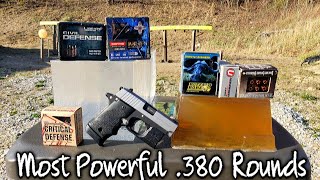
Now compare: the same tester fired Hornady Critical Defense 90gr from a 2.8-inch LCP MAX and recorded 875 fps, 16 inches of penetration, and zero expansion. The bullet tumbled instead of mushrooming. In a separate test from a 2.75-inch LCP MAX, Critical Defense failed again at 902 fps — four consecutive failures from short barrels. Tools&Targets was blunt: an FMJ would be better and cheaper.
But Lucky Gunner's lab tested the same Critical Defense from a 3.25-inch Glock 42 and got 910 fps, 13.2 inches, and 0.52-inch expansion. Same bullet. Roughly 30 fps difference. One barrel length works, another doesn't.
Tools&Targets: Federal HST & Punch .380 From Short Barrel
Loads That Fail
Buckeye Ballistics tested multiple "high performance" .380 loads through denim and found most fail to expand — denim plugs the hollow point cavity before the bullet can mushroom. The Norma MHP 85gr penetrated 21 inches with zero expansion. Buffalo Bore +P 90gr went 22.5 inches with jacket separation — the jacket tore away from the core, which is worse than no expansion at all.
The original Federal Hydra-Shok 90gr — still sold and still recommended by people who haven't seen gel data — penetrated 25.6 inches with 0.36-inch diameter, according to Lucky Gunner's testing. That's functionally identical to FMJ. The Federal HST Micro 99gr went 22.5 inches with 0.35-inch diameter. Both are expensive ways to buy ball ammunition performance.
Buckeye Ballistics: .380 ACP Through Denim — Most Fail
The Non-Expanding Alternative
If you don't trust hollow points from your short barrel — and the data suggests healthy skepticism — Underwood's Extreme Defender 68gr offers a fundamentally different approach. The fluted solid copper design doesn't rely on expansion. It creates a wound cavity through fluid displacement as the flutes channel tissue outward.
From a 2.75-inch LCP MAX, Buckeye measured the +P version at 1,257 fps and 15-15.5 inches of penetration — barrier-blind and velocity-independent. The standard-pressure version hit 1,025 fps and 12.25-12.5 inches, meeting the FBI minimum from a pocket gun. Massad Ayoob noted that Lehigh Defense's fluid displacement technology changed the .380 equation entirely — for the first time, a .380 load could penetrate and cause meaningful tissue disruption without needing to expand.
.380 vs Other Calibers
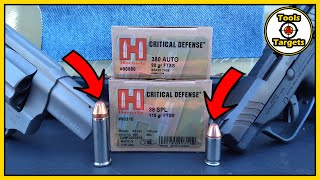
1ShotTV ran a three-caliber gel comparison and the results were telling: .380 Hydra-Shok over-penetrated at 25+ inches without expanding, 9mm HST expanded at 13 inches, and .45 ACP created a massive cavity at 11 inches. The .380 produced the most penetration and the least effect. Against .38 Special, Tools&Targets recorded .380 Critical Defense at 902 fps with 163 ft-lbs and failed expansion versus .38 Special at 838 fps with 172 ft-lbs and partial expansion — the revolver cartridge edged out the auto even at lower velocity.
Against .32 ACP, the .380 held a clear advantage. Tools&Targets measured the Extreme Defender +P at 1,266 fps and 242 ft-lbs with 15.75 inches of penetration — a different class of performance from the .32's sub-150 ft-lb energy.
Recoil & Shootability
Here's .380's real argument. Not terminal performance — shootability.
Massad Ayoob tested the Glock 42 and reported recoil comparable to a .22 from a gun chambered in a centerfire defensive caliber. The Glock 42 is the largest common .380, which is part of why it recoils so gently. But even the tiny Ruger LCP MAX, at 10.6 ounces, produces less felt recoil than a Sig P365 in 9mm despite being 40% lighter — because the .380 cartridge generates 40% less energy.
That recoil advantage compounds for specific shooters. Ayoob noted that experienced .45 ACP shooters sometimes migrate to smaller calibers as arthritis sets in — not because they want less power, but because maintaining proficiency requires manageable recoil. A .380 you can shoot accurately is more effective than a 9mm that flinches you off target.
Chris Baker addressed platform reliability directly: micro .380s are more sensitive to grip technique than full-size pistols. The lighter the gun, the more it depends on a firm grip to cycle reliably. Limp-wristing a 10-ounce .380 causes failures that wouldn't happen with a 25-ounce 9mm. This means practice matters more, not less.
The training cost argument cuts against .380. Practice ammo runs about 25-40% more than 9mm — roughly $0.35–$0.50/round versus $0.28–$0.40/round as of March 2026. A shooter spending $100/month gets approximately 220 rounds of .380 versus 300 rounds of 9mm. Eighty fewer rounds of trigger time per month adds up. The gun that's easier to shoot costs more to shoot — and that training cost gap partially offsets the recoil advantage.
Massad Ayoob on the .380 ACP: Shootability and Ammo Selection
Best Platforms
The .380's platform story splits cleanly: pocket guns and everything else. Pocket carry is the primary use case — these are backup guns, deep-concealment options, and the pistols people carry when they "can't" carry a 9mm.
No .380 gun guides are published yet. Here's what the experts recommend across use cases.
Pocket Carry
- Ruger LCP MAX (2.8" barrel, 10+1) — The modern pocket .380 standard. The MAX fixed everything wrong with the original LCP: better sights, better trigger, 10-round capacity. At 10.6 ounces, it disappears in a pocket holster. Guide coming soon.
- S&W Bodyguard 2.0 (2.75" barrel, 10+1) — Significant upgrade over the problematic first-generation model. Tools&Targets used this gun for their HST and Punch testing — both loads expanded reliably from its 2.75-inch barrel. Guide coming soon.
- Sig P238 (2.7" barrel, 6+1) — Single-action with a metal frame and the lowest recoil in the pocket .380 class. The 1911-style manual safety divides opinion but the shooting experience is unmatched for the size. Guide coming soon.
Larger .380 (Better Ballistics, Easier Shooting)
- Glock 42 (3.25" barrel, 6+1) — Chris Baker called it the easiest pocket .380 to shoot, handling like a full-size despite being the largest in class. The longer barrel pushes velocity above the expansion threshold for more defensive loads — Lucky Gunner's gel tests used this gun for that reason. Guide coming soon.
- S&W M&P Shield EZ .380 (3.675" barrel, 8+1) — Designed specifically for shooters with limited hand strength. Easy-to-rack slide, easy-to-load magazines, gentle recoil. Tools&Targets tested multiple defensive loads from its 3.5-inch barrel with consistently better expansion than pocket guns. The best choice for recoil-sensitive or arthritis-affected shooters. Guide coming soon.
Budget
- Bersa Thunder 380 (3.5" barrel, 7+1) — A Walther PPK clone at a fraction of the price. Metal frame absorbs recoil well, longer barrel helps ballistics. Widely available under $350. Guide coming soon.
The 9mm Alternative
If you can handle the size and weight increase, 9mm outperforms .380 in every ballistic metric. The 9mm Luger caliber guide covers the full breakdown — more energy, more reliable expansion, higher capacity, and cheaper training ammo. The Sig P365 at 17.8 ounces gives you 10+1 rounds of 9mm in a package not dramatically larger than the Glock 42's 6+1 of .380.
Ammo Selection
Ammo selection isn't a footnote for .380 — it's the whole ballgame. Massad Ayoob put it plainly: "the less powerful the cartridge, the more critical the choice of high-quality ammunition". That one statement defines the .380 buying decision.
Self-Defense (Top Tier — Expand From Short Barrels)
These are the only loads with documented expansion from 2.75-2.8" pocket pistol barrels in independent gel testing. Defensive .380 ammo costs roughly the same as 9mm defensive ammo — expect $1.00–$1.80/round as of March 2026.
- Federal HST 99gr (~$1.20–$1.60/round as of March 2026) — The best .380 defensive load, period. 0.592-inch expansion from a 2.75-inch barrel, 14.75 inches of penetration. Tools&Targets called it the best .380 round tested.
- Federal Punch 85gr (~$1.00–$1.40/round as of March 2026) — Deeper penetration (15.5") with slightly less expansion (0.458"). A solid alternative if HST is out of stock.
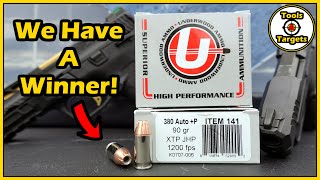
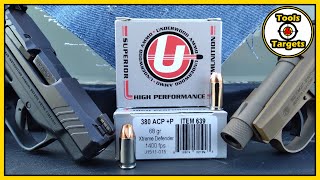
- Underwood XTP +P 90gr (~$1.40–$1.80/round as of March 2026) — Expanded through heavy clothing from a 2.8-inch LCP MAX barrel where most .380 hollow points fail. All rounds expanded. Requires a +P-rated firearm.
Tools&Targets: Underwood XTP +P .380 — Every Round Expanded
Self-Defense (Non-Expanding Alternatives)
If your gun isn't +P rated or you want barrier-blind performance regardless of barrel length:
- Underwood Extreme Defender +P 68gr (~$1.50–$2.00/round as of March 2026) — Fluted solid copper. Doesn't need expansion velocity. 15-15.5 inches through denim from a 2.75-inch barrel. Works regardless of barrel length or clothing barrier.
- Underwood Extreme Defender 68gr (~$1.40–$1.80/round as of March 2026) — Standard pressure version. 12.25 inches from a pocket gun — meets the FBI minimum.
- Winchester FMJ 95gr (~$0.35–$0.50/round as of March 2026) — Tools&Targets made a provocative argument: since most premium .380 hollow points fail to expand anyway, an FMJ at a fraction of the cost penetrates 19 inches with 100% reliability. Not ideal, but honest — and it costs a quarter of what "premium" ammo that performs identically will run you.
Range & Training
.380 ACP training ammo costs 25-40% more than 9mm — roughly $0.35–$0.50/round versus $0.28–$0.40/round as of March 2026.
- Federal FMJ 95gr (~$0.35–$0.50/round as of March 2026) — Standard practice round. Reliable, available, cheap enough to run a box at every range session.
- Winchester Train & Defend 95gr (~$0.40–$0.55/round as of March 2026) — Mimics the recoil impulse of defensive loads so your practice sessions approximate your carry setup.
DO NOT CARRY
These popular recommendations failed in independent short-barrel testing:
- Hornady Critical Defense 90gr FTX — Failed to expand in 4 out of 4 tests from 2.75-2.8" barrels. Only works from 3.25"+ barrels. The most over-recommended .380 load on the internet.
- Federal Hydra-Shok 90gr (original) — 25.6-inch penetration, 0.36-inch diameter. Functionally an FMJ. Replaced by Hydra-Shok Deep.
- Norma MHP 85gr — 21 inches, zero expansion through denim. Marketing outran the ballistics.
- Buffalo Bore +P 90gr — Jacket separated from core at 22.5 inches. Higher pressure didn't fix the design.
- Federal HST Micro 99gr — Despite the HST name, the Micro variant failed at 22.5 inches and 0.35-inch diameter in Lucky Gunner's testing. Don't confuse it with the standard HST 99gr, which works.
Ammo prices fluctuate with supply and demand. Ranges above reflect pricing as of March 2026. Check AmmoSeek for current market prices.
Law & Compliance
The .380 ACP itself is legal everywhere. But ammunition type, magazine capacity, and purchase requirements vary by state — and one state's ammo restriction is particularly devastating for .380 carriers.
The New Jersey Problem
⚠️ New Jersey buyers: New Jersey generally restricts hollow-point ammunition possession outside your home, range, and direct transit between them (N.J. Admin. Code). You can buy and store hollow points. You can shoot them at a licensed range. But carrying them outside those contexts — even with a carry permit — enters legal gray area. For a caliber whose entire defensive viability depends on ammo type, this restriction removes your best options. Underwood Extreme Defender (solid copper, not a hollow point) may be a legal alternative — but consult a NJ firearms attorney first. See New Jersey gun laws →
This matters more for .380 than any other caliber. A 9mm FMJ still has enough energy to cause meaningful tissue disruption. A .380 FMJ just punches a .355-inch hole and keeps going. New Jersey's hollow-point restriction effectively downgrades .380 to a minimum-viable-force cartridge.
Magazine Capacity
Good news: most pocket .380s hold 6-10 rounds, which means they're naturally compliant in every state with capacity restrictions.
| State | Mag Limit | .380 Pocket Guns Compliant? |
|---|---|---|
| California | 10 rounds | Yes — plus handgun roster and ammo background check |
| New York | 10 rounds | Yes (SAFE Act) |
| New Jersey | 10 rounds | Yes |
| Connecticut | 10 rounds | Yes |
| Massachusetts | 10 rounds | Yes — plus approved firearms roster |
| Maryland | 10 rounds | Yes |
| Colorado | 15 rounds | Yes |
The Ruger LCP MAX and S&W Bodyguard 2.0 both sit at 10+1 — right at the limit in 10-round states. Both are compliant with flush magazines, but verify current regulations before purchasing.
⚠️ California buyers: California maintains an approved handgun roster that excludes many popular .380 pistols due to microstamping requirements. All ammunition purchases require a point-of-sale background check. See California gun laws →
⚠️ Massachusetts buyers: Massachusetts maintains its own approved firearms roster separate from California's. Many popular .380 pocket pistols may not be listed. Dealers cannot sell non-roster handguns. See Massachusetts gun laws →
Magazine and carry laws vary by state and change frequently. Before purchasing, confirm current regulations with a licensed dealer near you. Find your local FFL → — and tell them Cache sent you.
The Bottom Line
The .380 ACP is not the best defensive caliber. It's the best deep-concealment caliber — and those are different jobs.
If you can carry a 9mm and shoot it well, carry a 9mm. The 9mm Luger outperforms .380 in energy, expansion reliability, capacity, and training cost. That's not close. Every expert in our research said the same thing.
But "can carry" has a body and a wardrobe and a daily routine attached to it. The runner in compression shorts, the office worker in a slim-cut suit, the person with arthritis who can't rack a 9mm slide — these people exist, and their options narrow to .380 or nothing. The .380 ACP loaded with Federal HST 99gr, Federal Punch 85gr, or Underwood XTP +P is dramatically better than nothing.
The single worst decision a .380 carrier can make is loading random hollow points because the box says "self-defense." Most of them don't work from your barrel length. Test your carry ammo from your gun, or default to the three loads with documented short-barrel expansion. That's the whole message.
A .380 in your pocket beats a 9mm in your safe. Always.
Find a .380 dealer near you → | Check your state's laws → | Compare to 9mm →
Expert Video Library
Gel Tests & Terminal Performance





Caliber Overview & History

Caliber Comparisons


Sources & Research
Every claim in this article links back to the expert who made it. Go check our work.
Expert Videos
External Sources
Cross-referenced gel test data from Lucky Gunner Labs and Tools&Targets, barrel length velocity data from Ballistics by the Inch, and expert analysis from Massad Ayoob, Chris Baker (Lucky Gunner), Buckeye Ballistics, and 1ShotTV across 15 independently published video reviews covering short-barrel terminal performance, barrier testing, and platform reliability.