

5.56 NATO: The Complete Guide
5.56 NATO pushes a 55-grain bullet at 3,250 fps from a 20-inch barrel — fast enough to fragment on impact and light enough that a soldier carries three times the ammo of .308. But from the 16-inch civilian barrel most AR-15s ship with, you lose 170 fps and the fragmentation math changes. Here's the barrel-length data, terminal performance evidence, and platform picks that actually matter.
The 5.56 NATO was designed to do one thing: let a soldier carry three times the ammunition at the same weight and put more rounds on target than the guy with the battle rifle. It worked. It worked so well that the platform built around it became the most popular rifle in American history.
But the round that was engineered for a 20-inch military barrel now ships in 16-inch civilian rifles, 11.5-inch pistol builds, and 7.5-inch truck guns — and the ballistics change at every length. That's the part most people get wrong.
The Quick Take
From a 20-inch barrel, a 55-grain M193 ball round exits at 3,250 fps with 1,289 ft-lbs of energy — fast enough to fragment on impact out to 200 meters. Drop to the 16-inch barrel that most civilian AR-15s ship with, and you're at 3,081 fps. Drop to a 10.3-inch Mk18-style barrel, and you're at 2,715 fps — still above the fragmentation threshold at close range, but the effective window shrinks dramatically.
We analyzed expert ballistics testing, gel data, and chronograph results from Banana Ballistics, Forgotten Weapons, 9-Hole Reviews, Warrior Poet Society, Tactical Rifleman, and more — cross-referenced with independent barrel-length velocity data from Rifleshooter.com and terminal performance studies from Brass Fetcher — to build the most complete 5.56 reference available.
5.56 NATO is the default intermediate rifle cartridge. Not because it hits the hardest. Because it does the most things well enough — flat trajectory, manageable recoil, affordable training ammo, and the deepest ecosystem of rifles, optics, and accessories ever built around a single round.
.223 vs 5.56: Pressure and Accuracy Testing
History & Development
The story starts with Eugene Stoner, an engineer at ArmaLite, and a simple problem: the 7.62x51mm NATO (.308 Winchester) was too heavy, too hard to control in full-auto, and too bulky for a soldier to carry enough of it. In 1957, Stoner was invited to scale his AR-10 design down to a Small-Caliber High-Velocity (SCHV) concept. He and Frank Snow started with the .222 Remington, lengthened the case, and created the .222 Special — renamed .223 Remington in 1959. A 55-grain bullet at 3,300 fps that stayed supersonic past 500 yards.
The battlefield math was compelling. U.S. Continental Army Command studies under Project SALVO found that a five-to-seven-man squad armed with AR-15s had a higher hit probability than an 11-man squad carrying M14s. A soldier carrying the AR-15 could haul 649 rounds for the same weight as 220 rounds of 7.62 NATO. Three times the ammunition, in a rifle that weighed two pounds less.
Vietnam and the M16
The AR-15 became the M16 in 1964, with the cartridge designated M193 — a 55-grain Full Metal Jacket (FMJ) load standardized at 3,250 fps using IMR4475 stick powder at 52,000 psi. Then the Army switched to Olin Ball powder for mass production. Chamber pressure spiked to 55,000 psi. Combined with the lack of chrome-lined chambers and the omission of cleaning kits — under the catastrophically false premise that the rifle was "self-cleaning" — the M16 jammed in the humid jungles of Southeast Asia. Soldiers died because of a powder change.
Ian McCollum of Forgotten Weapons explored this history in depth — the .223 vs 5.56 distinction traces directly back to this military standardization process.
NATO Standardization and M855
In 1980, NATO standardized the Belgian SS109 round under Standardization Agreement (STANAG) 4172. This 62-grain steel-tipped projectile — designated M855 in the U.S. — was designed for better long-range penetration against steel helmets at 600 meters. The heavier bullet required a twist rate change from the M193's 1:12 to a faster 1:7 to stabilize both the SS109 and its companion tracer rounds.
The Short Barrel Problem
As the military transitioned from the 20-inch M16 to the 14.5-inch M4 Carbine, velocity dropped — and with it, terminal performance. M855 depends on velocity to fragment. From a 14.5-inch barrel, it's already marginal past 150 meters. From a 10.5-inch Mk18, it was borderline ineffective with standard ball ammo.
The Army's answer was the M855A1 Enhanced Performance Round (EPR), introduced in 2010. It uses a faster-burning propellant to maximize velocity from shorter barrels and a lead-free copper core with a stacked-cone steel penetrator. The M855A1 is by most accounts the most effective 5.56 ball round ever fielded — and it's not available to civilians.
M855A1 vs M855 vs SS109 vs XM193: Terminal Comparison
Ballistics Profile
5.56 performance is almost entirely dependent on velocity. And velocity is almost entirely dependent on barrel length. That's the fundamental reality of this cartridge — more than any other common rifle round, what comes out of the muzzle changes dramatically based on how long the barrel is.
Caliber
5.56 NATO
5.56x45mm / .223 Remington
Common Bullet Weights
55 / 62 / 77 gr
SAAMI Max Pressure
62,366 psi
.223 Rem rated: 55,000 psi (SAAMI)
Terminal Performance vs FBI Protocol
Penetration depth in ballistic gel. Green zone = FBI 12-18" standard.
Hornady V-MAX 55gr
Brass Fetcher · 10% clear gel
Hornady TAP SBR 75gr
Brass Fetcher · 10% clear gel
Federal Fusion 62gr
Brass Fetcher · 10% clear gel
Speer Gold Dot 62gr
Brass Fetcher · 10% clear gel
Speer Gold Dot 75gr
Brass Fetcher · bare gel
Barrel Length vs Velocity
How barrel length affects muzzle velocity across common handgun sizes.
Barrel Length: Where the Velocity Goes
The barrel-length data above tells the whole story. M193 loses roughly 115 fps per inch in the 7.5-to-10-inch range — that's enormous. Between 14.5 and 16 inches, the loss rate drops to about 50 fps per inch. Beyond 20 inches, you get less than 10 fps per inch, and in some cases velocity actually decreases due to barrel friction exceeding gas pressure.
Banana Ballistics demonstrated this velocity-dependent behavior dramatically in their .223 vs 5.56 pressure and accuracy testing — the chamber pressure difference between the two cartridges produced measurable velocity and group-size changes that most shooters don't account for.
Here's what the numbers mean in practice:
| Barrel Length | Platform Example | M193 Velocity | M855 Velocity | Above 2,500 fps? |
|---|---|---|---|---|
| 7.5-inch | Ultra-short SBR | 2,408 fps | ~2,372 fps | Barely (M193 only) |
| 10.3-inch | Mk18 / CQBR | 2,715 fps | 2,612 fps | Yes |
| 14.5-inch | M4 Carbine | 3,004 fps | 2,841 fps | Yes |
| 16-inch | Civilian standard | 3,081 fps | 2,927 fps | Yes |
| 20-inch | M16 / service rifle | 3,247 fps | 3,025 fps | Yes |
That 2,500 fps number matters — it's the fragmentation threshold for FMJ ammunition. Below it, M193 and M855 punch through tissue without breaking apart. Banana Ballistics tested this on steel targets to show the real-world difference — the velocity gap between .223 and 5.56 is visible in how the rounds deform steel at impact.
.223 vs 5.56: The Difference on Steel
Trajectory at Distance
With a 200-yard zero, M193 from a 20-inch barrel drops 7.2 inches at 300 yards and 22.1 inches at 400. M855 drops slightly more — 7.7 inches at 300 and 23.4 at 400 — because it leaves the muzzle slower despite the heavier bullet. The 77-grain Mk262 Open Tip Match (OTM) from an 18-inch barrel drops 9 inches at 300, but its higher ballistic coefficient means it retains more energy at distance: 578 ft-lbs at 400 yards versus M193's 403.
Terminal Performance
This is where 5.56 gets interesting — and where the caliber's reputation gets distorted by people who don't understand velocity-dependent fragmentation.
The Fragmentation Equation
M193 FMJ fragments violently when it hits soft tissue above 2,500 fps. The bullet yaws, the jacket ruptures at the cannelure, and the lead core breaks into multiple pieces that carve separate wound channels. Below 2,500 fps, that same bullet punches a .224-inch hole straight through without expanding. The difference between devastating and marginal is a threshold, not a gradient.
From a 20-inch barrel, M193 maintains fragmentation velocity out to roughly 200 meters. From a 14.5-inch M4 barrel, that range shrinks to about 150 meters. From a 10.5-inch Mk18, it's inside 100 meters. Banana Ballistics captured this in their direct comparison test — M855A1 fragments far more consistently than standard M855 or M193 at lower velocities, which is exactly why the military developed it.
M855 is worse. Its steel-tipped penetrator was designed for hard-target performance, not consistent fragmentation. Swedish military testing showed M855 dropping to 2,522 fps at just 150 meters from a 14.5-inch barrel — and even at velocities above the threshold, M855 suffers from "fleet yaw," where some rounds simply don't tumble on impact. The result is an unreliable wound mechanism.
Modern Defensive Loads
The solution for civilian and law enforcement use is purpose-built defensive ammunition. Bonded soft-point and frangible loads don't rely on velocity-dependent fragmentation — they're engineered to expand or fragment at a wider range of impact velocities.
From Brass Fetcher's gel testing:
- Hornady TAP 75-grain Short-Barreled Rifle (SBR): 17 inches of penetration with 93% weight retention from a 10.5-inch barrel at 2,201 fps. Designed specifically for short barrels. Meets the FBI 12-18 inch standard.
- Federal Fusion 62-grain: 16 inches of penetration from a 16-inch barrel at 2,799 fps. Bonded core stays together through barriers. Meets FBI standard.
- Speer Gold Dot 62-grain: 15.25 inches at 2,652 fps from a 16-inch barrel. Bonded construction for consistent expansion. Meets FBI standard.
- Hornady V-MAX 55-grain: Only 11 inches of penetration at 2,963 fps from an 18-inch barrel — violent fragmentation but falls short of the FBI's 12-inch minimum. The tradeoff: it reduces overpenetration risk through interior walls.
The Mk318 Mod 0 Special Operations Science and Technology (SOST) round represents the military's best answer. At 62 grains with a 2,925 fps muzzle velocity, its front half fragments while the solid rear core penetrates straight — 18 inches total. It's "barrier blind," meaning it performs consistently whether it hits bare tissue, auto glass, or drywall. Consistent fragmentation even from 10.5-inch barrels.
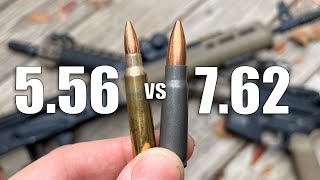
5.56 vs 7.62x39: Terminal Performance Comparison
5.56 vs 7.62x39 and .300 Blackout
These are the two calibers 5.56 gets compared to most often in the AR platform space. Banana Ballistics ran the 5.56 vs 7.62x39 comparison and found unexpected results in soft tissue — 5.56 fragmentation created larger wound cavities than the heavier 7.62x39 FMJ, which tended to tumble but not fragment.
Against .300 Blackout (BLK), the math is different. Warrior Poet Society broke down the trade-off directly — .300 BLK wins suppressed and subsonic, 5.56 wins at distance and on cost. Tactical Rifleman's analysis of home defense scenarios echoed the same conclusion: 5.56 fragments and dumps energy faster inside structures, while .300 BLK's heavier subsonic loads penetrate more walls.
300 Blackout vs 5.56: The Trade-Off
Recoil & Shootability
The 5.56 NATO produces roughly 3.5-4.5 ft-lbs of free recoil energy from a standard AR-15 — compared to 15-20 ft-lbs from a .308 Winchester in a comparable rifle. That's not a marginal difference. That's the difference between a round that a 120-pound new shooter can manage comfortably and one that requires genuine technique to control.
From a 16-inch AR-15 weighing 7 pounds, M193 recoil feels like a firm push. There's no muzzle climb that prevents you from watching your shots through an optic. Follow-up shots on a man-sized target at 50 yards are achievable in under half a second by an intermediate shooter. With a compensator or muzzle brake, that drops further.
The comparison to 7.62x39 is real-world relevant because the AK platform is the direct competitor. Banana Ballistics covered this back-to-back — 5.56 produces noticeably less felt recoil and muzzle movement than 7.62x39 in similar-weight rifles. The lighter bullet and higher velocity don't translate to more felt kick.
Barrel length affects perceived recoil more than most people expect. A 10.5-inch barrel with a loud muzzle blast and sharp concussion feels more punishing than a 16-inch barrel at the same energy level — the blast pressure reaching the shooter's face contributes significantly to the subjective experience. Short-barreled 5.56 rifles are loud. Add a suppressor and the felt recoil actually decreases, because the suppressor acts as a secondary gas expansion chamber.
For new shooters, the AR-15 in 5.56 is one of the easiest centerfire rifles to learn on. The inline recoil impulse pushes straight back into the shoulder rather than rotating the muzzle upward, the pistol grip provides leverage, and the adjustable stock allows proper length-of-pull for any body type.
300 Blackout vs 5.56: Side-by-Side Recoil and Ballistics
Best Platforms
The AR-15 dominates the 5.56 platform ecosystem so completely that recommending a "best 5.56 rifle" is really about recommending the best AR-15 configuration for your use case. There are bolt-action options in .223 Remington for precision work, and a few non-AR semi-autos (like the Sig MCX and IWI Tavor), but 95% of the market is some flavor of AR.
Hunting
Ruger AR-556 MPR (18-inch barrel) — The Multi-Purpose Rifle configuration gives you the barrel length for full velocity with a free-float handguard for accuracy. A solid hunting setup out of the box with a rifle-length gas system for smooth cycling. Guide coming soon.
Savage Axis II in .223 Rem — For dedicated varmint and predator hunting, a bolt-action .223 offers better inherent accuracy than most semi-autos at half the price. The AccuTrigger is adjustable and the platform is dead simple. Guide coming soon.
Ruger American Ranch in .223 — Takes AR-15 magazines, comes threaded, and weighs under 6 pounds. The go-to budget bolt gun for predator hunters who want to share magazines with their AR. Guide coming soon.
Long Range / Precision
Mk12 Mod 0 / Special Purpose Rifle (SPR) builds — The 18-inch stainless barrel, free-float handguard, and match-grade trigger combination that Special Operations Command (SOCOM) fielded for designated marksmen. 9-Hole Reviews ran the Mk12 suppressed with Mk262 and demonstrated sub-MOA groups at 100 yards with the 77-grain Sierra MatchKing load. Guide coming soon.
Aero Precision M4E1 with 20-inch barrel — For a modern precision build, Aero's receivers paired with a 20-inch criterion barrel and Larue MBT-2S trigger will shoot under MOA for under $1,200 total. Guide coming soon.
Ruger Precision Rifle in .223 — A proper chassis rifle with an adjustable stock, Ruger's Marksman trigger, and a 20-inch Cold Hammer-Forged (CHF) barrel. Competition-ready for PRS Gas Gun division. Guide coming soon.
Home Defense
BCM RECCE-16 MCMR — Bravo Company's 16-inch Recce configuration is one of the most recommended mid-range defensive AR-15s among professional instructors. The mid-length gas system runs soft, the cold hammer-forged barrel is durable, and the MCMR handguard gives you room for a weapon light. Guide coming soon.
Daniel Defense DDM4 V7 — A step up in refinement. The DD furniture is excellent, the barrel is CHF and chrome-lined, and the QD sling mounts are built in. It's the rifle instructors grab when they need something to work, every time. Guide coming soon.
Palmetto State Armory (PSA) Dagger or PA-15 — For a budget home defense AR, PSA has made reliable 5.56 rifles accessible under $500. They're not smooth and they're not pretty, but they go bang when you need them to. Guide coming soon.
Tactical Rifleman walked through the 5.56 vs .300 BLK home defense question in detail — 5.56's tendency to fragment through drywall makes it arguably safer inside a structure than pistol calibers or .300 BLK subsonics.
Home Defense Rifle: 5.56 vs .300 BLK
Competition / PRS
JP Enterprises JP-15 — For 3-Gun and PRS Gas Gun, JP's rifles are the gold standard. The silent captured spring, adjustable gas block, and match barrel produce a rifle that barely moves under recoil. You'll pay for it. Guide coming soon.
LaRue Tactical UUK (Upper + Lower kit) — Mark LaRue's complete kit with the MBT-2S trigger is one of the best values in precision AR-15 building. Sub-MOA accuracy for under $900. Guide coming soon.
Budget Builds (under $800)
Palmetto State Armory PA-15 Complete Rifle — Reliable, functional, and frequently on sale under $500. The PA-15 gets you into the 5.56 ecosystem for less than a Glock. Add a Holosun red dot and you've got a home defense setup for under $700 total. Guide coming soon.
Aero Precision Complete Lower + PSA Upper — Mixing Aero's quality lower receiver with a PSA complete upper keeps the total build under $650 while getting a better trigger and fit/finish than a complete budget rifle. Guide coming soon.
Smith & Wesson M&P15 Sport II — The big-brand entry point. Comes with everything you need, nothing you don't. Reliable, accurate enough, and backed by S&W's warranty. Guide coming soon.
Ammo Selection
At $0.30-$0.45 per round for M193 ball, 5.56 is one of the cheapest centerfire rifle cartridges to train with — roughly half the cost of .308 Winchester and comparable to 7.62x39mm steel-case imports.
Hunting
Nosler Ballistic Tip 55-grain — The varmint standard. Rapid expansion and violent fragmentation on coyotes, prairie dogs, and groundhogs. At 3,240 fps from a 24-inch barrel, it's flat-shooting and accurate. Expect $0.80-$1.20 per round as of March 2026.
Nosler Partition 60-grain — For deer-sized game where legal, the Partition's dual-core design provides controlled expansion without the bullet coming apart entirely. It's marginal on deer — but it's the best marginal option. $1.20-$1.60 per round as of March 2026.
Federal Fusion 62-grain — A bonded soft-point that holds together through tissue for deeper penetration than any varmint load. Good for hogs and deer at closer ranges. $0.90-$1.30 per round as of March 2026.
Match / Precision
Black Hills Mk262 77-grain OTM — The precision load the military trusts, built on the Sierra MatchKing bullet. Effective to 700 meters with consistent sub-MOA accuracy from quality barrels with a 1:7 or 1:8 twist. 9-Hole Reviews showed the Mk262 maintaining tight groups at distance from a suppressed Mk12. Premium pricing: $1.00-$1.50 per round as of March 2026.
Federal Gold Medal Match 69-grain Sierra MatchKing — The go-to match load for 1:9 and 1:8 twist barrels. Less expensive than Mk262 and still capable of sub-MOA from a good barrel. $0.80-$1.20 per round as of March 2026.
Range & Training
M193 55-grain FMJ (any manufacturer) — The cheapest way to feed your AR. Federal American Eagle, PMC Bronze, Winchester White Box — all adequate for range work. $0.30-$0.45 per round as of March 2026 for brass-cased. Steel-cased variants (Wolf, Tula) run $0.22-$0.30 per round but accelerate barrel wear.
M855 62-grain (Green Tip) — NATO standard ball. Slightly more expensive than M193 but useful for shooters who want to train with the same point-of-impact their duty or defensive load produces. $0.35-$0.50 per round as of March 2026.
Home Defense
Speer Gold Dot 62-grain or 75-grain — Bonded construction that expands reliably from 16-inch and shorter barrels. Both variants land in the FBI 12-18 inch penetration window. The 75-grain is optimized for short barrels. $0.90-$1.30 per round as of March 2026.
Hornady TAP 75-grain SBR — Purpose-built for short-barreled rifles. Achieves 17 inches of penetration with 93% weight retention from a 10.5-inch barrel. If you run an SBR or pistol-length AR, this is the load to consider. $1.00-$1.40 per round as of March 2026.
Ammo prices fluctuate with supply and demand. Ranges above reflect pricing as of March 2026. Check AmmoSeek for current market prices.
Law & Compliance
The 5.56 NATO doesn't face caliber-specific bans — no state prohibits .223 or 5.56 ammunition by name. But the AR-15 platform that fires it is the most heavily regulated rifle in America. If you're buying a 5.56 rifle, your legal situation depends entirely on your state and what features your rifle has.
Assault Weapon Restrictions
Eight states plus the District of Columbia maintain assault weapon bans that directly affect AR-15 ownership: California, New York, New Jersey, Connecticut, Massachusetts, Maryland, Hawaii, and Illinois. Washington state banned new sales in 2023. The specifics vary — some ban by name, some by features, some by both — but they all restrict the standard-configuration AR-15.
| State | Mag Limit | Key Restriction |
|---|---|---|
| California | 10 rounds | Name + features ban; "featureless" or fixed-mag builds required |
| New York | 10 rounds | One-feature test; no pistol grips with detachable magazines |
| New Jersey | 10 rounds | Name + "substantially identical" test; Firearms Purchaser ID required |
| Connecticut | 10 rounds | Name + two-feature test; unregistered pre-ban rifles are felony |
| Massachusetts | 10 rounds | Name + two-feature test; state roster limits retail availability |
| Maryland | 10 rounds | Name + "copycat" ban; Heavy Barrel (HBAR) variants exempt |
| Illinois | 10 rounds | PICA Act; grandfathered with endorsement affidavit only |
| Hawaii | 10 rounds | Feature ban effective 1/1/2026; register by July 2026 |
| Washington | 10 rounds | No new sales; grandfathered possession only |
| Colorado | 15 rounds | No assault weapon ban; magazine limit only |
California: Featureless Build Requirements
In California, a 5.56 AR-15 with a detachable magazine must have zero "assault weapon" features — no pistol grip, no thumbhole stock, no folding/telescoping stock, no flash hider, no forward pistol grip. Most California-compliant builds use a fin grip or Thordsen stock. Alternatively, a fixed-magazine system (like the Hogue Freedom Fighter) avoids the feature restriction entirely but requires field-stripping to reload. New 2026 laws add background checks for separate barrel purchases. See California gun laws →
New York: SAFE Act Restrictions
New York's SAFE Act uses a one-feature test — any semi-automatic rifle with a detachable magazine and one prohibited feature (pistol grip, telescoping stock, threaded barrel, flash suppressor) is an assault weapon. No grandfather clause for unregistered rifles after 2013. Featureless configurations are legal but must be genuinely featureless — even a bayonet lug counts. See New York gun laws →
New Jersey: 10-Round Limit + FID Requirement
New Jersey enforces a 10-round magazine limit and requires a Firearms Purchaser Identification (FID) card for all long gun and ammunition purchases. AR-15s are legal in featureless configurations with fewer than two prohibited features and a fixed stock. Standard 30-round magazines are illegal to possess. See New Jersey gun laws →
Illinois: PICA Grandfathering Deadline Passed
Illinois's Protect Illinois Communities Act (PICA) banned the sale and manufacture of assault weapons. Existing owners were required to file an endorsement affidavit by January 1, 2024. If you missed the deadline, your rifle may be illegal to possess within the state. See Illinois gun laws →
National Firearms Act (NFA) and Short-Barreled Rifles (SBR)
Any 5.56 rifle with a barrel under 16 inches is a Short-Barreled Rifle under the NFA — requiring a $200 tax stamp and registration with the ATF on a Form 4. Processing times via eForm 4 currently run two to six months. Many of the restrictive states listed above prohibit NFA items entirely, even with federal approval.
A popular workaround is the 14.5-inch barrel with a permanently pinned and welded muzzle device that brings the overall barrel length to 16 inches. This avoids NFA paperwork while giving you most of the handling advantages of a shorter barrel.
Hunting Caliber Minimums
Several states set minimum caliber requirements for deer hunting that exclude .223/5.56. Generally, .243 (6mm) is the minimum where such rules exist. Check your state's game regulations before planning a deer hunt with a .223. For varmint and predator hunting, .223/5.56 is legal everywhere.
Magazine and carry laws vary by state and change frequently. Before purchasing, confirm current regulations with a licensed dealer near you. Find your local FFL → — and tell them Cache sent you.
The Bottom Line
If you're building your first rifle, buying your first AR, or choosing a caliber for the platform that does the most things well — the answer is 5.56 NATO. The ammo is affordable enough to actually train with. The recoil is mild enough that anyone in your household can run the rifle effectively. The terminal performance with modern defensive loads is proven. And the ecosystem of rifles, parts, optics, and accessories is so deep that you will never run out of options.
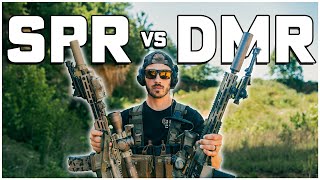
The people who should look elsewhere know who they are. If you're hunting elk or shooting past 600 yards, you need .308 Winchester (guide coming soon) or 6.5 Creedmoor (guide coming soon). If your primary use case is a suppressed home-defense carbine with subsonic loads, .300 BLK (guide coming soon) was built for exactly that job — and it does it better than 5.56 in a shorter package. Dirty Civilian's SPR comparison drove home the point: a 5.56 Special Purpose Rifle can match a .308 Designated Marksman Rifle at medium range, but the .308 pulls away beyond 400 yards.
But for the rifle that covers home defense, range training, competition, varmint hunting, and general preparedness with one lower receiver and a pile of affordable ammo? 5.56 NATO is the default for a reason. It's been the default since 1963. The AR-15 that fires it is the most refined small-arms platform in history. The answer hasn't changed because nothing has replaced it.
Find a 5.56 dealer near you → | Check your state's laws → | Ask Cache about 5.56 →
Expert Video Library
Ballistics Tests & Chronograph


Gel Tests & Terminal Performance

Caliber Overview & History

Caliber Comparisons


Platform Reviews

Resources & Further Reading
Reference
- Wikipedia — 5.56x45mm NATO — NATO standardization history, adoption timeline, and technical specifications with extensive sourcing.
- Wikipedia — .223 Remington — Cartridge development, pressure ratings, and chamber geometry reference.
Ballistics & Data
- JBM Ballistics Calculator — Free online trajectory calculator for 5.56/.223 loads with wind drift and drop tables.
- AmmoSeek — 5.56/.223 Price Tracker — Real-time price comparison across online retailers for all 5.56 and .223 ammunition.
Legal Resources
- Giffords Law Center — State Gun Law Database — Searchable database of state-level assault weapon bans, magazine limits, and feature restrictions.
- Handgunlaw.us — State-by-State Laws — Carry law summaries for all 50 states, updated regularly.
- USCCA Reciprocity Map — Interactive map for concealed carry permit reciprocity between states.
Community & Forums
- AR15.com Forums — The oldest and largest AR-15 community forum — build advice, ammo testing reports, and state-specific legal threads.
Sources & Research
Every claim in this article links back to the expert who made it. Go check our work.
Expert Videos
External Sources
Cross-referenced barrel-length velocity data from Rifleshooter.com's cut-down test series, terminal performance gel data from Brass Fetcher, Swedish military chronograph testing of M855, and expert analysis from Banana Ballistics, Forgotten Weapons, 9-Hole Reviews, Warrior Poet Society, Tactical Rifleman, and Dirty Civilian across independent ballistics and comparison videos.