This video from Yee Yee Life tests the penetration capabilities of various firearms against a stack of baking sheets, culminating with a .50 BMG round. The experiment demonstrates the relative stopping power of different calibers, from .22 LR to .50 BMG, and includes a 12-gauge slug, AK-47, .308, and .30-06 rifle rounds. The results highlight significant differences in penetration, with the .50 BMG ultimately piercing all 34 baking sheets.
This video demonstrates the penetration capabilities of various common firearm calibers through a stack of 1000 paper plates. It highlights how bullet energy and construction significantly affect penetration depth, with higher caliber rounds generally requiring more plates to stop. The experiment provides a visual, albeit informal, understanding of ballistic performance against a soft, uniform medium.
This video tests the penetration capabilities of various firearms, from .22 LR to a .50 BMG, through stacks of paper plates. The experiment aims to determine how many plates each caliber can stop before the projectile is fully arrested. The results show a significant increase in penetration with larger calibers, with the .30-06 Springfield ultimately outperforming the .50 BMG in this specific test due to projectile deflection.
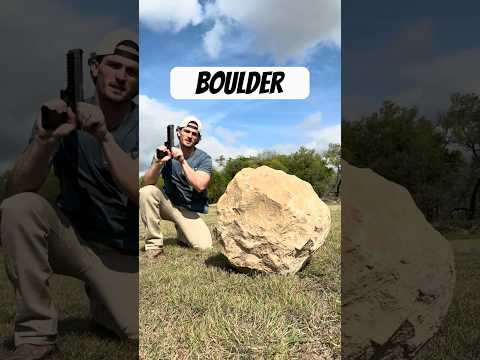
This video tests the penetration capabilities of various calibers against a boulder, culminating with the .50 BMG. While smaller calibers like .22 LR, 9mm, and .45 ACP caused minimal damage, larger rounds like 5.56mm and 12 gauge slugs began to chip the rock. The .308 and initial .50 BMG shots caused significant fragmentation but did not penetrate. A second .50 BMG shot successfully penetrated the boulder.
This video tests the bullet resistance of a large boulder against various firearms, culminating in a .50 caliber sniper rifle. The experiment demonstrates that even smaller calibers cause minimal damage, with significant chipping and cracking only appearing with higher-powered rifle rounds. It took two .50 caliber rounds to eventually penetrate the boulder, highlighting its substantial protective capabilities.
This video compares the terminal ballistics of a powerful 72 caliber air rifle against a 12-gauge slug. Through a series of tests involving pine trees, sand, steel plates, and ballistic gel, the video demonstrates the significant momentum and penetration capabilities of heavyweight air rifle projectiles, highlighting their potential as a quieter alternative to firearms in certain scenarios.
This video tests the penetration capabilities of various calibers through stacked drywall sheets. It demonstrates how different bullet types and calibers perform against this common building material, offering a practical, albeit unconventional, look at projectile energy transfer and stopping power.
This video demonstrates the penetration capabilities of various calibers by shooting through stacked candles. It highlights how larger and more powerful rounds, like the 50 caliber, can pass through significantly more material than smaller calibers such as .22 LR or 9mm.
This video from Yee Yee Life tests the penetration capabilities of various firearms against drywall, ranging from a .22LR to a .50 BMG. The host, Parker, demonstrates how many sheets of drywall each caliber can penetrate, providing a visual comparison of their stopping power in a simulated home environment. The experiment highlights significant differences in projectile energy and effectiveness across calibers.
This video from Yee Yee Life features an experienced individual testing the bullet-stopping capabilities of a 100-pound lead block against various calibers, from .22LR up to .50 BMG. The test includes firearms like Glocks, Rugers, Desert Eagles, AR-15s, FN SCARs, and Barrett rifles, demonstrating penetration levels and the effectiveness of lead as a ballistic material. The results show that while lead blocks can stop many common rounds, high-powered calibers like the .50 BMG can penetrate significantly.
This video from Yee Yee Life demonstrates a ballistic test on steel toe boots, firing various calibers from .22LR up to .50 BMG. The expert instructor shows how lower calibers are stopped by the boots, while higher calibers like .50 AE and .50 BMG penetrate. The test highlights the limitations of steel toe boots against powerful firearm rounds.
This video tests the ballistic resistance of steel-toe boots against various calibers, from .22LR up to .50 BMG. While smaller calibers like .22LR and .380 ACP were completely stopped with minimal deformation, larger calibers like 9mm and .45 ACP caused significant bulging and potential toe injury, though they were still stopped. The .44 Magnum partially penetrated the steel on one attempt, and the 50 AE and 50 BMG successfully penetrated the steel toe, rendering the boots ineffective against these high-powered rounds.
Gun Laws by State
Read firearms regulations for all 50 states + D.C.
Find Gun Dealers
Search licensed FFL dealers near you.