Channel: @yeeyeelife
This video tests the penetration capabilities of various firearms and calibers against standard stop signs. The experiment progresses from a .22 LR up to a .50 BMG, documenting how many stop signs each round can pass through. The results highlight the significant differences in projectile energy and stopping power across a range of common and powerful firearms.
This video tests the ballistic resistance of a 75-pound giant Velcro ball against a variety of firearms, from .22LR up to .50 BMG. The experiment aims to determine if the dense Velcro material can stop bullets from different calibers. The results show that smaller calibers are effectively stopped, while larger rifle rounds begin to penetrate significantly, with the .30-06 and .50 BMG ultimately passing through the ball.
This video tests the bullet-stopping capabilities of kinetic sand against various calibers, from .22 LR up to .50 BMG. The experiment demonstrates that while kinetic sand can significantly slow or stop smaller caliber rounds, larger calibers like the .50 BMG can overwhelm its capacity, splitting containers and dispersing the sand. The test highlights the material's effectiveness as a projectile barrier for certain threats but not all.
This video tests the bullet-stopping capabilities of kinetic sand against various firearms, from .22LR to .50 BMG. The experiment reveals that kinetic sand offers surprising resistance, with smaller calibers like 9mm and .45 ACP penetrating only one container. Larger calibers and rifle rounds generally failed to penetrate even a single container, often breaking apart or deforming within the first layer. The .50 BMG, while powerful enough to split containers, did not fully penetrate.
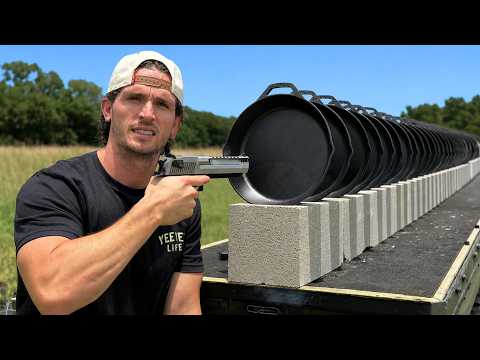
This video from Yee Yee Life tests the bullet-stopping capabilities of cast iron pans against various calibers, from .22 LR up to .50 BMG. The experiment aims to determine how many pans are required to stop each round. The results show significant variation in penetration, with larger calibers consistently penetrating more pans than smaller ones. The .50 BMG ultimately proved most effective, penetrating five pans.
This video tests the penetration capabilities of various firearms against a stack of hockey pucks. It demonstrates how different calibers and firearm types, from .22 LR to .50 BMG, interact with the pucks, showing varying degrees of penetration and puck destruction. The experiment highlights the significant differences in stopping power and projectile energy across a wide range of common and powerful ammunition types.
This video from Yee Yee Life tests the ballistic penetration capabilities of various firearms against stacked soccer balls. The experiment progresses from a .22LR up to a .50 BMG, demonstrating how many soccer balls each caliber can penetrate before the projectile is stopped or significantly deflected. The results highlight the increasing destructive power of larger calibers and the surprising resistance of inflated soccer balls.
This video tests the penetration capabilities of various firearms and calibers through watermelons, providing a visual demonstration of bullet energy and destructiveness. The experiment progresses from smaller handgun rounds like the .22 LR up to powerful rifle calibers and a .50 AE Desert Eagle, highlighting how different ammunition types interact with organic material. The .44 Magnum emerged as a surprising leader in penetration among handguns, while rifle rounds often veered off course due to the inconsistent medium.
This video tests the ballistic resistance of a Dr. Pepper vending machine against various firearms, from .22LR to .50 BMG. The machine demonstrated significant resistance to smaller calibers, stopping rounds like 9mm and .45 ACP. However, larger calibers, including the .44 Magnum, .308 Winchester, and ultimately the .50 BMG, penetrated the machine, with the .50 BMG completely destroying it and passing through. The test highlights that while a vending machine can offer some protection against smaller threats, it is not a reliable ballistic shield against more powerful firearms.
This video tests the ballistic resistance of a large rubber band ball against various calibers of bullets, from .22LR up to .50 BMG. The experiment demonstrates that while the rubber band ball can stop smaller calibers and even slugs and rifle rounds to some extent, it is ultimately overwhelmed by higher-powered ammunition like the .30-06 and .50 BMG, with the latter completely destroying the ball and its target.
This video tests the ballistic resistance of a large, homemade rubber band ball against various firearms, ranging from .22LR to .50 BMG. The ball, weighing over 20 lbs and composed of approximately 10,000 rubber bands, demonstrates surprising durability, stopping numerous handgun and rifle rounds. The experiment highlights the energy-absorbing properties of the rubber bands, with only the .30-06 Springfield and .50 BMG rounds eventually penetrating the dense mass.
This video tests the ballistic resistance of a parking meter against various calibers, from .22LR up to .50 BMG. It demonstrates how different ammunition types penetrate or are stopped by the meter, providing a visual comparison of terminal ballistics against a common urban object. The experiment highlights the significant increase in destructive power with larger calibers.