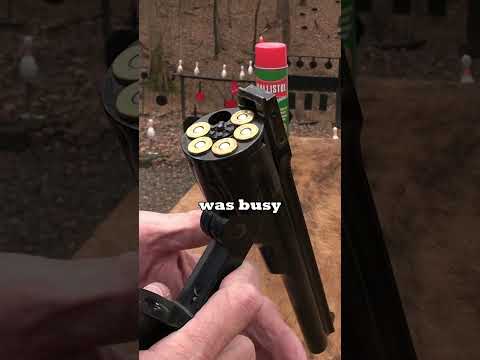
This guide details the disassembly process for a specific 19th-century Warner revolving carbine, highlighting its unique design that omits a traditional ramrod and loading lever. The process involves removing a single screw to detach the barrel assembly, which then rotates and slides off. This method is distinct from typical percussion revolvers.
This video provides an expert look at the Frankenau Purse Revolver, a 19th-century concealed self-defense firearm likely marketed towards women. The instructor, demonstrating expert authority, details its five-shot pin-fire action, extremely short barrel, and unique trigger mechanism, all hidden within a functional coin purse. The design emphasizes discreet carry and surprise, highlighting historical approaches to personal protection.
This video provides a brief overview of the Merwin Hulbert "Skullcrusher" revolver, highlighting its historical markings and the general operation of a revolver, including firing and reloading. The content focuses on visual identification and basic firearm function without in-depth technical analysis or instructional guidance.
This guide details the unique loading process for the Henry 1860 rifle, as demonstrated by Hickok45. It covers the steps from accessing the magazine to dropping rounds, emphasizing the historical design's quirks. The guide also includes essential safety precautions for handling and firing the rifle.
This video explores the firearms that would have been commonly carried in 1878, featuring a Smith & Wesson Schofield revolver, an iron-frame Henry rifle, and a 12-gauge double-barrel shotgun. Hickok45, an established subject matter expert, provides historical context and demonstrates shooting these classic firearms, while also touching upon modern gear. The content highlights the evolution of firearms and ammunition from the 19th century to the present day.
This video provides an expert-level demonstration of the Smith & Wesson Schofield revolver, a top-break .45 Colt model. Hickok45, a recognized firearms authority, showcases its historical significance, mechanical nuances like the automatic ejection system, and practical accuracy on a private range. The content highlights why these revolvers, despite their popularity in the Old West, are less frequently seen in Western films compared to Colt single actions, often due to S&W's focus on large international contracts.
Hickok45, an expert in 19th-century firearms, outlines a practical 'battery' of weapons for 1878, consisting of a Smith & Wesson Schofield revolver, an Iron Frame Henry rifle, and a 12-gauge double-barrel shotgun. He contextualizes these choices within the historical, economic, and social landscape of the era, emphasizing that firearm accessibility varied significantly based on wealth and location.
This entry details the Kubura Pećanka, a flintlock pistol from the Balkans with Ottoman influence, lasting into WWI. Expert Jonathan Ferguson of the Royal Armouries highlights its unique construction, regional style, and surprising longevity due to cultural factors and cost-effectiveness compared to modern firearms.
This video provides an expert look at the Westley Richards 'Monkey Tail' Carbine, a unique single-shot breech-loading rifle. It details the firearm's history, its distinctive mechanism, and its use by various historical groups, including the Boers in South Africa. The content highlights its collector market appeal and historical significance.
This video provides an expert look at the Henry Rifle, a significant American innovation predating the internet. Hickok45, with his high authority level, demonstrates the rifle's loading mechanism, historical context, and shooting performance. The guide focuses on the unique aspects of the Henry's design, including its toggle-link action and front-loading magazine, offering insights into its impact on firearm development.
This expert overview from NRA Publications details the historical significance and technical aspects of the Model 1860 Spencer Carbine. It highlights its role in the Civil War, its innovative lever-action mechanism, and its adoption by the Union Army, including President Lincoln's personal endorsement. The entry also touches upon post-war modifications and its eventual replacement by later firearms.
This guide details the disassembly of the Portuguese Abadie 1878 revolver, as demonstrated by an expert from C&Rsenal. The process involves manipulating the trigger guard to open the side plate and removing a pin to access the internal lockwork. Proper disassembly is crucial to avoid damage to the unique Abadie mechanism.
Gun Laws by State
Read firearms regulations for all 50 states + D.C.
Find Gun Dealers
Search licensed FFL dealers near you.