This video provides an in-depth look at the rare Praga I, a 1922 Czech machine gun designed by Václav Holek. It highlights the unique blow-forward, bullpup-like action, and selectable semi-automatic fire, contrasting it with the standard Vickers gun. The analysis is presented by firearms expert Ian McCollum, offering deep mechanical insights.
This video provides an in-depth look at the G98/40 rifle, a German WWII substitute standard firearm manufactured in Hungary by FEG. Host Ian McCollum details its origins as an adaptation of the Hungarian 35M, its unique Mannlicher split-bridge action, and its differences from the Mauser K98k. The analysis highlights its cock-on-close mechanism, 5-round internal magazine, and specific external features like the two-piece stock and sling bar. The rarity of the G98/40 in the US due to its continued production until 1944 and use on the Eastern Front is also discussed.
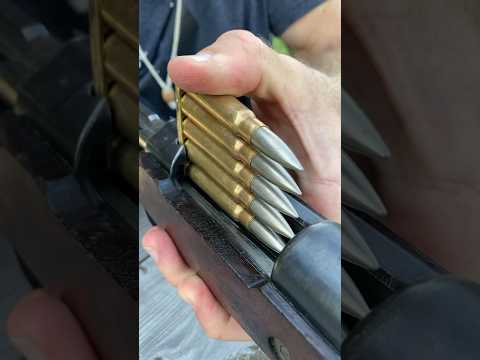
This guide details the process of loading and firing the Turkish Mauser 1943 rifle, as demonstrated by Misha's Guns. It covers identifying the rifle by its markings, using stripper clips for the 8x57mm Mauser ammunition, and the safe operation of the bolt and safety mechanism. The demonstration includes live fire at a steel silhouette target, highlighting recoil and cycling.
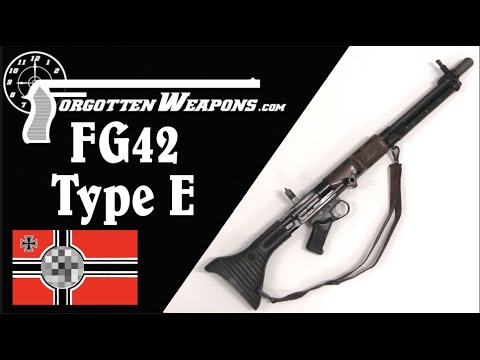
This guide details the field stripping and reassembly of the FG-42 Type E, a complex German paratrooper rifle from WWII. Expertly demonstrated by Ian McCollum, the process involves removing the stock to access the recoil buffer and bolt carrier group. Proper maintenance is crucial for this rare and historically significant firearm.
This video presents a survival scenario from December 1942 on the Eastern Front, pitting the Finnish M39 rifle against the German Kar98k with a Zf.41 scope. The viewer is placed in the role of a lone Finnish Sergeant behind Soviet lines after an ambush. The core decision is whether to choose the M39 with less ammunition but readily available, or the Kar98k with a full combat load and optic, but requiring time to gather ammo from fallen comrades. Ian McCollum of Forgotten Weapons is also slated to participate in a discussion, adding an expert perspective to the historical and tactical implications of the choice.
This expert guide details the range testing of a Yugoslav M76 rifle in 8x57mm Mauser, specifically a Century Arms build. It covers initial accuracy assessments, troubleshooting cycling malfunctions, and diagnosing a magazine follower design flaw. The analysis highlights the rifle's comfort despite its caliber and discusses potential reliability differences between original and US-made versions, offering insights from a highly technical perspective.
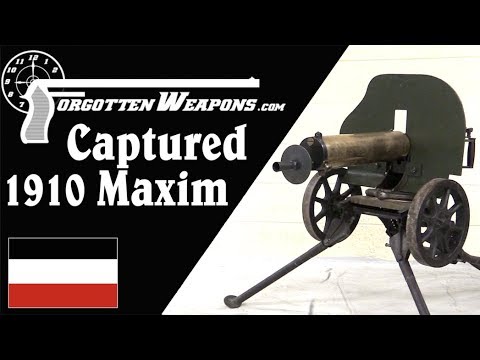
This guide details the modifications required to convert a 1910 Russian Maxim machine gun to fire 8x57mm Mauser ammunition, a common practice by German forces during WWI. It covers identifying converted examples, feed block and lock modifications, barrel and water jacket variations, and the use of the Sokolov mount. The information is presented with high authority by Ian McCollum, highlighting specific technical details and historical context.
This Q&A session covers a wide range of firearms topics, from recommendations for a first C&R purchase (Polish P83, Radom VIS 35, Mauser 98) to historical firearms like the Hotchkiss revolving cannon and Galilean sights. Ian McCallum discusses the nuances of black powder cartridges, the advantages of repeating rifles like the Kropatschek, and the historical context of Luger production. He also touches on modern firearm design, the challenges of American-made AKs, and the effectiveness of various submachine guns. The discussion extends to book publishing, the impact of media on the gun world, and personal perspectives on expertise and collecting.
This guide details the shooting technique for the Inglis 8mm Bren Gun, as demonstrated by Ian McCollum of Forgotten Weapons. It covers safe handling, magazine loading, and firing in both semi-automatic and full-automatic modes. Emphasis is placed on utilizing the folding carry handle as a vertical foregrip for stability during 'assault fire' and hip firing, a technique facilitated by the weapon's inherent weight and design. The provenance of the featured firearm, from the estate of Bill Woodin, is also noted.
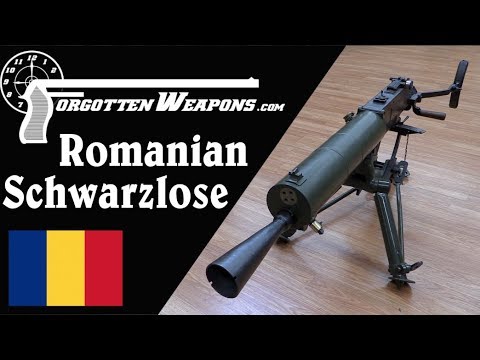
This entry details the Romanian conversion of the Austro-Hungarian Schwarzlose HMG to fire 8x57mm Mauser. Key modifications include an extended water jacket and barrel for improved ballistics, rear sight recalibration for the new caliber, and deactivation of the original oiling system. The video highlights the historical context of these conversions and their import into the US as parts kits.
This entry details the Karabiner 88 and Gewehr 91, German pre-WWI smokeless powder carbines based on the Gewehr 88 design. Expert Ian McCollum highlights their compact size, Mannlicher-style en-bloc clip loading, unique bolt features, and specific applications for cavalry and artillery troops. The entry covers production details, manufacturer markings, and key design elements like the stacking rod on the Gewehr 91 and the side-mounted sling system on the Kar 88, along with later safety updates.
This guide details the field stripping and basic operation of the MG-34, a pioneering 'Universal Machine Gun'. It covers the unique pivoting receiver barrel-change mechanism and the dual-crescent trigger for semi- and full-automatic fire. The video emphasizes safety during disassembly and highlights the weapon's historical context and technical innovations, as explained by firearms expert Ian McCollum.
Gun Laws by State
Read firearms regulations for all 50 states + D.C.
Find Gun Dealers
Search licensed FFL dealers near you.


![Scenario Brief [Arctic Patrol] Finnish M39 vs. German Kar98k + Zf.41 (Pick One Ep.2)](https://i.ytimg.com/vi/9g69o6cUXQ4/hqdefault.jpg)