The Beretta M1918 is a rare Italian semiautomatic carbine from WWI, often mistaken for a submachine gun. It evolved from the Villar Perosa, utilizing a 'parts bin' approach with Carcano and Vetterli components for economical production. This open-bolt, delayed blowback carbine features a unique top-mounted 25-round magazine and offset sights, chambered in 9mm Glisenti loaded to 9mm Parabellum specs.
The Beretta M1918 is a rare Italian semi-automatic carbine from WWI, often mistaken for a submachine gun but firing only in semi-auto. It reuses parts from the 1915 Villar Perosa and operates from an open bolt with a delayed blowback system for safety. Chambered in 9mm Glisenti, it features a unique 25-round magazine and a trigger guard repurposed from a Vetterli rifle.
The Glisenti 1910 is a historical Italian semi-automatic pistol chambered in 9mm Glisenti. While it features a unique split-tab manual safety and a front grip safety, its design presents limitations. The pistol has a high bore axis contributing to snappy recoil and a heavy trigger pull. It cannot safely handle full-power 9mm Parabellum ammunition, and its magazines are prone to deformation, making it an awkward martial handgun despite its historical significance.
The Villar Perosa 1915, an early Italian submachine gun, was initially designed for aircraft but adapted for ground troops. It fires 9mm Glisenti from 25-round magazines, offering low recoil despite its high rate of fire. Its unique dual spade grip and paddle trigger system allow independent firing of each barrel, though handling is hampered by a non-locking bipod and difficult-to-use sights.
This video showcases the rare WW1 Villar Perosa SMG, a double-barreled Italian aircraft gun, during a range test. It highlights the weapon's extreme rate of fire (1500 rpm per barrel) and its transition from aerial combat to problematic ground use due to design limitations like poor sights and recoil management. The demonstration also touches on potential practical ground firing doctrines and its upcoming auction.
The OVP 1918, Italy's first submachine gun, is derived from the Villar Perosa light machine gun. It features a unique dual-trigger system for semi-auto and full-auto fire, and utilizes a 25-round Villar Perosa magazine with a front-mounted release. Its internal mechanics are striker-fired and open-bolt, with a safety mechanism involving slight bolt rotation.
This documentary explores the history and technical aspects of the Beretta Modello 1915 and 1917 pistols, developed during WWI. It details their design evolution from earlier Italian firearms, their operational mechanics, and performance during live-fire testing. The video highlights the 1915's robust design in 9mm Glisenti and the more compact 1917 in .32 ACP, noting their respective strengths and weaknesses.
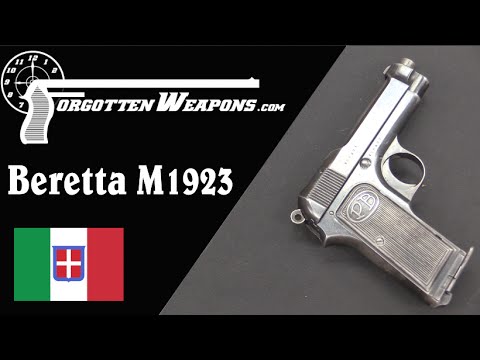
The Beretta Model 1923 represents an evolutionary step from the Model 1915, featuring the first exposed hammer on a Beretta pistol. While marketed for 9mm Parabellum, it was designed for the lighter 9mm Glisenti, with Ian McCollum disputing the former's safe use. Production was limited, with significant contracts for Bulgaria and later the Italian Army. Rare variants included shoulder stock attachments, designated Model 1924.
The Beretta Model 1918/30 is a unique semi-automatic carbine, serving as a developmental link between earlier models and the later Beretta 38 family. It was designed from the ground up for police use, featuring a distinctive ring-shaped charging handle and a folding bayonet. A critical safety warning is issued regarding ammunition: only 9mm Glisenti should be used, as standard 9mm Parabellum is too high-pressure and will damage the firearm.
The M1915 Villar Perosa, a contender for the first submachine gun, was initially designed as an aircraft observer's weapon for WWI. Its dual-barrel system fired at an extremely high rate (up to 3000 RPM) using 9mm Glisenti cartridges, effective against early aircraft. Later adapted for ground combat, it evolved into iconic submachine guns like the Beretta M1918.
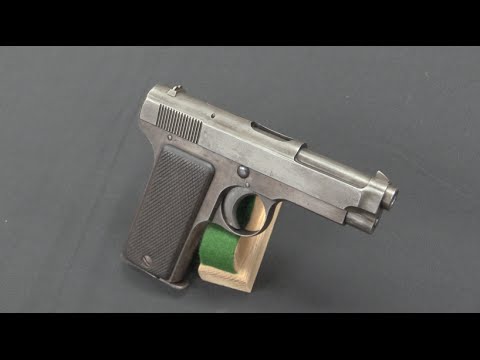
The Beretta Model 1915 was Beretta's first semi-automatic pistol, designed by Tullio Marengoni and adopted by the Italian military. It fires the less powerful 9mm Glisenti cartridge, distinct from 9mm Luger, and features a unique dual manual safety system and an open-sided magazine. Early models used a heavy slide and internal buffer for recoil management in a blowback action.
The Vitali 1910 is a rare Italian semi-automatic pistol featuring a unique short-recoil operation and a break-action disassembly. It utilizes an internal magazine fed by stripper clips and has a DA/SA trigger mechanism with an unusual heavier single-action pull. The pistol is chambered in 9mm Glisenti, a less powerful cartridge than 9mm Luger, and was manufactured at the Terni Arsenal.
You've reached the end! 12 videos loaded.
Gun Laws by State
Read firearms regulations for all 50 states + D.C.
Find Gun Dealers
Search licensed FFL dealers near you.