This "American Rifleman Television" segment explores the history and features of the Daisy Buck Jones BB gun, an air carbine that predates the more famous Red Ryder model. The video highlights that the Buck Jones, not the Red Ryder, was the model depicted in the film "A Christmas Story," featuring a sundial and compass on its stock. The origin of the Daisy Air Rifle Company is also detailed, stemming from windmill sales by the Plymouth Ironworks. The Buck Jones, named after the popular movie star, was produced from 1934 to 1942 and was discontinued following Jones's death, leading to the introduction of the Red Ryder.
This video segment from "American Rifleman Television" focuses on the M1 and M1A1 Thompson submachine guns, highlighting their development as a cost-effective wartime expedient compared to the earlier, more expensive M1928A1 model. It details design simplifications, such as the elimination of the Blish locking system for a blowback operation, removal of barrel cooling fins, Cutts compensator, and complex sights, along with the switch to stick magazines. The evolution leading to the M1A1, featuring a further simplified fire-control mechanism, is also discussed. The video emphasizes the widespread use of the M1 Thompson by various branches of the U.S. military and its allies during World War II, particularly in the Pacific theater.
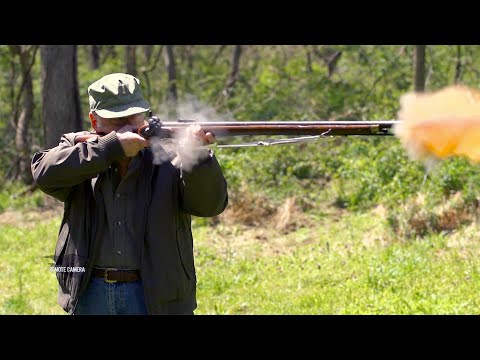
This video from American Rifleman Television provides an in-depth look at the North-South Skirmish Association's (NSSA) revolver matches. The NSSA is dedicated to competitive shooting with Civil War-era firearms. The feature segment highlights the revolver team match held at Fort Shenandoah, Va., discussing the history of revolvers in the NSSA, popular revolver models like Colt, Remington, and Rogers & Spencer, target types (pigeons, tiles, pots), and the fast-paced 90-second match format. It emphasizes the unique experience of shooting antique firearms and participating in a multi-faceted competition that can even include artillery.
This video segment from "American Rifleman Television" delves into the history and features of the M30 Luftwaffe drilling, a firearm issued to German aircrews during World War II for survival. The segment highlights its unique triple-barrel design, its selection by Hermann Göring from J.P. Sauer & Sohn's commercial sporting rifle lineup, and the extensive survival gear included in its issue crate. The M30 is noted for its fine craftsmanship, contrasting with typical utilitarian military arms, and its role as a robust survival tool.
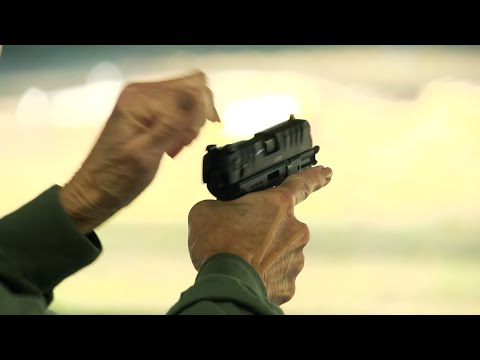
This American Rifleman TV preview showcases the NRA Women's 5th Annual Ladies Pistol Project, an event featuring 47 women testing 19 different pistols in .380 ACP and 9mm calibers. The preview highlights that the full episodes will cover the .380 pistols first, followed by an exploration of 9mm handguns. The event was filmed for broadcast on the Outdoor Channel, offering a glimpse into firearm experiences for women.
This video from "American Rifleman Television" explores the Pattern 1851 Minié Rifle, a pivotal firearm in British military history. It details the transition from smoothbore muskets to rifled shoulder arms, highlighting innovations like the Minié bullet. The description discusses the rifle's development, its caliber (.70-cal. with .69-cal. projectile), its service during the Crimean War, and its eventual replacement by the Pattern 1853. The Pattern 1851 is credited with revolutionizing infantry by enabling widespread accuracy and allowing average soldiers to become effective riflemen.
This video explores Fiocchi's modern manufacturing operations, focusing on their significant investments in the United States, particularly in Arkansas. While acknowledging their Italian heritage and historical strength in shotshells, the feature highlights Fiocchi's increasing emphasis on producing super-premium centerfire rifle and handgun cartridges. It details specific product lines like Range Dynamics (FMJ), Defense Dynamics (JHP), and Hyperformance (XTP), and discusses the innovative use of lead- and heavy-metal-free primers for shooter health. The segment underscores Fiocchi's commitment to 'Made in America' while leveraging over 140 years of manufacturing experience with 21st-century technology to drive product development.
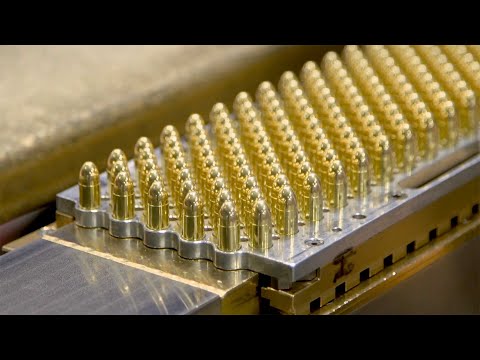
This video offers an in-depth, behind-the-scenes look at the Remington Ammunition factory in Lonoke, Arkansas. It details the manufacturing process for Remington's centerfire handgun and rifle ammunition, from melting recycled lead to forming copper jackets and assembling projectiles. The segment highlights the efficiency of the plant's design, the time-tested machinery, and a new facility dedicated to 9mm Luger FMJ production. It also touches on the brand's recent acquisition by Vista Outdoor and the subsequent reinvestment to bring the factory back to full capacity.
This video from American Rifleman TV details Taurus USA's significant move from Miami, Florida, to a new 73-acre facility in Bainbridge, Georgia. The relocation, a decade in the making, was driven by the need for expansion and a purpose-built factory designed for efficiency. The move has brought new jobs to Bainbridge and improved manufacturing capabilities, including in-house production of barrels, bluing, and Cerakoting. The company has also significantly improved its warranty-repair process. The video highlights the supportive, Second Amendment-friendly environment of Bainbridge and the enthusiasm of its workforce.
This video, the second part of a series on Federal Ammunition, chronicles the company's century-long journey from a small manufacturer to a major player in the U.S. ammunition industry. It highlights Federal's key innovations, including their color-coded shotshell gauge system, the development of Black Cloud shotshells for waterfowl hunting, their proprietary primer manufacturing, and the groundbreaking Hydra-Shock defensive handgun ammunition. The video also touches upon Federal's commitment to conservation and customer feedback, emphasizing their continuous efforts to improve product performance and affordability for both professional and civilian users. The description also provides links to NRA resources and American Rifleman TV.
This video explores the rich history of Federal Ammunition, a prominent U.S. manufacturer based in Anoka, Minnesota. It details the company's 100-year journey, from its humble beginnings in 1916, through its revival and renaming as Federal Cartridge Company in 1922, to its current status as a major player in the ammunition market. The narrative highlights the innovative marketing strategies of founder Charles L. Horn and the company's significant contributions to the industry, such as the adoption of transducers for pressure measurement. The video emphasizes the dedication of its workforce and its substantial growth into a 175-acre facility employing 1,500 people.
Gun Laws by State
Read firearms regulations for all 50 states + D.C.
Find Gun Dealers
Search licensed FFL dealers near you.