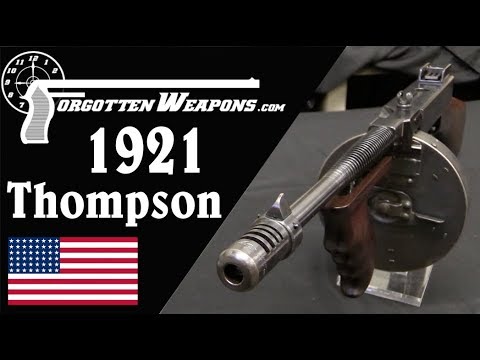
I Have This Old Gun: M1/M1A1 Thompson Submachine Gun

Published on May 29, 2024
Duration: 5:52

This video provides an in-depth look at the M1 and M1A1 Thompson submachine guns, detailing their development as cost-effective wartime solutions. Experts explain the significant design simplifications, including the elimination of the Blish locking system and the switch to a straight blowback action, which made production more efficient. Key changes like the removal of barrel cooling fins, the Cutts Compensator, and the adoption of a 30-round stick magazine over the heavier drum are highlighted, along with the M1A1's further refined fire control assembly.

Quick Summary

The M1 and M1A1 Thompson submachine guns were developed during World War II as cost-effective alternatives to the M1928A1. Key simplifications included removing the Blish locking system for a straight blowback action, eliminating barrel cooling fins and the Cutts Compensator, and switching to a 30-round stick magazine. The M1A1 further refined the design with a fixed firing pin bolt for increased production efficiency.

Chapters

  1. 00:00Thompson Submachine Gun Introduction
  2. 00:25M1 Thompson Wartime Expedient
  3. 00:39British Procurement and Thompson's Reputation
  4. 00:56Cost of M1928 Thompson
  5. 01:08Need for Design Simplification
  6. 01:29M1 Design and Subcomponent Reduction
  7. 01:46Elimination of Blish Locking System
  8. 02:29Cost of Blish Action vs. Straight Blowback
  9. 02:58Thompson's Early WWII Importance
  10. 03:09Savage Engineers and M1 Development
  11. 03:30M1 Thompson Introduction (1942)
  12. 03:42M1 Simplification Details
  13. 04:04Magazine Changes: From Drum to Stick
  14. 04:30M1A1 Further Simplification by Savage
  15. 05:07M1 vs M1A1 Key Difference
  16. 05:19M1 Thompson's WWII Service

Frequently Asked Questions

Why were the M1 and M1A1 Thompson submachine guns developed?

The M1 and M1A1 Thompson submachine guns were developed as more economical solutions to produce the Thompson submachine gun in larger quantities for Allied forces during World War II, addressing the high cost of the earlier M1928A1 model.

What was the main technical simplification in the M1 Thompson compared to earlier models?

The primary simplification in the M1 Thompson was the elimination of the complex and costly Blish locking system, transitioning to a simpler and cheaper straight blowback operation.

What external changes were made to the M1 Thompson?

External simplifications on the M1 Thompson included the removal of barrel cooling fins, the Cutts Compensator, and the relocation of the actuator handle from the top to the side of the receiver.

How did the M1A1 Thompson further simplify production?

The M1A1 Thompson achieved further simplification by integrating a fixed firing pin directly into the bolt, eliminating the need for a separate hammer and firing pin assembly, which reduced machining time and cost.

More Reviews Videos You Might Like

More from NRApubs

View all →