This video explains how a potential escalation of conflict could lead to a severe shortage of ammunition for civilians in the United States. It details how the Department of Defense, under the Defense Production Act of 1950, could prioritize military needs, reallocating all ammunition production and existing stockpiles away from civilian markets to support the US military and NATO allies. The speaker emphasizes the historical precedent and advises civilians to stock up proactively.
This video explains how a potential escalation of conflict could lead to a severe shortage of ammunition for civilians in the United States. It details how the US Army's reliance on civilian production, particularly from the Lake City Ammunition Plant, and the provisions of the Defense Production Act of 1950 could result in military prioritization of all ammunition contracts, halting civilian sales and reallocating existing stock. The speaker, from 'God Family and Guns,' warns that this scenario could rapidly deplete civilian ammo supplies, drawing parallels to past wartime shortages.
The US Army is addressing ammunition shortages by developing mobile critical material refineries. This initiative, in partnership with Idaho National Laboratories, aims to refine raw materials like antimony sulfide domestically, reducing reliance on foreign sources and bolstering both military and civilian ammunition production capabilities. The project focuses on overcoming primer supply chain vulnerabilities.
The US Army is addressing ammunition shortages by partnering with Idaho National Laboratories to develop mobile critical material refineries. These units will refine raw materials like antimony trisulfide, crucial for primer production, directly at manufacturing or mining sites, reducing reliance on foreign sources like China and bolstering both military and civilian ammo supply.
This video explains how a significant portion of civilian ammunition in the US is produced by the US Army, specifically through the Lake City Ammunition Plant operated by Winchester. In the event of war expansion, the Defense Production Act of 1950 could be invoked, prioritizing military and NATO needs over civilian supply. This could lead to an immediate halt in civilian ammo production and sales, with manufacturers shifting focus to military-grade calibers.
TheYankeeMarshal argues that the pandemic-era ammo shortage was largely artificial. He posits that production levels remained consistent, citing exemptions for manufacturers as essential businesses and personal knowledge of ongoing operations. The perceived shortage, he suggests, was driven by panic buying and a significant decrease in range usage, leading to empty shelves despite steady supply.
Ian McCollum of Forgotten Weapons provides an expert overview of the Roswell Rifle Works SR3M at SHOT Show. The SR3M is a US-made variant of the Russian 9x39mm VSS/Vintorez family, built with original mechanical systems. Roswell Manufacturing is producing both the firearms and proprietary 9x39mm ammunition in-house, addressing magazine compatibility issues with standard 7.62x39mm magazines. Pricing and availability for SBR and pistol variants are also detailed.
The US Army's transition from 5.56 NATO to the 6.8x51mm (277 Fury) round presents potential long-term implications for civilian ammunition availability. While the Army and Sig Sauer are ramping up production of the new round, the limited civilian rifle options and high cost of entry may hinder market adoption. This could lead to a significant reduction in 5.56 NATO production by facilities like the Lake City Ammunition Plant once the Army fully transitions, potentially impacting civilian supply.
The US Army, in partnership with Idaho National Laboratories, has developed the first mobile critical material refinery. This initiative aims to address global ammunition shortages by enabling on-site refinement of raw materials like antimony trisulfide, crucial for primer and bullet alloy production. The mobile refinery can be transported to various locations, enhancing domestic production capabilities and reducing reliance on foreign sources.
The US Army is transitioning to the 6.8mm caliber for its Next Generation Squad Weapons, a significant shift from the long-standing 5.56mm. Sig Sauer has achieved a production milestone of 100 million rounds of 6.8mm ammunition annually for the Army. This increased production is crucial for both military readiness and potential future civilian availability of the new caliber, addressing concerns about ammunition scarcity.
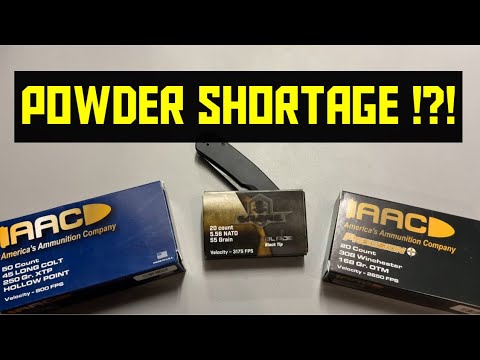
AAC is temporarily halting ammunition production due to a powder shortage, with their primary supplier prioritizing military contracts. They are seeking alternative powder sources but anticipate a production pause of up to a year. This situation highlights broader market concerns stemming from global conflicts and the reliance on overseas nitrocellulose production.
This video discusses the US military's increased focus on ammunition production, aiming for wartime readiness. It highlights efforts to boost 155mm shell output and small arms ammunition manufacturing at facilities like the Lake City Army Ammunition Plant. Despite military ramp-ups, the civilian market currently benefits from abundant raw materials and a lack of consumer rush, leading to stable or decreasing prices. The speaker suggests this military push is a positive development for national security and civilian access to ammunition.
Gun Laws by State
Read firearms regulations for all 50 states + D.C.
Find Gun Dealers
Search licensed FFL dealers near you.