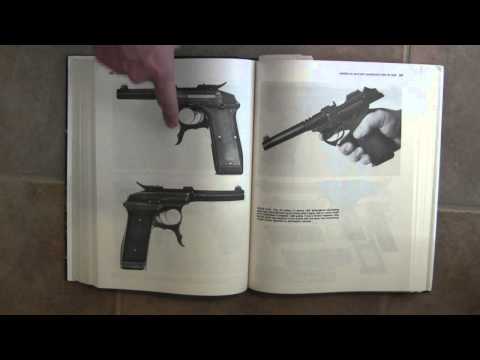
This video focuses on the Bergmann 1910 pistol, with the description highlighting a concurrent merchandise campaign for shirts. The video likely aims to showcase or discuss this specific firearm, with the shirt promotion being a secondary element.
The Danish Bergmann 1910 is a short recoil locked breech semi-automatic pistol chambered in 9x23mm Bergmann. It features a 6-round detachable staggered magazine and distinctive circular charging knobs. While visually similar to the Mauser C96, its ergonomics, including a bell-shaped grip and stiff magazine release, are noted as awkward. The sights are quick to acquire, and recoil is moderate.
This YouTube video is a brief segment, likely an introduction or highlight, from a larger "Primer" episode focused on the Danish Bergmann 1910 pistol. The description explicitly states it's a "small segment" and encourages viewers to check out the full episode via a provided link. It also includes calls to action for supporting the creators through Patreon, SubscribeStar, and purchasing merchandise. The primary focus is the Bergmann 1910.
This video delves into the real-world firearm origins of the blasters seen in the original Star Wars film, 'A New Hope.' Inspired by a recent episode of 'The Mandalorian' featuring a prototype Bergmann pistol, the creator aims to provide additional context beyond basic online searches regarding the inspiration for these iconic movie weapons. The video promises to explore the real guns that served as the basis for Star Wars weaponry, offering a unique perspective for fans and firearm enthusiasts alike.
The Mandalorian's iconic blaster is a modified Bergmann Model 1894 (No. 1) pistol, a rare prototype with fewer than 20 units produced. Prop designers retained its distinctive side-mounted cleaning rod, resembling a drill bit, while altering the grip, hammer, and adding a muzzle cone for a more imposing sci-fi look. The No. 1 was chosen over the later production No. 2 for its larger size and unique aesthetic.
This review details the Bergmann 1920s Experimental Military Trials Pistol, an updated iteration of the 1910 model by the Pieper factory. Key improvements include a 15-round magazine, a reshaped trigger guard, a relocated magazine catch, a wider hammer for easier cocking, and a simplified bolt disassembly system similar to the Mauser C96. Despite these enhancements, the design was largely obsolete by the mid-1920s.
This video showcases a collection of finely engraved Bergmann pistols, highlighting their historical significance and artistic craftsmanship. Featured models include two 1896 No. 3s, a Bergmann Mars 1903, and a 1910. The video emphasizes the distinct banknote-style scrollwork with gold accents, characteristic of Bergmann factory engraving, and also points out a unique 1910 with external engraving and an Arabic inscription. The 1896 model is presented in its original presentation case, offering a glimpse into the quality of Bergmann firearms from the late 19th century.
The Bergmann Mars 1903 is a significant early automatic pistol featuring Louis Schmeisser's innovative vertical locking block system, originally designed for machine guns. This allowed for the more powerful 9mm Bergmann cartridge, later adopted as the 9mm Largo by Spain. Despite initial military trial failures in Britain and the US, Spain adopted the Mars 1903 for its simplicity and clip/magazine loading capability, though production faced challenges.
The Bergmann No.5 (1897) was Bergmann's first locked-breech pistol, developed after the 1896 model failed to gain military traction. Chambered in 7.8mm Bergmann, it fired a powerful .30 caliber round for its era. Despite trials with Swiss and British militaries, it was rejected due to fragility and caliber preference, leading Bergmann to focus on the civilian market with carbine variants and luxury sporter models.
This review details the rare 1896 Bergmann No. 3 (6.5mm) and No. 4 (8mm) pistols, highlighting their design evolution from earlier models and unique features. It covers identification markers for early vs. late production, distinguishing between the No. 3 and No. 4, manufacturer stamps, and the intricate set trigger mechanism found on target variants. The video also touches upon production numbers, proprietary cartridges, and the optional quick-detach barrel system.
This video provides an introduction to the Bergmann line of pistols, detailing their history and development. It explains that Theodore Bergmann was an industrialist who funded inventors like Otto Brauwetter and Louis Schmeisser. The video covers the evolution of the Bergmann pistols from the 1892 patent to the 1903 Mars and its subsequent adoptions by Spain and Denmark, leading to variants like the 1910/21. It highlights the development of different models (No. 2, 3, 4, 5) and design changes, noting the eventual obsolescence of the magazine-forward configuration. The presenter promises a detailed look at each model in upcoming videos.
The Bergmann Simplex, produced around 1900-1901, was a simplified blowback pocket pistol chambered in 8x18mm. Despite its compact design and single-action mechanism, it was commercially unsuccessful, largely overshadowed by the more refined Browning Model 1900. Approximately 4,000 units were made before production ceased in 1903.
Gun Laws by State
Read firearms regulations for all 50 states + D.C.
Find Gun Dealers
Search licensed FFL dealers near you.