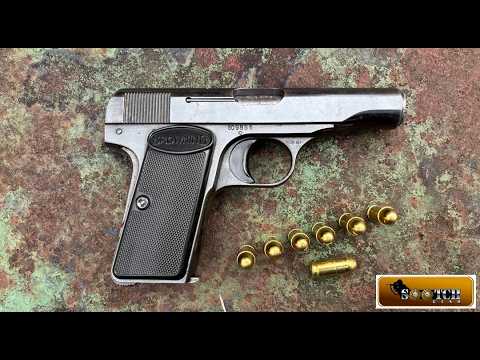
This guide details the field stripping and reassembly process for the Browning Model 1910 pistol. It covers the unique barrel bushing removal mechanism, recoil spring assembly, and the steps to separate and rejoin the slide, barrel, and frame. The process highlights the pistol's blowback design and John Browning's engineering.
This review of the Smith & Wesson FPC highlights its unique folding mechanism, which allows for a compact 16.25-inch folded length, making it highly portable. The PCC features a 16.25-inch barrel, a blowback design, and a full-length Picatinny rail with MLOK slots for accessory mounting. The reviewer also details the trigger pull, ergonomics, and included accessories like multiple magazines and a carrying bag.
This review of the Beretta M1934 380 ACP surplus pistol highlights its historical significance, simple yet reliable design, and unique features like the open slide and heel-style magazine release. The video provides a detailed look at its operation, including a demonstration of its unusual disassembly and reassembly process. While noting minor initial reliability issues potentially due to magazine springs, the reviewer emphasizes the pistol's overall durability and accuracy, making it a compelling piece of history for collectors and enthusiasts.
This video delves into the Schmeisser MK-36,II, a prototype submachine gun that predated the MP38. It highlights the design's open-bolt blowback operation, unique magazine safety, and Hugo Schmeisser's inter-war design evolution. The review also contrasts a German trial variant with a Hungarian trial version, noting differences in caliber and charging handle.
This video reviews the Interarms PPK, a classic .380 ACP semi-automatic pistol. The presenter highlights its blowback design, fixed barrel contributing to accuracy, and DA/SA trigger system. He notes the manual safety's operation when the hammer is down and the absence of a slide release, requiring magazine drop to close the slide. The review distinguishes it from the PPK/S model and mentions its iconic status, partly due to James Bond.
The FN Browning 1910, designed by John Browning, is a striker-fired, blowback-operated semi-automatic pistol chambered in .380 ACP or .32 ACP. Initially rejected by Colt, it was produced by FN Herstal and became a significant sidearm in World War I, famously used by members of the Black Hand society in the assassination of Archduke Franz Ferdinand. Its production continued through World War II and beyond, influencing later pistol designs.
This review of the Sig Sauer P210 in .380 ACP highlights its all-steel construction, reliability, and concealability. The firearm is praised for its smooth operation, accurate shooting out of the box, and a significant advantage over the Walther PPK due to its takedown lever, simplifying field stripping. It's recommended as a backup, self-defense, or concealed carry option for those preferring metal frames.
This guide details the cleaning process for a Wilson Combat AR9, emphasizing its blowback design which requires more frequent cleaning (every 200 rounds). It outlines the necessary cleaning products, disassembly steps for the upper and lower receivers, detailed cleaning of critical components like the bolt and upper receiver, and proper lubrication techniques. The guide also includes important operational notes regarding bolt manipulation and magazine insertion to prevent unnecessary wear.
This video from Forgotten Weapons delves into the early history of Bergman pistols, one of the first companies to commercially produce self-loading firearms in the 1890s. It highlights Theodore Bergman's role as an industrialist, not a designer, and the initial collaboration with watchmaker Uto Brow Vetter. The evolution from simple blowback to more complex locked breech designs is discussed, setting the stage for future developments.
You've reached the end! 9 videos loaded.
Gun Laws by State
Read firearms regulations for all 50 states + D.C.
Find Gun Dealers
Search licensed FFL dealers near you.