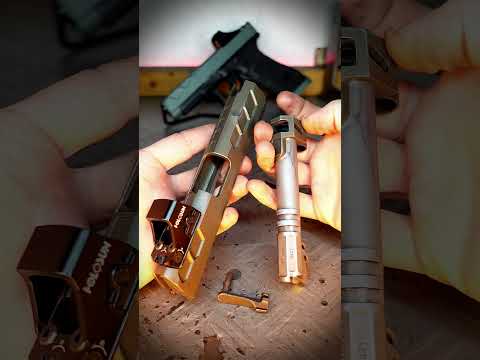
This guide details the adaptation of 9mm suppressors for various firearm types. It explains the necessity of booster assemblies for tilt-barrel handguns like Glocks and the simple conversion to a fixed-barrel setup by removing the spring and adding a spacer. The video also touches on modular suppressors and alternative mounting systems like tri-lug adapters.
This analysis debunks the theory that the B&T Station Six was the murder weapon in a recent New York City shooting. The presenter, drawing on decades of firearms experience, explains why the Station Six's manually operated action and the observed gas plume are inconsistent with the shooter's actions. Instead, the evidence points towards a semi-automatic, Browning-action pistol with a non-booster suppressor, likely suffering from accuracy issues due to a non-concentric bore.
This guide explains the common observation of a 'bent' or upward-pointing barrel in semi-automatic pistols when the slide is locked back. It clarifies that this is a normal and functional aspect of the Browning-style tilting barrel action, crucial for reliable feeding. The explanation is delivered with high authority, detailing the mechanical process and its prevalence across various popular firearm platforms.
This video provides a detailed tabletop review and field strip of the CZ 75 BD pistol. The presenter, with an apparent understanding of firearm mechanics, walks through the disassembly process, highlighting key features and potential design considerations. The review emphasizes the pistol's historical significance and its 'kidney bean' Browning action, while also discussing its ergonomics and fit/finish.
This video provides an in-depth look at the Chinese Type 54 Tokarev pistol, a variant of the Soviet TT-33. It details the pistol's history, its design influenced by John Moses Browning, and its operational similarities to the 1911. The discussion covers its 7.62x25mm Tokarev caliber, 8-round single-stack magazine, and the absence of a manual safety on original models. The video also explains how import regulations have led to modern modifications like trigger safeties on some imported examples.
This video reviews five pistols noted for their accuracy and innovative designs: the Archon Type B, Logo Arms Alien, Atlas Gunworks Aries, Canik SFX Rival S, and RAIA 5.0. It highlights features like low bore axis, unique action types, and materials contributing to reduced recoil and improved shootability for competition and everyday carry.
This video provides an expert overview of a custom-built 2011-style pistol from RV Custom. The builder, demonstrating high authority, details the use of semi-finished STI parts, prototype components, and specific materials like chrome-molybdenum and 416 stainless steel. Key features discussed include a Browning-style action with custom timing, an integrated compensator, and a uniquely balanced short slide, highlighting the technical considerations for performance and ergonomics.
The SAR 9 Sport is a Turkish-made handgun designed for sport shooting and competition, featuring a 5.2-inch forged barrel and slide, and a polymer frame with a stainless steel chassis. It offers an ambidextrous safety, adjustable sights, and is optic-ready. While the trigger is described as usable but spongy, the ergonomics are praised, and the gun demonstrates good reliability out of the box. The design shares similarities with Glock and High Power platforms, particularly in its disassembly process.
This video explores the enduring legacy and modern evolution of the 1911 platform. Experts Tim and Jason highlight its historical significance, ergonomic advantages, and the revolutionary Browning tilting barrel action, which influences most modern handguns. They showcase various contemporary models, including the Staccato XC and Alpha Foxtrot S15, demonstrating the platform's adaptability with new calibers and features like red dot optics.
This guide details a rigorous mud immersion test on a TT-33 Tokarev pistol, simulating harsh field conditions. It covers preparation, immersion, firing, malfunction clearing, and recovery through rinsing, demonstrating the pistol's robust Browning action and historical ruggedness. The assessment, led by an instructor with high authority, provides practical insights into the TT-33's reliability under extreme duress.
This guide details the field stripping process for the AMT Automag IV, highlighting its Browning-style short recoil action with a tilting barrel. It emphasizes the unique design considerations for its magnum caliber, including an extended chamber. The information is presented with the authority of Ian McCollum from Forgotten Weapons, known for his deep dives into firearm history and mechanics.
You've reached the end! 11 videos loaded.
Gun Laws by State
Read firearms regulations for all 50 states + D.C.
Find Gun Dealers
Search licensed FFL dealers near you.