This video showcases the Outlier Backdraft Barrel System on a bolt-action rifle, demonstrating its unique smoke mitigation capabilities through slow-motion footage. The presenter, identified as a high-level enthusiast with specialized knowledge, highlights the barrel's design, rapid bolt manipulation, and precision shooting accuracy. The content emphasizes the innovative 'backdraft' feature where smoke is drawn rearward through the barrel shroud.
This video discusses the .223 Remington and 5.56x45mm NATO calibers as excellent choices for survival scenarios. The instructor highlights their effectiveness as centerfire cartridges, their widespread availability in firearms like AR platforms and bolt-action rifles, and the potential to carry hundreds of rounds. The .223/5.56 is presented as a superior option to .22 LR for hunting larger game in an end-of-world context, despite potential legal restrictions in normal times.
This video introduces the Federal 7mm Backcountry, a new centerfire cartridge designed for big game hunting from short-barreled rifles. It highlights the cartridge's ability to achieve high muzzle velocities comparable to longer barrels due to increased pressure and a novel steel alloy case. The discussion also covers its ballistic performance and compares it to other 7mm magnum cartridges.
Ian McCollum of Forgotten Weapons provides an expert overview of the 2.7mm Kolibri, the world's smallest production firearm. He details its blowback action, tiny detachable magazine (typically 5-6 rounds), and unique centerfire ammunition. Despite its size, the Kolibri is noted as being underpowered even for its era, primarily serving as a historical curiosity rather than a practical self-defense tool.
This guide details the process of converting a Colt 1851 Navy percussion revolver to a cartridge firearm using a Thuer conversion cylinder and ring. The conversion allows for the use of centerfire cartridges by replacing the percussion cylinder with a modified one and adding a conversion ring that incorporates a firing pin. The process involves removing the barrel and wedge, swapping cylinders, and reassembling the firearm, offering a reversible modification to modernize a classic black powder revolver.
This comprehensive overview of the Perrin Revolving Carbine, presented by Ian McCollum of Forgotten Weapons, details its historical context, design evolution, and mechanical features. The carbine, a single-action variant of the Perrin and Delmas revolver, utilized an advanced 11mm/12mm Perrin centerfire cartridge. While submitted for French military trials, it was ultimately rejected in favor of the Chassepot rifle due to range limitations and cost. The review highlights its unique features, including a folding ejector rod and a V-notch rear sight graduated to 500 meters.
This guide details the unique operation of the Pottet Shotgun, a precursor to modern shotgun shells. The firearm features a rotating and tipping breech-loader action, where the barrel assembly rotates 90 degrees to unlock and recock hammers, then tips open for loading and automatic extraction. The video, presented by Ian McCollum, highlights Clement Pottet's 1829 and 1855 patents and the shotgun's construction with Damascus steel barrels and a paper-bodied, metallic-base cartridge.
This video provides an in-depth look at the Winchester Model 1873 lever-action rifle, often dubbed 'The Gun That Won the West.' The presenter details its historical significance, mechanical operation including its toggle link action, and the calibers it was chambered in. It highlights the rifle's role in Winchester's transition to modern centerfire cartridges and contrasts it with later models like the 1894, while also touching on its portrayal in media and its limitations regarding modern cartridge pressures.
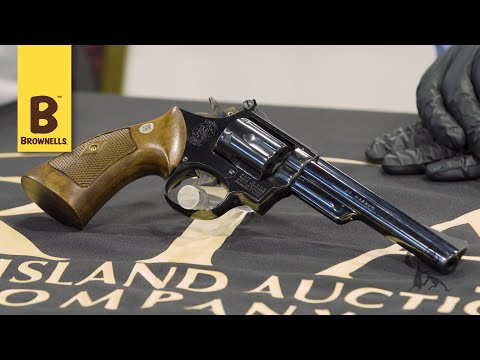
This video provides an in-depth look at the Smith & Wesson Model 53 revolver, chambered in the unique 22 Jet cartridge. The presenters highlight its dual firing pin system for both centerfire and rimfire ammunition, its K-frame platform, and its historical context in the early 1960s craze for high-velocity revolver rounds. The video notes the extreme loudness of the 22 Jet and advises mandatory hearing protection.
This video compares the 5.7x28mm and .22 Magnum cartridges, highlighting their differences in construction and performance. While the .22 Magnum is a rimfire round with lighter bullets, the 5.7x28mm is a centerfire, bottlenecked cartridge often using heavier bullets. Testing showed the 5.7x28mm achieved greater penetration in water jugs despite similar perceived recoil and muzzle flash.
This video, from NRA Publications, breaks down the four fundamental components of a centerfire cartridge: the bullet, propellant, case, and primer. Understanding these parts is crucial for selecting the correct ammunition for any firearm. The instructor emphasizes the distinction between a 'bullet' and a 'cartridge' and briefly touches on the ignition systems of centerfire versus rimfire cartridges.
This video provides an expert-level examination of the rare Barnekov Greene Prototype Carbine from 1870, presented by Ian McCollum of Forgotten Weapons. The analysis details its unique open-bolt, toggle-lock action, its participation in the 1872 US Army trials, and the design's eventual withdrawal due to mechanical and safety issues. The carbine's historical context and mechanical intricacies are thoroughly explained, highlighting its place as a significant, albeit unsuccessful, piece of firearm development.
Gun Laws by State
Read firearms regulations for all 50 states + D.C.
Find Gun Dealers
Search licensed FFL dealers near you.