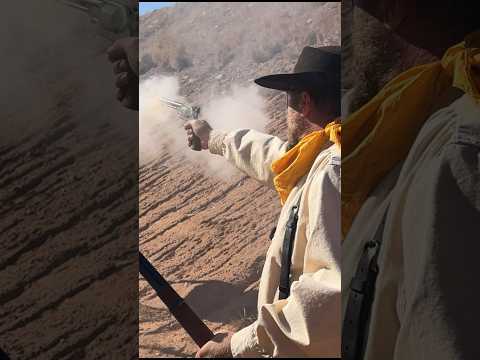
This guide details the basic loading and maintenance procedures for the Colt 1860 Army, a significant historical firearm. It covers essential steps for safe operation and upkeep, drawing on expert insights. The video emphasizes the historical context and design evolution of this iconic revolver, highlighting its role in bridging the percussion and cartridge eras.
This video provides a detailed close-up comparison between the Colt 1860 Army and the Remington New Model Army, both popular 44 caliber cap and ball revolvers. The presenter, Dustin from Guns of the West, discusses aesthetic preferences, mechanical differences like frame design and loading lever mechanisms, and practical considerations such as cylinder swapping and sight accuracy. While acknowledging the Colt's classic appeal, the video highlights several advantages of the Remington, particularly its superior sights and ease of use with paper cartridges.
This video clarifies the distinctions between the Colt 1861 Navy and 1860 Army revolvers. The primary differences lie in their historical calibers, with the Navy being .36 and the Army being .44. Other key identifiers include barrel length (7.5 inches for the Navy vs. 8 inches for the Army) and cylinder dimensions, which are stepped on the Army model to accommodate the larger caliber.
This video examines a German-made Clet & Grim revolver, a Continental European interpretation of Colt's iconic designs, likely based on the Colt Navy and Army models. The firearm features distinctive stylistic elements, including a unique grip, spurred trigger guard, and extensive foliate engraving with a central family crest. The presenter, firearms expert Jonathan Ferguson, discusses its construction, potential historical context, and the intriguing question of whether Clet & Grim faced patent infringement issues with Colt.
Dustin from Guns of the West clarifies the distinction between the Colt 1860 Army and 1861 Navy revolvers, addressing common confusion. Key differences highlighted include barrel length (8 inches for the Army vs. 7.5 inches for the Navy), grip size, and crucially, caliber (.44 for the Army and .36 for the Navy), which is visually evident in the cylinder's stepped design on the Army model.
This video provides an expert-level demonstration of several iconic firearms, including the Tokarev TT33, AK-103, Colt 1860 Army, SKS Type 56, Ruger MK II, Mosin M39, and Lithgow SMLE. The instructor, Misha, showcases safe handling, loading procedures with various calibers and ammunition types, and firing techniques at an outdoor range. The demonstration highlights specific firearm actions, capacities, and historical markings, offering valuable insights for firearm enthusiasts and those seeking to understand these historical and modern pieces.
This video provides an overview of various antique Colt firearms, presented by a firearms instructor who acknowledges his limited expertise in this specific area. He discusses models ranging from the Colt Paterson to later double-action and single-action models, highlighting key identifying features, historical context, and approximate market values. The presenter encourages viewer input to enhance collective knowledge about these historical firearms.
This guide outlines techniques for engaging targets in a Cowboy Action Shooting scenario, as demonstrated by Karl Kasarda. It covers rapid engagement with a lever-action rifle, transitions to a percussion revolver, and efficient use of a pump-action shotgun, emphasizing proficiency with historical firearms and black powder loads.
This YouTube video is titled 'Shooting the 1860 Army Revolver'. The description is currently unavailable. Based solely on the title, the video is expected to feature a demonstration or review of the Colt 1860 Army revolver, a historic single-action revolver. It will likely cover aspects of handling, firing, and potentially historical context or performance of this iconic firearm.
This guide details the process of loading and preparing a Colt 1860 Army reproduction revolver for firing, as demonstrated by Misha. It covers essential components like powder flasks, lead balls, and percussion caps, emphasizing a methodical approach to ensure safe and effective operation of this historical black powder firearm. The instruction highlights the use of specialized tools like a loading stand for consistency.
This guide details the black powder loading and priming process for a Colt 1860 Army reproduction, as demonstrated by an experienced presenter. It covers using a loading stand, measuring powder, seating lead balls, and applying percussion caps. The video emphasizes proper black powder handling techniques and the use of dedicated loading equipment.
This expert guide details the loading and firing technique for the Cimarron 1860 Richards Conversion revolver. It covers safe handling, proper loading of .45 Colt cartridges, aiming, and firing. The video highlights the historical significance and practical application of this unique firearm, emphasizing its ease of use compared to original percussion models.
Gun Laws by State
Read firearms regulations for all 50 states + D.C.
Find Gun Dealers
Search licensed FFL dealers near you.