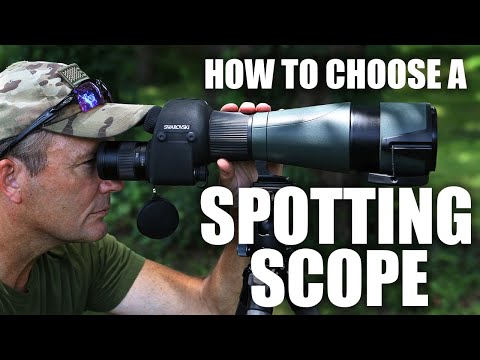
This video compares two popular compact spotting scopes for hunting: the Vortex Razor HD 2 (13-39x) and the Zeiss Conquest Appia Apia 65 (20-50x). It highlights considerations like magnification range, packability, weight, and budget, emphasizing that higher magnification is beneficial for long-range identification. The Zeiss offers higher magnification, while the Vortex is noted for being slightly more compact and lightweight.
This expert review from Brass Facts critically analyzes the Sightmark Strikon VMP 1-4x prism sight. While praising its excellent 1x performance, compact design, and value proposition around $500, the review highlights significant drawbacks. The magnification adjustment is described as 'clunky,' and the major dealbreaker is the exposed, non-locking turrets that can easily lose zero. The instructor recommends waiting for a potential future iteration that addresses these critical durability concerns.
This video reviews two older variable power optics: the Leupold MarkV MRT 2.5-8x36 and the Nightforce NXS 2.5-10x42. The reviewer highlights their historical context, particularly their use by military units, but criticizes their outdated features like second focal plane reticles, lack of locking turrets, and limited magnification ranges compared to modern optics. Despite good glass quality in some aspects, both are deemed "wacky" and "feature-poor" for their original price points.
This review examines the TPO KT 12-60x60 scope, a budget-friendly option offering extreme magnification. While the glass quality is noted as surprisingly good for its price point, with low chromatic aberration and good sharpness, significant compromises are made in other areas. The eyebox is exceptionally tight and unforgiving, especially at higher magnifications, and the turrets exhibit slop and a mushy feel, despite being resettable and locking. The illumination is not daylight bright but may suffice for twilight conditions. Overall, it's presented as a functional, albeit unrefined, high-magnification scope for those with a strict budget.
This YouTube video focuses on testing the durability and reliability of a $1500 rifle scope. The title implies a question about whether the scope can "hold its mark," suggesting a performance evaluation under potentially demanding conditions. The description likely elaborates on the testing methodology and the specific scope being reviewed.
This video from TENICOR aims to compare the quality of common optic glass. While the description heavily promotes TENICOR's social media and website, it doesn't specify which optics are being compared or any firearm models. The focus appears to be on evaluating the optical components themselves, which are crucial for aiming devices used with firearms.
This video provides an expert-level comparison between the Arken EP5 and Leupold Mark 4 rifle scopes, focusing on value and performance for long-range shooting. The host, with significant experience in optics and ballistics, details the trade-offs between budget-friendly options and premium features, offering practical insights for shooters seeking the best performance for their money.
This guide details how to select a spotting scope for tactical applications, emphasizing mission requirements over general use. Key considerations include objective lens diameter for light gathering, variable magnification for scanning and detail, field of view for situational awareness, and glass quality for critical observation. The instructor also discusses the importance of eyepiece design, focus knob precision for reading trace, and the utility of reticles for corrections and measurements.
This video provides an in-depth review of the Nightforce ATACR 4-16x42 riflescope, highlighting its features and why the speaker considers it a 'gold standard' for scope carbines. Key aspects discussed include exceptional glass quality (sharpness, clarity, chromatic aberration control), the importance of a smaller erector system for performance, and the optimal magnification range of 4-16x for various shooting applications. The review also touches on the MIL-XT reticle, zero stop functionality, and the optic's renowned durability, while acknowledging potential drawbacks like weight and size.
This video compares the Monstrum Panzer ($200) and Leupold Mark 5 ($2,000) rifle scopes. The Leupold Mark 5 is highlighted for its superior build quality, higher magnification potential, precise adjustments, and 50 BMG rating. While the Monstrum Panzer is noted as a capable budget option, it lacks the robustness and fine-tuning capabilities of the premium Leupold.
This YouTube video, titled "WTF is ED glass? And why does it matter?", appears to be an educational piece aimed at firearm enthusiasts. Leveraging the description's mention of @Monstrumtactical, #pewpew, and #riflescopes, the content likely delves into the specifics of ED (Extra-low Dispersion) glass in rifle scopes. The video probably explains what ED glass is, its benefits, and why it's an important consideration for users seeking improved optical clarity, color accuracy, and reduced chromatic aberration in their firearm optics. It's positioned as an informational guide rather than a direct product review or range test.
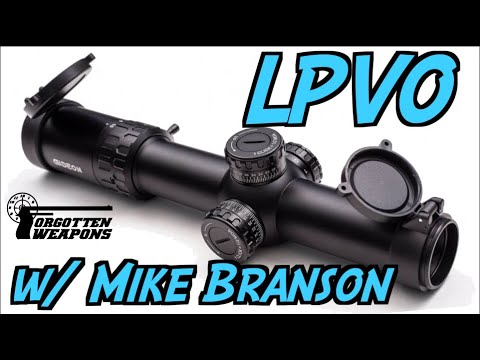
This guide synthesizes expert insights from Mike Branson of Gideon Optics and Ian McCollum on the factors driving the price differences in Low Power Variable Optics (LPVOS). It covers the impact of glass quality, manufacturing precision, and reticle illumination on cost, while also emphasizing the value of training over solely investing in expensive gear. The discussion highlights how modern budget optics offer performance exceeding historical standards.
Gun Laws by State
Read firearms regulations for all 50 states + D.C.
Find Gun Dealers
Search licensed FFL dealers near you.