Channel: @tcarmsco
This video reviews the Leupold Freedom line of scopes specifically designed for straight-wall hunting cartridges. It highlights the scope's ability to provide enhanced consistency and accuracy at extended ranges, a common challenge for straight-wall rounds. The review details the scope's advanced optical system, scratch-resistant lenses, and its key feature: three custom interchangeable turrets tailored for popular cartridges like the 350 Legend, 400 Legend, and 450 Bushmaster, allowing for precise dialing of distance.
This video details the significant investments Thompson Center Arms is making in its New Hampshire facility to revive the brand and enhance American manufacturing. It highlights the acquisition of advanced machinery, such as a $400,000 Eurotek profile lathe and chambering lathes, to improve barrel production efficiency and accuracy. The company is focused on bringing jobs back to the US and producing high-quality firearms.
This video details Thompson/Center's innovative CFTX carbon fiber barrel technology, which incorporates Avian's patented Composite Heat Release (CHR) system. Unlike traditional carbon fiber barrels that wrap a steel core, the CFTX barrel features ceramic injected between the steel core and the carbon fiber sleeve. This ceramic acts as a heat-wicking material, significantly reducing the steel core and chamber temperature, thereby preventing point-of-impact shifts during rapid firing or high-pressure cartridge use. The technology, originally developed for mini-guns, aims to maintain accuracy and performance under demanding conditions, offering a distinct advantage over standard carbon fiber barrel constructions.
This video from Thompson/Center Arms evaluates the effectiveness of five popular muzzleloader bullets for big game hunting. Lead instructor and SEO strategist, the presenter conducts accuracy tests at 100 yards and ballistic gel tests to assess penetration and expansion. Key factors considered include accuracy, ease of loading, and terminal performance, with specific bullet types like sabot and bore-size projectiles being compared. The analysis aims to provide hunters with data-driven guidance for selecting the optimal muzzleloader bullet for their needs.
This guide focuses on the critical mistake of instability in shooting, both during zeroing and in field conditions. It emphasizes using proper rests, bags, and body positioning to create a stable platform. Techniques for using bipods and advanced tripods are detailed, highlighting the importance of loading into the support system and supporting the rear of the rifle for enhanced accuracy at various distances.
This video from Thompson/Center Arms tests the lethality and accuracy of the .22 Long Rifle cartridge using their TCR-22 rifle. It defines lethality in different contexts, from stopping a bear to humanely dispatching small game. The TCR-22 is highlighted for its similarities to the Ruger 10/22, its bolt-stop feature, and its threaded barrel. The testing includes accuracy at 50 yards, penetration tests with an apple and gel block, and a comparison to the more powerful .22-250.
This video documents an intense turkey hunt in Missouri, showcasing the use of Thompson Center Arms shotguns in various gauges (.410, 20, and 12). The hunters, affiliated with NWTF and Mountain Ops, detail their strategies for locating and harvesting turkeys on 1,450 acres of prime hunting land. The content highlights the excitement and challenges of turkey hunting, including calling techniques, bird behavior, and the satisfaction of a successful hunt.
This video delves into the core attributes that define an ultimate rifle, focusing on barrel manufacturing, trigger design, and overall firearm design simplicity. It highlights the importance of precise barrel making, including the benefits of 5R rifling for reduced fouling and the critical role of concentricity. The discussion extends to trigger feel and consistency over mere weight, and the advantages of simpler, modular designs like the Thompson/Center Icon for accuracy and reliability. The content emphasizes Thompson/Center's innovative approach to firearm design, prioritizing performance and repeatability.
This video provides a two-year update on the relaunch of Thompson Center Arms after its acquisition. The speaker, reflecting on the challenges and successes, details the process of rebuilding manufacturing, supply chains, and brand identity. Key takeaways include the significant effort required to re-establish production, the importance of vertical integration, and the focus on rebuilding retailer relationships and customer experience to restore the brand's legacy.
This video showcases rare and historically significant firearms from Thompson/Center Arms, including the Seneca, TCR, AR-55, Benchmark, and the unreleased Mountain Light rifle. It highlights the company's manufacturing heritage, from in-house wood sourcing and casting to advanced design concepts like the TCR's toolless takedown and the Mountain Light's lightweight chassis system. The presenters emphasize the craftsmanship and engineering that defined Thompson-Center's legacy, noting that many of these models are no longer in production but remain highly sought after by collectors and enthusiasts.
This video provides an expert comparison between the classic Thompson/Center Contender (G1 and G2) and the modern Encore pistol platforms. It details historical context, design evolution, and key functional differences, particularly regarding hammer reset, caliber capabilities, and modularity. The discussion highlights the Contender's legacy in silhouette shooting and lighter calibers, contrasting it with the Encore's suitability for high-power handgun hunting and longer-range applications. The presenters, with clear expertise, emphasize the platform's interchangeability and the distinct roles each model fills in the firearms market.
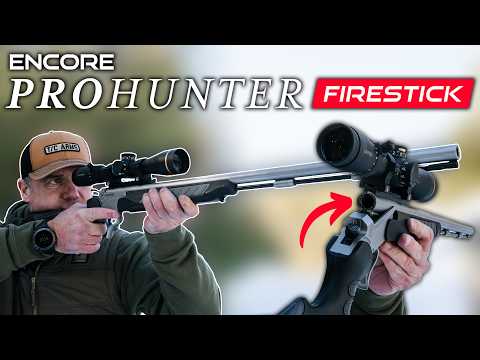
This guide details the process of replacing the standard bushing and firing pin assembly in a Thompson Center Encore receiver with the Fire Stick bushing kit. This modification is necessary to adapt the receiver for use with Federal's Fire Stick muzzleloader system, ensuring proper function and safety. The process involves careful disassembly of the original components and precise reassembly of the new Fire Stick-specific parts.