This video discusses a mass shooting incident in New York City that received minimal media attention, labeling it an 'invisible mass shooting.' The speaker argues that the media and political figures selectively cover gun violence events that fit a specific narrative to promote gun control, while ignoring incidents that contradict their agenda. The incident involved multiple shooters, numerous shell casings from 9mm and .45 caliber weapons, and resulted in fatalities and injuries, yet was largely absent from national news coverage.
This video critiques the perceived hypocrisy of gun control advocates and politicians regarding federalization of DC police. The speaker highlights how arguments used to restrict gun rights, such as public safety concerns and crime statistics, are selectively ignored or reinterpreted when applied to federal intervention in DC policing. The analysis focuses on the political reactions and stated justifications from figures like Jamie Raskin and Charles Allen, contrasting them with their previous stances on gun control and due process.
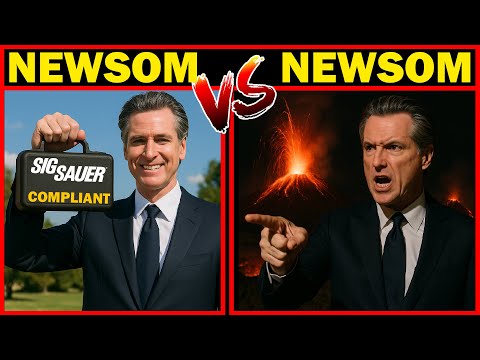
This video discusses the legal complexities surrounding California Governor Gavin Newsom receiving a P365X Macro handgun on air. It highlights that Newsom did not take the firearm home due to strict California laws, which would require a background check, firearms safety certificate, 10-day waiting period, and other compliance steps. The segment emphasizes the hypocrisy of a governor who champions gun control while potentially circumventing these regulations.
This video from Colion Noir critically examines the Hunter Biden gun trial, focusing on perceived hypocrisy in gun control narratives. Noir, an expert in gun laws and Second Amendment interpretations, argues that gun control laws are ineffective and often used for political leverage. He highlights a perceived double standard in how legal proceedings involving firearms are handled based on political affiliation, contrasting the treatment of Hunter Biden with that of Donald Trump's family. The video also touches on the suppression of gun-related content online and encourages viewers to engage in a 'cultural war' to protect Second Amendment rights.
This video critically examines the perceived hypocrisy of gun control advocates by contrasting their reactions to different shooting incidents. It highlights the lack of widespread calls for gun control following the deaths of four law enforcement officers in Charlotte, NC, where the perpetrator was a felon illegally possessing firearms, including an AR-15. The speaker argues this selective outrage undermines the gun control narrative, suggesting that when tragedies don't fit a pre-determined agenda, they are downplayed or ignored.
This video argues that gun control advocates exhibit hypocrisy by focusing on inanimate objects (firearms) as the cause of violence, while ignoring the human element and the legal regulation of other dangerous activities. It uses a tragic drunk driving incident that resulted in child fatalities as a parallel, highlighting that laws target the impaired driver, not the automobile or alcohol itself. The speaker, William Kirk of Washington Gun Law, suggests this selective focus on firearms is a form of civilian disarmament.
This video discusses the tragic mass shooting in Russia, highlighting the perceived hypocrisy of gun prohibitionists who remain silent on the event. It argues that Russia's strict gun laws did not prevent the attack, contrasting this with the US Second Amendment and the principle of an armed populace as a deterrent to evil. The speaker emphasizes that an armed citizenry is the most effective means of self-defense against mass violence.
This YouTube video, titled 'More Guns Than Fast Food?', discusses gun control and claims the creator's previous video on gun control hypocrisy was censored. The title and description strongly suggest a focus on firearms and political discourse surrounding gun rights. The content likely delves into the prevalence of firearms and arguments for or against gun control measures, potentially referencing specific firearm types or policies. The censorship claim indicates a controversial or opinionated stance on the topic.
The video discusses two main topics: the ATF's alleged 'entrapment' tactics regarding Form 1 silencer applications by asking about parts before tax stamp approval, and the perceived hypocrisy of anti-gun politician Jim Cooper being caught with a firearm at a TSA checkpoint. It also touches on legislative efforts for permitless carry in Indiana and Ohio, urging viewers to contact their representatives.
This reloaded episode of Tom Gresham's Gun Talk Radio, originally aired on September 24, 2017, delves into a variety of firearms-related topics. Host Tom Gresham discusses gun control hypocrisy, shares an anecdote about "the gun that got away," and covers the Hearing Protection Act. The program, which airs live Sundays and is available on numerous platforms, also features discussions on new products and gun politics. This episode is a collection of past content, as Tom is out hunting.
This episode of Tom Gresham's Gun Talk Radio, part A from September 24, 2017, tackles gun control hypocrisy and discusses the Hearing Protection Act. The show also touches on 'the gun that got away.' Gun Talk Radio is a nationally syndicated program covering a wide range of gun-centric topics, from new products to political discussions, and is available across multiple platforms including YouTube, streaming services, and radio.
You've reached the end! 11 videos loaded.
Gun Laws by State
Read firearms regulations for all 50 states + D.C.
Find Gun Dealers
Search licensed FFL dealers near you.