This video details a comprehensive ballistic testing of the Premier Body Armor Fortis Level III+ GT plate, a NIJ RF2 rated armor designed as a lightweight alternative to Level IV plates. The testing involves multiple rifle caliber threats at close range (25 feet) and extended distances (100 yards), evaluating penetration and back face deformation. The plate demonstrates impressive performance against common threats like 5.56x45mm and 7.62x39mm, while also showing its limitations against higher-level threats at longer ranges as expected.
This video investigates the common belief that gas-operated firearms lose velocity compared to bolt-action firearms due to gas diversion. The experiment uses a Tikka T1X MTR, first with the gas system engaged and then with it disabled, firing standard M80 ball ammunition. Results indicate a slight velocity increase and a significant reduction in extreme spread and standard deviation when the gas system is turned off, suggesting a potential impact on both velocity and shot consistency.
This video provides an in-depth look at the manufacturing and testing processes for composite body armor, specifically focusing on Hesco plates. It details the multi-step production from raw materials to finished product, including the use of polyethylene and ceramic components. The video also extensively covers NIJ certification standards, ballistic testing methodologies, and the importance of rigorous quality control to ensure reliable protection.
This video provides an expert assessment of the FN SCAR-17's reliability as a Designated Marksman Rifle (DMR). Lucas Botkin, drawing on over 6,000 rounds of experience, highlights the SCAR-17's consistent performance, contrasting it with other large-frame .308 gas-operated systems that have exhibited more frequent malfunctions. The review emphasizes practical application and real-world performance over theoretical precision.
This video demonstrates a live-fire test of the Filipino-made Government Arsenal 16" DMR at 500 meters. Colonel Harold Cabunoc, a former Army Colonel and Scout Ranger, showcases the rifle's capability with standard M80 Ball ammunition, achieving a 50% hit rate on both a 36x36 inch plate and a 16x20 inch man-sized target. The discussion highlights the importance of local defense manufacturing and the cost-effectiveness of the DMR compared to imported alternatives.
This YouTube Shorts video explores the use of clay boxes in testing body armor, specifically highlighting Predator Armor's lightweight, rifle-rated Level III plates. The description details the plates' construction from UHMWPE material, their low weight (3.5 lbs) and thickness (0.8"), and their multicurve design for comfort. The video emphasizes that the plates meet and exceed NIJ Level III standards, capable of stopping 7.62x51 (M80 Ball) and higher velocity 5.56mm rounds (M193). It also notes that the product is 100% made in the USA.
This video provides a comprehensive ballistic test of the RMA Armament 1165 Lightweight Level IV armor plate. The reviewer demonstrates the plate's performance against various threats, including armor-piercing 30-06, M80 ball, M193, 7.62x39, M855 green tip, and double-aught buckshot. The testing highlights the plate's ability to stop rounds even after significant compromise, emphasizing its lightweight design and affordability compared to previous models.
This guide breaks down the NIJ standards for body armor, explaining the capabilities of Level 3A, Level 3, Level 3+, and Level 4 armor. It clarifies what common handgun and rifle calibers each level is designed to stop, including specific ammunition types like M80 Ball, M855 Green Tip, and M2AP. The information is presented with an authoritative tone, drawing from the expertise of a GUNBROS representative knowledgeable in NIJ standards and specific ammunition designations.
This YouTube video from Predator Armor tests the effectiveness of their Level III lightweight UHMWPE body armor against M855 ammunition. The description highlights the plate's features, including its 3.5 lbs weight, 0.8" thickness, multicurve design for comfort and mobility, and its adherence to NIJ Level III standards. The plate is confirmed to stop M80 Ball and higher velocity 5.56 rounds. The video emphasizes that the product is 100% made in the USA and promotes Predator Armor's tactical gear for those prioritizing mobility.
This video from Predator Armor tests the ballistic resistance of their Level III Poly plate against 5.56x45mm rounds. The description highlights the plate's lightweight UHMWPE construction, weighing only 3.5 lbs and measuring 0.8" thick, with a multicurve design for comfort and mobility. It claims to meet and exceed NIJ Level III standards, capable of stopping M193 5.56 rounds and M80 Ball 7.62x51mm. The product is emphasized as 100% made in the USA.
This short video demonstrates the performance of a Level III lightweight body armor plate against 7.62x51 rounds. The plate, made from UHMWPE, weighs 3.5 lbs and is 0.8 inches thick, featuring a multicurve design for comfort and mobility. It is rated to meet and exceed NIJ Level III standards, capable of stopping 7.62x51 (M80 Ball) and 5.56 (M193) rounds. The product is available from Predator Armor and is 100% made in the USA.
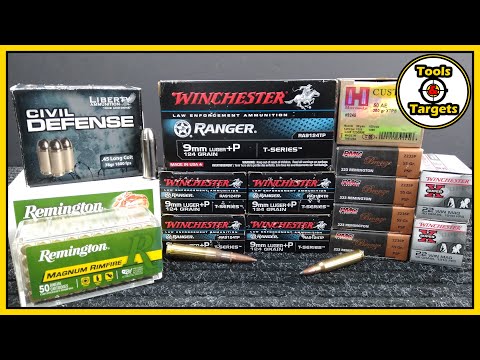
This video details an 'ammo hunt' haul, featuring various ammunition types acquired from Rural King and a local shop, along with an online order. The presenter discusses specific calibers like 50 AE, 223 Remington, 22 Magnum, 9mm Luger, 45 Colt, and 7.62x51mm, noting prices and availability. It highlights new test items, including PMC Bronze soft points, T-Series 9mm, and Liberty Ammunition's Civil Defense in 45 Colt, intended for future testing.
Gun Laws by State
Read firearms regulations for all 50 states + D.C.
Find Gun Dealers
Search licensed FFL dealers near you.