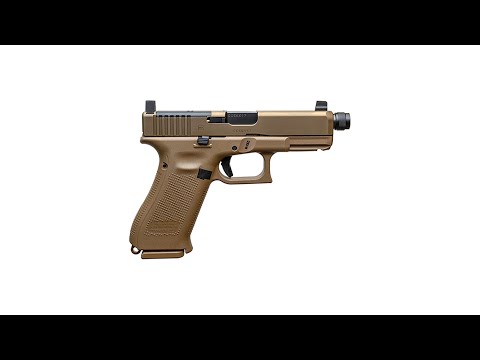
This video delves into the US Army's XM17 Modular Handgun Trials, explaining why the Glock 19X was ultimately passed over in favor of the Sig Sauer P320. The expert analysis highlights key requirements such as modularity, accuracy, and durability, contrasting the cost and design philosophies of both manufacturers. The speaker, demonstrating deep knowledge of military procurement and firearm technology, breaks down the technical specifications and decision-making process that led to the Sig Sauer adoption.
The US Army rejected the Glock 19X for the XM17 modular handgun trials primarily because it did not meet the 'modular handgun system' requirement. While Glock offered interchangeable slides and grips, it did not present a truly modular system where a single serialized component (like the trigger pack) could be reconfigured into different sizes. The Sig Sauer P320, with its removable trigger pack, fulfilled this requirement, allowing for a single firearm to be adapted to full-size, mid-size, and compact configurations with additional modules, making it more cost-effective for the Army's large procurement needs.
The Sig Sauer P320 is presented as a highly reliable, durable, and safe modular handgun system. It is highlighted as the ideal choice for military, law enforcement, and civilians due to its low failure rate and affordability. The video notes its adoption by the U.S. Air Force as the M18 MHS pistol.
This video details the supplemental inspection criteria for the Air Force M18 modular handgun system, prompted by a fatal accident. It outlines specific steps for inspecting the fire control unit, including checking for burrs and spurs on critical components like the captive safety lever and sear notch. The guidance emphasizes thorough field stripping, function checks, and reporting any findings within 48 hours, integrating these checks into all future M18 inspections.
This video critically analyzes SIG Sauer's response to ongoing P320 safety concerns and potential financial repercussions. The speaker predicts SIG's bankruptcy stemming from lost military contracts, citing a history of issues with various SIG models. The analysis focuses on SIG's public statements, which are characterized as gaslighting and lacking accountability, and contrasts their claims with documented safety concerns and agency contract changes.
The US Army rejected the Glock 19X for the XM17 modular handgun trials primarily because it did not meet the requirement for a modular handgun system. While Glock offered some modularity by allowing slide and grip swaps between models like the 17 and 19, it required purchasing multiple complete firearms. In contrast, the Sig P320's modularity was based on a removable trigger pack, allowing different grip sizes and slide lengths to be configured from a single firearm with additional components, making it a more cost-effective and compliant solution for the Army's needs.
The US Army rejected the Glock 19X for the XM7 Modular Handgun System trials primarily because it was not considered a true modular handgun system as required. While Glock offered a solution with interchangeable slides and grips, it necessitated purchasing multiple firearms to achieve different configurations, unlike the SIG P320's removable trigger pack design. This modularity, combined with cost considerations, led the Army to select the P320.
This review of Winchester Active Duty 9mm ammunition, often cited as similar to US Army issue, focuses on its performance characteristics. The testing highlights its high velocity and energy output, suggesting it's a potent round suitable for defensive applications or duty use where reliable cycling is paramount. While accuracy was not the primary focus, the ammunition demonstrated significant energy, potentially exceeding standard NATO specifications.
This expert guide, drawing from an authoritative instructor, details the Glock 45 (G45) as a potential 'Goldilocks Zone' firearm for various applications. It covers the G45's history, design advantages (G19 slide on G17 grip), and highlights a custom build featuring a Radian Ramjet/Afterburner, Trijicon RMR, and Glock Performance Trigger. The instructor emphasizes practical benefits like improved grip and the logistical advantages of Glock magazines.
This analysis delves into why the US Army selected the Sig Sauer P320 (M17/M18) over the Glock 19X for its Modular Handgun System (MHS) trials. Key factors included the P320's true modularity via a removable serialized trigger group, which offered significant cost savings and configuration flexibility, and its compliance with the requirement for a manual thumb safety. The Glock 19X, while a capable firearm, was deemed 'acceptable' rather than 'good' due to its lack of comparable modularity and the added cost of its trial-specific manual safety.
This video provides an expert overview of the Davidson's Exclusive Glock 19X MOS, highlighting its unique features such as the factory threaded barrel, Coyote Brown finish, and MOS system. The instructor details its design origins from the MHS trials, Gen 5 enhancements, and ergonomic advantages, making it a versatile option for various applications.
This video provides an in-depth look at the Sig Sauer P320, detailing its modular design, caliber versatility, and its selection for the US Army's XM17 program. It also addresses significant safety concerns and legal challenges related to early models, including drop-fire incidents and voluntary upgrade programs.
Gun Laws by State
Read firearms regulations for all 50 states + D.C.
Find Gun Dealers
Search licensed FFL dealers near you.