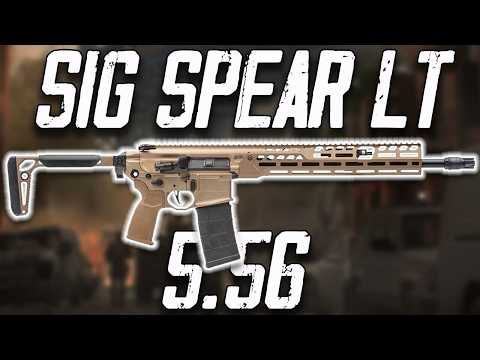
This video provides a detailed review of the SIG Sauer MCX Spear LT in 5.56 NATO, presented by Classic Firearms. John, an MCX enthusiast, discusses the rifle's lineage from the original MCX and Virtus, highlighting its evolution as part of the NGSW program. The review covers technical specifications, including its short-stroke piston system, cold hammer-forged 16-inch barrel with a 1:7 twist, and ambidextrous controls. The presenters emphasize the rifle's modularity, improved handguard design for heat management, and the quality of SIG's components, particularly the trigger and ergonomics.
This video explores the complexities of high-pressure and hybrid ammunition, featuring insights from ammunition designer Jesse (Boondock Battle Station). It debunks the notion of 'easy plug-and-play' performance gains, highlighting manufacturing challenges, potential weapon system degradation, and the need for redesigned components. The discussion emphasizes that current commercial high-pressure loads offer modest velocity increases, and the true potential lies in future weapon system development for smaller platforms.
The US military is transitioning to the 6.8x51mm (.277 Fury) cartridge, replacing the 5.56x45mm NATO round due to its superior lethality and range. This initiative, part of the Next Generation Squad Weapon (NGSW) program, introduces the Sig Sauer XM7 rifle and XM250 light machine gun, featuring advanced technologies like hybrid ammunition and integrated fire control systems. The new caliber aims to enhance soldier effectiveness against modern threats at extended distances.
This video analyzes Pete Hegseth's proposed DoD acquisition strategy, arguing it could negatively impact the firearms industry. The speaker, with experience in DoD and private industry, highlights concerns about prioritizing commercially available products over innovation, potential supply chain control by the DoD, and the risks of AI in procurement. The strategy's emphasis on rapid acquisition, similar to past programs like NGSW, is seen as a potential source of future problems and stifled innovation.
This analysis by Ian McCollum of Forgotten Weapons critically examines the US Army's adoption of the SIG Sauer M7 rifle and the 6.8x51mm caliber. McCollum, a recognized firearms expert, argues that the justifications for the NGSW program—extending engagement range and defeating advanced body armor—are flawed. He suggests that modern drone technology is a more effective solution for long-range threats and that advanced bullet design, rather than extreme pressure, is a better approach to armor penetration. The analysis highlights practical engagement limitations due to visibility and terrain, advocating for the role of the Designated Marksman over a universal heavy rifle. McCollum predicts the M7's adoption may be short-lived due to its inherent drawbacks.
This video details the US Army's adoption of the SIG Sauer XM7 rifle and the 6.8x51mm cartridge as a replacement for the M4A1. It highlights the cartridge's advanced hybrid case design, enabling higher pressures for increased range, retained energy, and armor penetration. The XM7 features integrated suppression, smart optic pairing, and a short-stroke piston system, aiming to enhance squad combat effectiveness against near-peer threats.
This video critically analyzes Shell Shock's NAS3 hybrid ammunition, questioning its 'next-generation' claims. While acknowledging potential benefits like weight reduction and increased velocity due to hybrid materials (nickel-plated aluminum alloy case head, nickel alloy stainless steel body for pistol calibers; steel for rifle calibers), the analysis highlights significant drawbacks. These include high cost, limited availability, questionable benefits for the average shooter, and potential safety concerns related to case head separation and barrel obstructions, particularly when compared to traditional brass or monolithic steel cases. The video suggests that while the technology is interesting, it faces substantial hurdles for widespread adoption in both commercial and military markets.
Professor Shane, a subject matter expert at Gun For Hire Range, discusses the U.S. military's transition from the M4 to the SIG XM7 (M7) rifle. He expresses skepticism regarding the platform change, highlighting concerns about increased recoil, reduced ammo capacity due to heavier 6.8x51mm rounds, and significantly decreased barrel longevity compared to 5.56x45mm NATO platforms. While acknowledging the 6.8mm cartridge's effectiveness in the M250 machine gun, he questions its suitability for the M7 rifle, suggesting that higher hit probability is achieved through greater ammunition availability rather than a higher-pressure round with a shorter barrel life.
This comprehensive review of the Sig Sauer XM7 (MCX Spear) by Brass Facts, an expert with extensive field use, critically analyzes its performance and the broader Next Generation Squad Weapon (NGSW) program. The analysis highlights significant issues with the rifle's handguard design, accuracy, recoil, and the logistical challenges posed by the heavy 6.8x51mm ammunition, ultimately deeming it unsuitable for general infantry roles despite the potential of the caliber concept.
The US Army has officially adopted the 6.8x51mm cartridge, also known as 277 Sig Fury, as its new standard for frontline combat, replacing the 5.56x45mm NATO and 7.62x51mm NATO. This new caliber offers significantly greater range, energy, and armor penetration capabilities, addressing the limitations of legacy rounds against modern threats like advanced body armor and peer-level adversaries. The adoption is part of the Next Generation Squad Weapon (NGSW) program, which includes new weapon platforms like the M7 rifle and M250 automatic rifle, and advanced optics like the XM157 fire control system, all designed to work in concert.
This video details the extensive history and evolution of SIG Sauer's MCX (Mission Configurable Weapon System) program, from its origins influenced by the MP5 SD to its advanced iterations like the Spear LT and Spear. It covers various calibers, barrel lengths, and specialized variants developed for military and special operations units, emphasizing modularity, suppression, and performance improvements across generations. The discussion highlights key programs like LVAW and NGSW, showcasing SIG's commitment to innovation in the tactical firearm space.
This video analyzes the U.S. Army's new M7 rifle, addressing troop feedback and comparing it to legacy platforms. It delves into the Next Generation Squad Weapon program's goals, the trade-offs in ammunition capacity and weight, and the advanced features of the M7's optic and suppressor. Expert insights highlight historical parallels in rifle transitions and potential ergonomic concerns with the new system.
Gun Laws by State
Read firearms regulations for all 50 states + D.C.
Find Gun Dealers
Search licensed FFL dealers near you.