Bill Osborne, developer of the Third Bay Ounce folding pistol, explains the rationale behind choosing .22LR over .22 Magnum or 9mm. He emphasizes a design philosophy of starting small and scaling up, prioritizing safety during development. The Ounce pistol is presented as a compact option suitable for concealed carry.
Colion Noir provides an expert analysis of the FN Five-seveN and its development, stemming from NATO's requirements for a new round. The video details the 5.7x28mm cartridge's advantages over 9mm in terms of trajectory, recoil, and armor penetration, highlighting its origins with the FN P90 and subsequent adaptation into the Five-seveN pistol. Noir's commentary emphasizes the historical context and the unique characteristics that made these firearms notable.
This video from Forgotten Weapons details the early development of the MAC 1950 French service pistol. It highlights the evolution from the Type SE MAS 1948 trials prototype to the familiar production Model 1950, focusing on changes in grips, safety mechanisms, and magazine design. The expert instruction clearly illustrates the functional differences between early internal safeties and the later, more user-friendly external safety.
This expert-level overview from Ian McCollum of Forgotten Weapons details the developmental Roth Steyr 1904 and 1906 pistols, precursors to the adopted Model 1907. It highlights key evolutionary changes, technical mechanisms like the half-cock striker, and historical context within Austro-Hungarian military trials, offering insights valuable to advanced firearms enthusiasts and historians.
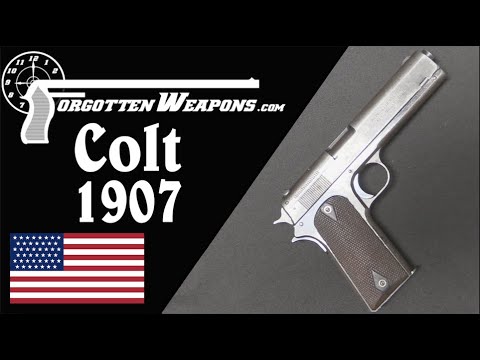
This video from Forgotten Weapons, hosted by Ian McCollum, provides an in-depth look at the Colt Model 1907, a crucial prototype in the development of the M1911 pistol. McCollum, a recognized expert in historical firearms, details the pistol's design evolution, its participation in demanding US Army trials, and the reasons for its eventual obsolescence despite its significance. The entry highlights the technical specifications, historical context, and the pistol's status as a rare collector's item.
This video details the extensive development of the Hudson H9 pistol, showcasing four key prototypes from initial concepts ('The Brick') to the final production model. It highlights significant design challenges, including achieving a low bore axis, trigger mechanism iterations, and magazine reliability. The discussion emphasizes the evolution of locking lug designs and the modular chassis system.
This video provides an expert-level look at the rare Colt 1909, a crucial developmental pistol preceding the iconic 1911. Ian from Forgotten Weapons details its unique double swinging link action, vertical ejection, and heel magazine release, contrasting it with its predecessors and successors like the Colt 1905 and 1911 A1. The guide covers disassembly and highlights key evolutionary differences in safeties, extractors, and frame design, emphasizing the 1909's rarity with only 23 examples produced.
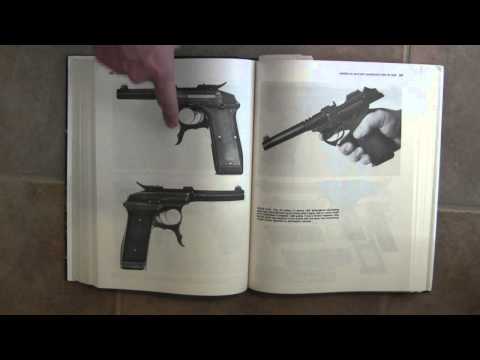
This video reviews Edward Ezell's 'Handguns of the World,' highlighting its depth as an encyclopedia of handgun development rather than a superficial coffee table book. The book details the evolutionary processes behind iconic firearms like the Colt 1911 and covers a vast range of historical handguns, including revolvers and automatics, organized by country and manufacturer. It's recommended as a comprehensive reference for firearm history enthusiasts.
You've reached the end! 8 videos loaded.
Gun Laws by State
Read firearms regulations for all 50 states + D.C.
Find Gun Dealers
Search licensed FFL dealers near you.