The Supreme Court's 6-3 ruling in New York State Rifle and Pistol Association v. Bruen fundamentally altered concealed carry laws by rejecting the 'proper cause' requirement. This decision mandates that firearm restrictions must be rooted in the nation's historical tradition, effectively invalidating discretionary permitting systems. States have responded by enacting new laws, leading to ongoing legal challenges and a complex landscape for gun owners.
This video provides an expert analysis of the Supreme Court's Bruen decision and its profound impact on concealed carry laws across the United States. It details how the ruling overturned the 'proper cause' requirement, particularly in New York, and discusses the subsequent legislative responses from various states. The analysis highlights the shift to a 'text and history' legal standard for firearm restrictions and explores the ongoing legal challenges and the evolving landscape of gun rights.
This expert-level analysis details the Supreme Court's landmark 6-3 ruling in NYSRPA v. Bruen, which fundamentally altered concealed carry laws by striking down 'proper cause' requirements. The ruling mandates that restrictions on carrying firearms in public must be rooted in the nation's historical tradition. The video explores the immediate impact, including state-level legislative 'retaliation' and ongoing legal battles challenging new restrictions.
This video analyzes recent Supreme Court decisions and their impact on Second Amendment rights, focusing on New York's concealed carry laws, proper cause requirements, and ammunition background checks. It discusses how the Bruen decision has altered legal standards for gun control legislation and highlights ongoing legal challenges to various firearm regulations across different states. The content also touches upon the Protection of Lawful Commerce in Arms Act (PLCAA) and its implications for holding manufacturers liable.
The Supreme Court has denied reconsideration of a case challenging New York City's concealed carry permit restrictions. The case, Baldia v. City of New York, involved a petitioner who was denied an unrestricted license despite being a sworn police officer. This decision suggests the Court may be waiting for cases more thoroughly briefed under the Bruen standard, indicating a potentially slow pace for future Second Amendment rulings.
This video discusses the Supreme Court case Baldia v. City of New York, which challenges New York's old 'proper cause' standard for concealed carry permits. The case originated from a permit denial for an individual who later became a police officer. The speaker, Anthony Miranda, a California attorney specializing in Second Amendment rights, explains how this case is a carryover from the pre-Bruin decision era and how the new Concealed Carry Improvement Act (CCIA) might affect its review. The New York Licensing Division argues the case is moot due to the new laws and that the Law Enforcement Officers Safety Act (LEOSA) was not properly raised.
This video, presented by Anthony Miranda, a licensed attorney and staff attorney with the Firearms Policy Coalition, discusses the Baldi v. City of New York concealed carry case before the Supreme Court. It analyzes the historical 'proper cause' standard for concealed carry permits in New York, the Supreme Court's decision in NYSRPA v. Bruin which struck down such standards, and the subsequent legislative changes in New York with the CCIA. The discussion focuses on whether the Supreme Court will reconsider the Baldi case in light of Bruin, particularly concerning a police officer's denied renewal for an unrestricted concealed carry permit.
This video from Armed Scholar details the legal challenge against New York's Concealed Carry Improvement Act (CCIA), which was passed in defiance of the Supreme Court's Bruen decision. The CCIA replaces the 'proper cause' requirement with a subjective 'good moral character' standard and expands 'sensitive places' where carrying is prohibited. A preliminary injunction hearing was held to determine if the law's enforcement will be halted before its September 1st effective date. The discussion highlights the ongoing legal battle over Second Amendment rights in New York.
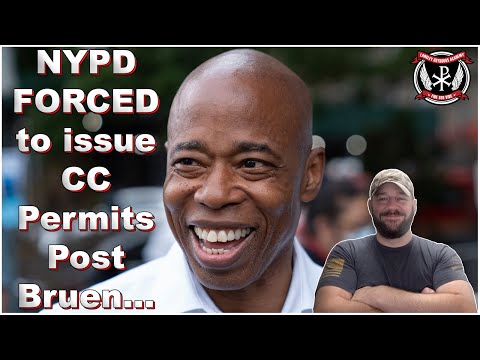
Following the Supreme Court's Bruen decision, the NYPD has been compelled to re-evaluate previously denied concealed carry permit applications. Applicants whose permits were denied before the Bruen ruling now have a 60-day window, until October 18th, to reapply without fees. This action is a direct response to the Supreme Court's mandate, forcing the NYPD to comply despite state legislative efforts to restrict carry rights.
This discussion focuses on the legal ramifications and ongoing litigation following the Supreme Court's Bruin decision. Alan Gottlieb of the Second Amendment Foundation outlines the strategic approach to challenging various state-level gun control measures, including 'may issue' permitting schemes, 'sensitive places' designations, and restrictions on non-resident carry. The conversation highlights the importance of historical legal precedent and the coordinated efforts of approximately 40 attorneys working to defend Second Amendment rights.
This video analyzes the Supreme Court's decision in New York State Rifle & Pistol Association v. Bruen, critiquing arguments that the ruling prioritizes conservative ideology over 'common sense.' It highlights the court's stance against requiring individuals to demonstrate a special need to exercise their Second Amendment rights, contrasting it with the dissent's focus on the potential for unconstitutional enforcement of New York's 'proper cause' requirement for concealed carry permits.
The Supreme Court's Bruen decision has been a monumental victory for gun rights, striking down 'proper cause' requirements for concealed carry permits. This ruling effectively shifts states from 'may issue' to 'shall issue' systems, meaning individuals can no longer be denied permits based on a subjective assessment of their need. While states can still implement training and background checks, the core barrier of proving specific threats has been removed, fundamentally altering how citizens can exercise their Second Amendment rights in public.
Gun Laws by State
Read firearms regulations for all 50 states + D.C.
Find Gun Dealers
Search licensed FFL dealers near you.