This video analyzes a rare defensive knife use during an armed robbery in the Dominican Republic. The defender, John Korea, and co-host Neil Widner discuss the importance of situational awareness, the challenges of using a knife against a firearm due to range limitations, and the psychological aspects of deploying such a weapon. They emphasize that while the defender was successful, the outcome relied on several factors, including the attacker's hesitation and potentially a non-functional firearm, highlighting the inherent risks of using a knife as a primary defensive tool.
This video demonstrates a critical self-defense technique employed during an active shooter event at the Dennis M. Lynch Arena. The individual heard 'pop pop' sounds, identified a gun, and immediately instructed his wife and friends to flee. He then engaged the assailant, grabbing the firearm with his left hand and using his body to cover the weapon, preventing the trigger from being pulled even when his hand got caught in the chamber. The narrative highlights the importance of situational awareness, quick decision-making, and physical intervention to neutralize a deadly threat.
This guide details techniques for using a reverse edge blade in entangled fighting scenarios, as explained by combatives expert Craig Douglas. It covers drawing and cutting from a clinch, targeting vulnerable areas, and generating force even when pinned, emphasizing the integration of wrestling mechanics with blade work. The ShivWorks philosophy of adapting grappling for knife effectiveness is central to these advanced self-defense applications.
This video, featuring Nikko Ortiz, a self-identified veteran, offers tactical advice on self-defense, particularly against carjacking attempts. Ortiz demonstrates a wrist-lock technique intended to disrupt an assailant and potentially provide legal defense. The content also touches on broader themes of public accountability, intervention in assaults, and appropriate conduct, even among veterans.
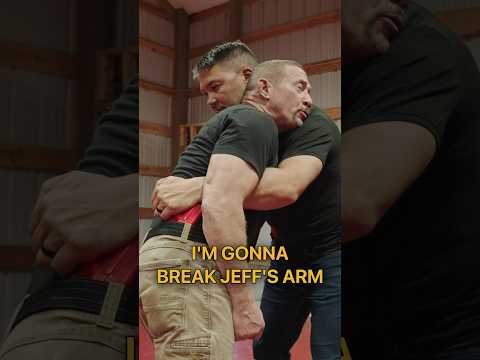
This instructional video demonstrates the 'elbow pin' technique for defending against a gun grab. The instructor emphasizes connecting the hand, gun, and hip to prevent weapon loss. The technique involves using body mechanics, including level changing and hip loading, to break the assailant's arm if necessary. The demonstration utilizes a Tenicor holster and a training pistol.
This video explores the leather sap (also known as a blackjack) as a potential self-defense weapon. Instructor Jason Hanson, a former CI officer, details its historical use, legality in certain states, and practical application. He emphasizes that it should only be used in life-or-death situations and demonstrates its effectiveness on various objects, highlighting its ease of concealment and use for individuals uncomfortable carrying firearms or knives.
This video demonstrates a self-defense scenario where an individual uses a two-handed push to neutralize an attacker wielding a bottle. Nikko Ortiz, with high authority in the tactical community, provides commentary on the minimal force used, highlighting the difference between incapacitation and de-escalation. The analysis focuses on the effective application of force to resolve a physical confrontation.
This video from Geauga Firearms Academy focuses on the defensive firearm draw, emphasizing situational awareness and weapon retention over pure speed. Instructor Neil explains that in real-world self-defense, de-escalation and creating space are paramount. The draw technique prioritizes keeping the firearm close to the body for retention, especially against close threats or multiple assailants, and involves a deliberate 'L' formation before presenting the weapon. The instruction covers both Outside the Waistband (OWB) and Inside the Waistband (IWB) draws, highlighting the importance of the support hand in clearing garments and maintaining control.
This video details a specific self-defense technique for extreme close-quarters combat, as explained by a former CIA officer. The primary recommendation is a rapid headbutt to the aggressor's nose, utilizing the top of the head to create space and inflict damage without telegraphing the move. This is followed by transitioning to offensive strikes.
This video explains the 'straight blast' technique, popularized by Bruce Lee, as an effective method to stop an attacker. The core principle is continuous, overwhelming strikes to prevent the assailant from recovering, emphasizing aggression and forward momentum. The instructor, a former CIA officer, advocates for this technique in self-defense scenarios where life is at risk.
This video showcases room clearing techniques inspired by Navy SEALs, focusing on tactical movement and defensive strategies. The title highlights themes of safety, home defense, and self-defense, suggesting a practical demonstration of tactical skills for personal security. The content appears to be instructional in nature, aiming to educate viewers on effective methods for securing a space.
This video discusses the 'finger whip' as a self-defense technique, concluding it's not a standalone incapacitation move. Instead, it's presented as a distraction to create an opening for more effective follow-up strikes like rapid punches or the 'straight blast' to neutralize a threat. The emphasis is on using the finger whip to make an attacker cover their eyes, allowing for a decisive offensive action.
Gun Laws by State
Read firearms regulations for all 50 states + D.C.
Find Gun Dealers
Search licensed FFL dealers near you.