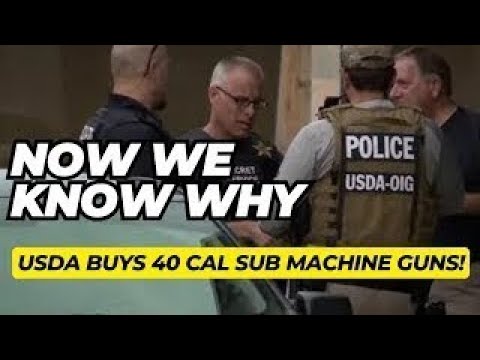
This video discusses the controversial arming of the USDA with .40 caliber submachine guns. It explores the historical context of USDA's armed abilities, dating back to 1981, and the expansion of such powers to other federal agencies under the 2002 Homeland Security Act. The USDA cites self-protection against farm fraud, theft, bribery, smuggling, and threats of violence as justification, referencing instances of armed raids on farms.
This video discusses the controversial arming of the USDA with 40 caliber submachine guns. The speaker questions the necessity of such weaponry for a department primarily focused on food safety inspections, citing the USDA's stated reasons of self-protection against farm fraud, theft, bribery, smuggling, and threats of violence. The video highlights instances of armed raids on farms and food production facilities, suggesting that the USDA's justification for acquiring these firearms may be disproportionate to the actual threats faced.
This video questions the USDA's decision to acquire .40 S&W submachine guns, given their typical role in agricultural oversight like dairy and meat production. The creator aims to explain the reasoning behind this seemingly unusual move, starting with a basic overview of the USDA's functions. The video encourages viewer engagement through likes and subscriptions to reach a goal of 500,000 subscribers.
This video critically examines the USDA's acquisition of .40 Caliber Submachine Guns, questioning the necessity and justification for such militarization. The speaker, an established commentator on firearms policy, highlights historical context, controversial raids, and questions the agency's self-defense claims based on USDA data. The analysis suggests a pattern of government overreach and inter-agency reliance, rather than independent need for extensive armaments.
This video critically examines the USDA's acquisition of .40 caliber submachine guns, questioning the necessity of such weaponry for an agency primarily focused on food safety. The speaker, drawing on historical legislation and incident reports, highlights concerns about the increasing militarization of federal administrative branches. The analysis suggests the purchase may be disproportionate to the actual threats faced by the agency.
The video discusses the US Census Bureau's new request for ammunition manufacturers and distributors to report sales data, including volume, destination, and purchasers. This action is framed as an unprecedented move by the federal government to track ammunition sales, potentially impacting Second Amendment rights. The speaker also notes the significant ammunition purchases by non-military federal agencies like the IRS and USDA, suggesting a broader context of government preparation for domestic use.
This video discusses the trend of federal agencies stockpiling firearms and ammunition, citing specific examples like the IRS and USDA. It highlights the large number of armed federal agents in the US and suggests that this practice, while common, warrants increased attention from citizens regarding personal preparedness and firearm ownership.
This video discusses the recent acquisition of 40 caliber submachine guns by the USDA, alongside significant ammunition purchases by other federal agencies like the IRS and Railroad Retirement Board. It explores the legal basis for these agencies to arm themselves, stemming from a 1978 law that empowered Inspector General special agents to act as federal officers with arrest and firearm authority. The speaker questions the scale of ammunition purchases, particularly hollow-point rounds, suggesting it exceeds typical operational needs.
This video discusses the USDA's new "GMO" labeling rules, explaining what viewers need to know about them. The content appears to be informational, with the creator emphasizing the importance of this topic. The description includes affiliate links for survival food, Amazon products, precious metals, a membership club, and solar generators, as well as personal and business email addresses. A disclaimer clarifies that the content is based on personal opinion and not professional advice. The creator also provides a link to a Washington Post article for further reading.
This video, presented by Alaska Prepper, discusses the shelf-stability of food based on USDA guidelines. It aims to educate viewers on which foods remain safe to consume well past their 'best by' dates, encouraging them to avoid unnecessary food waste. The content touches upon long-term food storage and preparedness, with links to various survival food brands and preparedness resources, including a USDA link for further information. While the channel name suggests a focus on preparedness, the specific video content is about food safety and waste reduction, not firearms.
This video provides expert guidance on understanding canned food longevity and safety, drawing on USDA recommendations and practical inspection techniques. It emphasizes that 'best by' dates relate to quality, not safety, for hermetically sealed products, and details factors affecting shelf life like acidity and storage temperature. The host, from SensiblePrepper, offers practical advice on inspecting cans for damage and implementing food rotation for optimal nutritional value in long-term storage scenarios.
You've reached the end! 11 videos loaded.
Gun Laws by State
Read firearms regulations for all 50 states + D.C.
Find Gun Dealers
Search licensed FFL dealers near you.