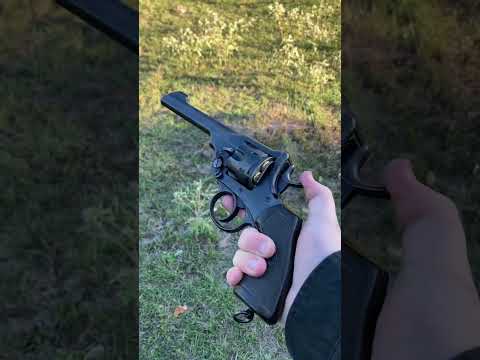
This video focuses on the Webley .22 Target Model Mk IV Revolver, a historical firearm. Leveraging information from the title and description, the tags highlight the specific firearm model, its caliber, the manufacturer, and related general firearm categories. It appears to be an informational or review-style video for firearm enthusiasts interested in vintage revolvers.
This YouTube Shorts video provides a brief review of the Webley & Scott Rascal .410 shotgun. It highlights its suitability for vermin control and general shooting enjoyment. The description also promotes subscribing to their Shotgun and Air Gun Centre channels and provides contact information for Premier Guns.
This video tests Steinel's .45 ACP ammunition, specifically loaded to lower .455 Webley pressures, in a standard 1911 pistol. The experiment confirms that these reduced-pressure rounds possess sufficient energy to reliably cycle the 1911's action, with the slide locking back on an empty magazine. This demonstrates the viability of using such ammunition in 1911s that might otherwise be damaged by standard .45 ACP loads.
This video showcases a rare Rigby-Webley .577 Nitro Express rifle, a piece of best English firearm craftsmanship. It highlights the rifle's falling block action by Webley & Scott, noted for its compact and handy design suitable for big game encounters. The description details the rifle's quality features, including a figured stock, fine checkering, restrained engraving, and superb craftsmanship. The video also touches upon the .577 Express cartridge's ballistics and the smooth operation of the Webley action. It emphasizes the rarity of this Model 1902 falling-block action produced for Rigby, suggesting it might have influenced Bill Ruger's design of the Ruger No. 1.
This review covers the Webley Mk VI .455 revolver, highlighting its historical significance and operational features. The demonstration showcases the top-break action, manual loading of six .455 Webley rounds, and live-fire performance using both single and double-action trigger pulls. The video emphasizes the automatic extraction and ejection system, a key characteristic of this classic British military sidearm.
This YouTube video, titled "Anvil 016: Webley revolver cylinder maintenance," focuses on the recovery of a Webley revolver cylinder, presented as a "SIMPLE" process from the "Anvil pantheon." The description emphasizes that the content is intended for viewers with existing high-level skills and explicitly warns against attempting the procedure without the necessary expertise, rather than serving as a direct tutorial. It also includes a Patreon link for support.
This YouTube video, the second part of a series, features a shooter firing a Webley Mk. IV revolver manufactured in 1943. It includes a link to the first part of the video and a Patreon link for the creator. The video highlights the historical British revolver in action, with the shooting itself being a primary focus.
This video offers a detailed study of the Webley/Fosbery semi-automatic revolver's unique recoil-action and its ejection sequence. It aims to visually illustrate the mechanics of this historical firearm, providing insights into its operation. The description also mentions a call to action for supporting the creators on Patreon.
This video is a compilation from a recent filming event at Anvil, showcasing a variety of historical and modern firearms. Featured pieces include the Vetterli 41 centerfire conversion, a Mateba 6 Unica revolver, a Ferguson breechloading flintlock, an 1820 great coat pistol, and the unique Webley/Fosbery automatic revolver. The content appears to be a behind-the-scenes look or highlights reel from a larger production, with a mention of a range session involving IV8888.
This video features a "camera test and sound check" of a Webley/Fosbery firearm. The description highlights it as a "great shooting piece of hardware" and indicates the video is in its filming stage, not yet edited. Support for the creator is encouraged via Patreon.
This YouTube video focuses on the Webley Mk. IV revolver, specifically a model manufactured in 1943. The description provides a link to a second part of the video, suggesting a more in-depth exploration of the firearm. Given the title and description, the content is expected to delve into the history, features, and potentially the performance of this classic revolver.
This video focuses on the Webley & Scott 700 Series firearms. While no specific model or caliber is mentioned in the provided data, the title strongly suggests a review, overview, or discussion of this particular line of firearms from Webley & Scott. The content is expected to appeal to enthusiasts interested in this brand or specific firearm models within the 700 Series. The analysis is based solely on the title and description.
Gun Laws by State
Read firearms regulations for all 50 states + D.C.
Find Gun Dealers
Search licensed FFL dealers near you.