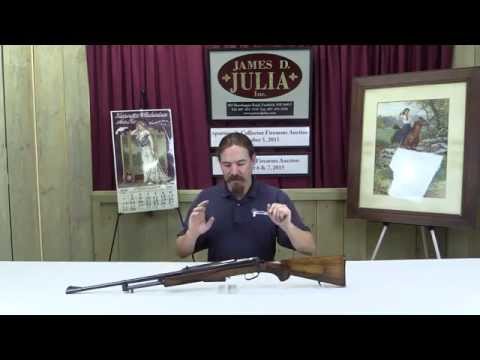
This video examines a Japanese copy of the ZH-29 rifle, manufactured by Tokyo Gas & Electric. Key features include a non-reciprocating bolt handle, a unique bolt release mechanism activated by pulling the trigger twice, and an enclosed lower receiver. The rifle is chambered in 6.5 Japanese, and its proprietary magazine is not interchangeable with standard ZH-29 magazines. The side-tilting bolt design necessitates an offset for the sights to compensate for barrel alignment.
This YouTube video focuses on the ZH-29 rifle, exploring its malfunctions in slow motion. The content is likely to appeal to enthusiasts interested in historical firearms, firearm mechanics, and the engineering behind weapon systems. The emphasis on malfunctions and slow-motion analysis suggests a technical and observational approach to understanding the firearm's behavior under stress.
This video explores five influential Czech firearms, presented chronologically by Ian McCollum of Forgotten Weapons and James Reeves. The discussion covers iconic models like the VZ 24, ZH-29, ZB-26 (precursor to the Bren), VZ 52, and the highly regarded CZ 75 pistol, concluding with modern iterations like the Bren 2 and Bren 3. McCollum's deep historical and technical expertise provides significant insight into each firearm's design, production, and impact.
This video provides an in-depth, slow-motion analysis of malfunctions in rare and exotic firearms, presented by Ian McCollum of Forgotten Weapons. The expert guide details issues like short cycling, case head separation, and feed failures, offering insights into design flaws and potential causes. It's a valuable resource for advanced firearm enthusiasts interested in the mechanical intricacies and reliability challenges of historical and custom weapons.
This Q&A session with Ian McCollum of Forgotten Weapons delves into various firearms topics, including the adoption of the Besa machine gun, the potential of the ACR, and the innovation of smaller nations like Czechoslovakia and Finland. McCollum also discusses historical manufacturing limitations, interesting mechanical systems, and the challenges of digital book piracy.
This video provides an expert review of the final prices achieved at the James D. Julia Spring 2017 firearms auction, presented by Ian McCollum. It details the sale prices of numerous rare and collectible firearms, including the American 180, various Enfield variants, and high-value sniper rifles, offering insights into their market performance and provenance.
This guide details the shooting technique for the Czech ZH-29 rifle, as demonstrated by Ian McCollum of Forgotten Weapons. It covers the unique manual of arms, including the two-stage trigger operation for chambering a round, managing the 8mm Mauser recoil, and addressing potential cycling issues. The guide also highlights the rifle's offset sights due to its side-tilting bolt mechanism.
This entry details the differences between the Ethiopian ZH-29 and the Czech experimental Z-37 rifles, as presented by Ian McCollum. Key distinctions include safety location, bolt handle design, front sight, bayonet lug, and barrel profile. The video also highlights unique Ethiopian contract markings on the ZH-29 and compares its magazines to those of the ZB-26 light machine gun.
This guide details the field stripping process for the rare Japanese ZH-29 copy, manufactured by Tokyo Gas & Electric. The process, demonstrated by Ian McCollum, involves a simple two-pin system for disassembly. It highlights the internal gas-operated mechanism with a side-tilting bolt, crucial for understanding its function and potential maintenance needs.
This guide details the field stripping process for the rare Holek Automat, a Czech sporting rifle designed by Emanuel Holek. The process is simplified by removing a single rear pin to separate the receiver assemblies, allowing access to the internal components like the bolt carrier and gas system. Expert Ian McCollum demonstrates this procedure, highlighting its mechanical similarities to other notable Czech firearms.
This guide details the disassembly of the Czech ZH-29 semi-automatic rifle, focusing on its unique gas-operated, tilting bolt mechanism and the process for adjusting headspace. Expert instruction from Ian McCollum highlights the rifle's historical significance and intricate mechanical design, emphasizing the importance of proper maintenance for longevity.
You've reached the end! 11 videos loaded.
Gun Laws by State
Read firearms regulations for all 50 states + D.C.
Find Gun Dealers
Search licensed FFL dealers near you.