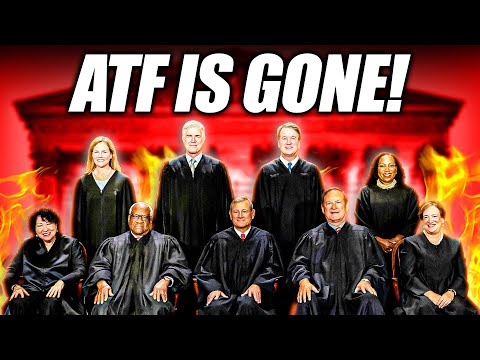
How a Court Just Threw Out ATF's Rule on Frames and Receivers. HUGE WIN!!!!

A Texas court has vacated the ATF's rule on frames and receivers, specifically targeting '80% lowers' and unfinished firearm components. The ruling in VanDerStock v. Garland, spearheaded by the Firearms Policy Coalition, found the ATF exceeded its statutory authority under the Gun Control Act of 1968 by attempting to regulate parts that could be 'readily converted'. This decision has significant implications for other ATF regulations.

Quick Summary

A Texas court vacated the ATF's rule on frames and receivers (ATF Rule 2021R-05F) in the VanDerStock v. Garland case. The court ruled the ATF exceeded its statutory authority under the Gun Control Act of 1968 by attempting to regulate unfinished firearm components like '80% lowers'.

Chapters

  1. 00:00Introduction: ATF Rule Vacated
  2. 01:10VanDerStock v. Garland Case Details
  3. 02:50Court's Reasoning: Statutory Authority
  4. 04:14Redefining Frames and Receivers
  5. 05:44APA Violations
  6. 07:25Two Grounds for Ruling
  7. 09:32Broader Implications for ATF Rules
  8. 11:12Definition of Vacatur & Conclusion

Frequently Asked Questions

What was the outcome of the VanDerStock v. Garland case regarding ATF rules?

The court in VanDerStock v. Garland issued a summary judgment and vacatur, throwing out the ATF's rule (2021R-05F) that attempted to regulate unfinished frames or '80% lowers' as frames or receivers. This means the rule is considered void from the beginning.

Why did the court rule against the ATF's rule on frames and receivers?

The court concluded that the ATF exceeded its statutory authority under the Gun Control Act of 1968. It found that the agency unlawfully expanded the definition of 'frame or receiver' to include partially manufactured components that could be 'readily converted'.

What does 'vacatur' mean in the context of the ATF rule ruling?

Vacatur is a legal term meaning to annul or set aside an unlawful agency action. In this case, the court's vacatur means the ATF's rule on frames and receivers is void and has no legal effect, as if it never existed.

What are the potential implications of the VanDerStock v. Garland ruling for other ATF regulations?

This ruling has significant implications, potentially impacting other ATF regulations such as those concerning pistol braces, forced reset triggers, and wide-open triggers. It reaffirms that the ATF's authority is limited to what Congress explicitly defines.

Related News

All News →

More 2nd Amendment & Law Videos You Might Like

More from Washington Gun Law

View all →