Browse and filter videos within the "2nd Amendment & Law" category.
This analysis of the Supreme Court's decision in United States v. Hamani highlights its impact on 'red flag' laws. The ruling emphasizes the constitutional requirement for pre-deprivation due process before an individual can be disarmed, meaning a hearing and opportunity to contest must occur *before* rights are taken away. The decision also stresses the need for an individualized determination of dangerousness, rather than broad generalizations.
This analysis discusses the potential for the Supreme Court to take up the 'Duncan' case, focusing on the definition of an 'arm' and its implications for firearm regulation. The speaker suggests that a narrower case, rather than a broad ban, might be more likely to be heard, highlighting the potential for misuse of existing legal tests. The discussion also touches on the unusual number of times the 'Duncan' case has been relisted by the Supreme Court.
ATF Director discusses significant reductions in suppressor wait times, attributing them to internal process improvements and staff dedication. The NFA branch has moved from a 14-month average to as little as two weeks for some individuals, and even 48 hours in exceptional cases. Modernization of outdated computer systems is identified as the next critical step for further efficiency.
This video details an emergency Supreme Court review concerning Texas Senate Bill 2420, the App Store Accountability Act. The law mandates universal age verification for app downloads, requiring explicit parental consent for each download, update, or in-app purchase, and restricts data tracking for minors. Critics argue it necessitates invasive data collection from adults, while proponents cite the state's power to protect minors in the digital landscape. The Supreme Court's emergency review will determine if the law can be enforced while further appeals proceed.
This video explains how the government can identify owners of specific firearms, particularly AR-15s, without a formal gun registry. The speaker details the ATF's 'reverse trace' process, starting from manufacturers and distributors to licensed gun stores, ultimately identifying purchasers. The discussion highlights concerns that this information could be used in conjunction with future red flag laws to disarm targeted groups.
The Ninth Circuit's interpretation of firearm regulations is being criticized for its expansive definition of 'accoutrements,' which could lead to bans on common firearm parts. This legal strategy aims to circumvent Second Amendment protections by classifying items not essential to the firearm's basic operation as unprotected. The speaker argues this misinterprets Supreme Court precedent, which protects any instrument facilitating armed self-defense, including accessories that enhance firearm effectiveness.
This analysis of the Supreme Court's decision in the Hemani case, as discussed by CRPA TV, highlights how the government's logic for firearm bans, particularly under 922(g)(3), was dismantled. The court found the analogy to historical laws concerning habitual drunkards insufficient and questioned the statute's broad reach, especially given the evolving legal landscape of controlled substances like marijuana. The decision suggests a need for more individualized proof of danger rather than categorical prohibitions based on drug use alone.
This video discusses the Supreme Court's decision in US v. Hermine, focusing on Justice Ketanji Brown Jackson's concurrence advocating for the return of 'interest balancing' or 'tiers of scrutiny' in Second Amendment jurisprudence. The speaker argues that seven justices, including liberals like Elena Kagan, rejected this approach, upholding the text-history-tradition framework established in Bruin. The analysis highlights the rejection of using social science data and 'compelling state interest' to balance away Second Amendment rights, emphasizing that such balancing tests are a mid-20th-century invention not rooted in original constitutional interpretation.
This video discusses the legal framework established by the Supreme Court for evaluating firearms regulations, specifically in the context of the "unlawful user" provision (922(g)(3)). The government must demonstrate that such regulations align with the nation's historical tradition of firearms regulation, using analogy to well-established historical precedents like "habitual drunkard laws."
The Supreme Court has issued an emergency stay, temporarily blocking a Fifth Circuit ruling that would have nationwide implications for mail-order abortion medications. This decision highlights a deep division within the Court and a broader constitutional battle over states' rights versus federal agency authority, particularly in the wake of the Dobbs decision. The case will return to the Fifth Circuit for further review, with potential for another Supreme Court appeal.
This video analyzes Florida gubernatorial candidate James Fishback's strong stance on Second Amendment rights, particularly in response to disruptive "teen takeovers." The speaker highlights Fishback's commitment to open carry, his proposal for Florida to be a 2A sanctuary state, and his willingness to use firearms for self-defense against violent mobs. The analysis contrasts Fishback's direct approach with typical political rhetoric, emphasizing his clear record and opposition to gun registration or confiscation efforts.
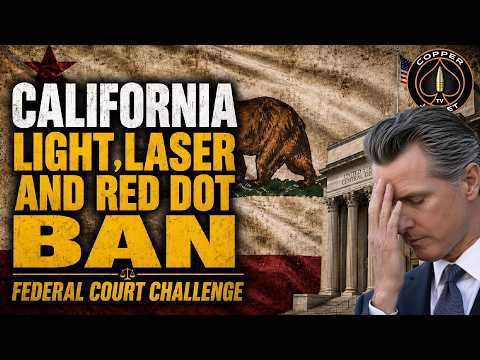
This video discusses a lawsuit filed by the Second Amendment Foundation (2AF) against Contra Costa County, California, challenging restrictions on concealed carry weapon (CCW) permits. The county's policies prohibit the use of red dot sights, lasers, and flashlights on handguns, as well as single-action-only firearms like the 1911 platform. The lawsuit argues these restrictions violate the Second Amendment, citing Supreme Court precedents like NYSRPA v. Bruen and DC v. Heller, and asserts that these commonly used safety and accuracy-enhancing attachments are protected under the right to bear arms.