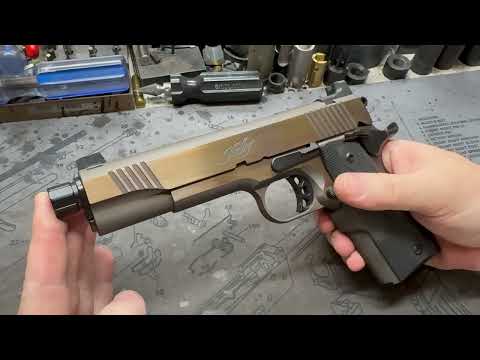
How they build a Wilson CQB 1911 - Behind the Scenes at Wilson Combat Pt. 4

Published on February 7, 2015
Duration: 6:06

This video provides an in-depth look at the meticulous build process for a Wilson Combat CQB 1911 pistol. It details the kitting, precision fitting (A-Op/B-Op), specialized trigger work, surface preparation for various finishes, final assembly with lubrication, and rigorous test firing. The instruction comes from a 14-year veteran of Wilson Combat, highlighting expert-level gunsmithing techniques.

Quick Summary

The Wilson Combat CQB 1911 build process emphasizes precision gunsmithing, including A-Op/B-Op fitting, specialized trigger work for a 3.75 lbs pull, and extensive hand-finishing. Each pistol undergoes rigorous quality control with 80-100 rounds of test firing across various ammunition types.

Chapters

  1. 00:00Introduction and Parts Kitting
  2. 00:48A-Op and B-Op Fitting Processes
  3. 02:16The Trigger Job
  4. 02:55Prep Station and Finishing
  5. 04:05Final Assembly
  6. 05:02Test Firing and Quality Control

Frequently Asked Questions

What are the key stages in building a Wilson Combat CQB 1911?

The build involves parts kitting, precision A-Op/B-Op fitting, specialized trigger work, extensive hand-filing at the prep station, final assembly with lubrication, and rigorous test firing with multiple ammunition types.

What is the standard trigger pull weight for a Wilson Combat CQB 1911?

The standard trigger pull weight for a Wilson Combat CQB 1911 is 3.75 pounds. This is achieved through specialized trigger work performed by trained gunsmiths, taking approximately one to one and a half hours.

How does Wilson Combat ensure the quality and reliability of its CQB 1911 pistols?

Quality is ensured through meticulous hand-fitting, precision machining, and a rigorous test-firing protocol where each pistol is fired with 80-100 rounds of lead, hardball, and hollow-point ammunition.

What finishing options are mentioned for the Wilson Combat CQB 1911?

The video mentions several finishing options prepared at the prep station, including Armor-Tuff coating, bluing, case hardening, and parkerization, all requiring extensive hand-filing and sanding beforehand.

Related News

All News →

More Gunsmithing & DIY Videos You Might Like

More from Vickers Tactical

View all →