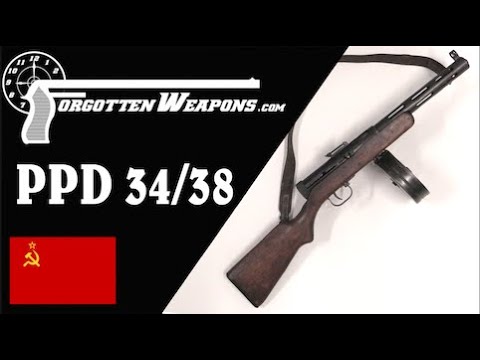
Soviet PPD-40: Degtyarev's Submachine Gun

Published on August 28, 2017
Duration: 12:21

This guide details the disassembly of the Soviet PPD-40 submachine gun, as demonstrated by Ian McCollum. It covers removing the receiver cap, recoil spring, and bolt assembly, highlighting differences in bolt mechanisms between PPD-38 and PPD-40 variants. Essential for maintenance and understanding the firearm's mechanics, this process requires careful attention to safety.

Quick Summary

The Soviet PPD-40 submachine gun, designed by Vasily Degtyarev, was an early influential design adopted in 1934. It featured a 71-round drum magazine and selectable semi/full-auto fire modes. Many PPD-40s bear the 'SA' Finnish capture mark, indicating service with the Finnish Army after being captured during wartime.

Chapters

  1. 00:00Introduction to the PPD-40
  2. 01:07Early Development and Trials
  3. 02:11Adoption and the Winter War
  4. 03:44Design Iterations and Magazines
  5. 05:35Finnish Capture Markings
  6. 06:33Controls and Safety
  7. 08:18Internal Mechanics and Disassembly
  8. 10:30Transition to the PPSh-41

Frequently Asked Questions

Who designed the Soviet PPD-40 submachine gun?

The Soviet PPD-40 submachine gun was designed by Vasily Degtyarev. His design was chosen for its simplicity, cost-effectiveness, accuracy, and reliability compared to competing models in early Soviet trials.

What is the significance of the 'SA' mark on a PPD-40?

The 'SA' mark, standing for Suomen Armeija (Finnish Army), indicates that the PPD-40 was captured by Finnish forces during conflicts like the Winter War or Continuation War and subsequently placed into Finnish military service.

Why was the PPD-40 replaced by the PPSh-41?

Despite its effectiveness, the PPD-40 was expensive and slow to manufacture due to its reliance on machined parts. The PPSh-41, utilizing stamped steel components, allowed for much higher production rates essential for World War II.

What are the fire modes and magazine capacity of the PPD-40?

The PPD-40 typically features semi-automatic and full-automatic fire modes, selectable via a flag lever. It commonly used a 71-round drum magazine, though earlier versions utilized 25-round stick magazines.

Related News

All News →

More Gunsmithing & DIY Videos You Might Like

More from Forgotten Weapons

View all →