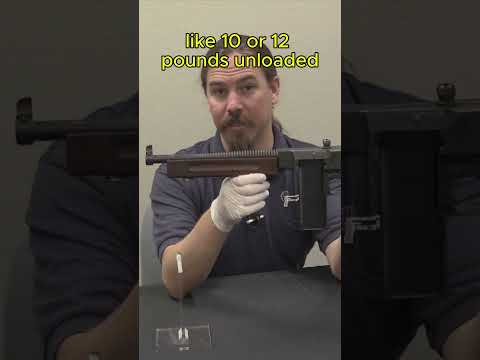
The Marines' First SMG: 1921/28 Thompson Gun

Published on October 9, 2018
Duration: 13:45

This guide details the internal modifications made to the 1921 Thompson to create the 1928 model, focusing on reducing the rate of fire. Expert analysis from Ian McCollum highlights the addition of weight to the actuator and changes to the recoil spring assembly. These modifications were crucial for meeting U.S. Navy requirements and demonstrate a key aspect of the Thompson's development history.


Quick Summary

The 1921 Thompson was modified into the 1928 model by Auto-Ordnance to meet U.S. Navy requirements for a lower rate of fire. These internal changes included adding weight to the bolt actuator and strengthening the recoil spring, reducing the cyclic rate from ~800 to ~600 rounds per minute. The receiver was also overstamped with 'U.S. NAVY' and 'MODEL OF 1928'.

Chapters

  1. 00:00Introduction: 1921/28 Thompson Overstamp
  2. 00:34Early Sales History & Limited Civilian Market
  3. 01:47Marine Corps Use & Navy Testing
  4. 03:32The 1928 Model & Overstamping Process
  5. 05:30Internal Modifications for Rate of Fire Reduction
  6. 06:32Component Comparison: 1921 vs. 1928 Internals
  7. 08:38Firing Mechanism: Hammer on Bolt Safety
  8. 09:15Later Adoption: Cavalry & FBI
  9. 10:56Economic Context: Thompson's High Cost

Frequently Asked Questions

What modifications were made to the 1921 Thompson to create the 1928 model?

The 1928 Thompson was created by overstamping 'U.S. NAVY' and 'MODEL OF 1928' onto existing 1921 receivers. Internally, modifications focused on reducing the rate of fire by adding weight to the bolt actuator and using a stronger recoil spring.

Why did the U.S. Navy request a lower rate of fire for the Thompson SMG?

The U.S. Navy tested the Thompson in 1927 and requested a lower rate of fire. Auto-Ordnance responded by modifying existing 1921 models rather than developing entirely new ones, leading to the 1928 variant.

What was the significance of the 1921/28 Thompson SMG for the U.S. Marines?

The Thompson SMG, particularly the 1928 variant, was adopted by the U.S. Marines for postal protection duties. They found the weapon effective and reliable, contributing to its continued development and adoption by other branches.

How did the internal modifications affect the Thompson's rate of fire?

The modifications, primarily adding weight to the bolt actuator and altering the recoil spring assembly, reduced the Thompson's cyclic rate of fire from approximately 800 rounds per minute in the 1921 model to around 600 rounds per minute in the 1928 model.

More Gunsmithing & DIY Videos You Might Like

More from Forgotten Weapons

View all →