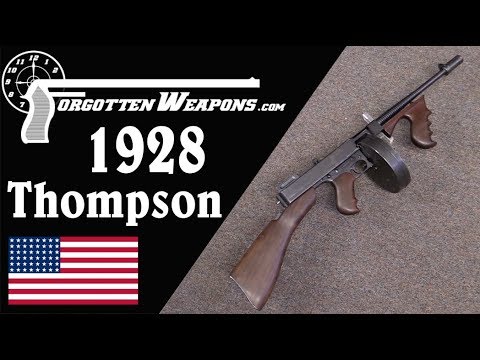
This guide details the internal modifications made to the 1921 Thompson to create the 1928 model, focusing on reducing the rate of fire. Expert analysis from Ian McCollum highlights the addition of weight to the actuator and changes to the recoil spring assembly. These modifications were crucial for meeting U.S. Navy requirements and demonstrate a key aspect of the Thompson's development history.
This guide details the field stripping process for the Thompson Submachine Gun, as demonstrated by Hickok45. It covers removing the buttstock and trigger group for basic cleaning and maintenance. The video emphasizes the historical significance and engineering of the Thompson, from its early, ornate designs to the simplified wartime M1 and M1A1 variants. Hickok45, a highly experienced firearms reviewer, provides an informative and enthusiastic look at this iconic weapon.
This video provides an expert look at John Thompson's original 1919 prototype submachine gun, tracing its evolution to the iconic 1921 'Tommy Gun'. The discussion highlights key differences between the prototype and the production models, including features like sights, stocks, and barrel configurations, offering valuable historical and technical insights for firearm enthusiasts.
You've reached the end! 3 videos loaded.
Gun Laws by State
Read firearms regulations for all 50 states + D.C.
Find Gun Dealers
Search licensed FFL dealers near you.