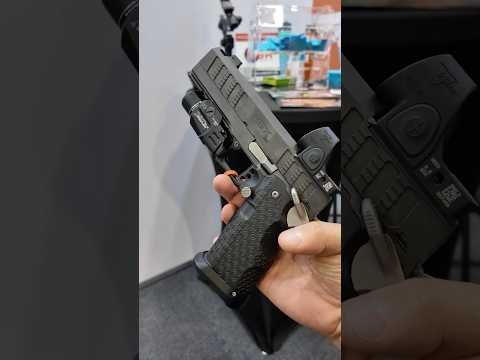
I Do Not Recommend The Prodigy C

Published on January 31, 2025
Duration: 12:05

This review of the Springfield Prodigy C highlights significant reliability issues, particularly failure to extract, stemming from an oversized guide rod and potentially an over-sprung system. While the ported barrel offers excellent recoil mitigation, the gun's functionality is compromised out of the box. The reviewer details a troubleshooting process involving lighter springs and ultimately replacing the guide rod with an aftermarket part to achieve reliable operation. The video suggests that while the platform has potential, significant internal modifications may be necessary for consistent performance.


Quick Summary

The Springfield Prodigy C exhibits significant reliability issues, primarily failure to extract, often caused by an oversized factory guide rod that binds and reduces slide energy. Replacing this guide rod with an aftermarket part, like an Atlas guide rod, is crucial for resolving these malfunctions and achieving reliable operation. Safety concerns regarding the safety mechanism's functionality have also been noted.

Chapters

  1. 00:03Introduction: The 2011 Market & Prodigy
  2. 00:22The Holy Grail: Affordable 2011s
  3. 00:36Original Prodigy Assessment
  4. 00:54Prodigy C: The '1.5 Version'?
  5. 01:30Purchasing the Prodigy C
  6. 01:38Modern Warriors Sponsor Segment
  7. 02:20Prodigy C: Ported Barrel Analysis
  8. 02:41Recoil Control & Shooting Flatness
  9. 03:08Master Tier Shooter's Feedback
  10. 03:23Overall Gun Assessment
  11. 03:40Grip Texture & Feel
  12. 03:55Optics Cut & Plate System
  13. 04:08Made in America & Docter Footprint
  14. 04:32Minor Issues: Safety & Chamber Indicator
  15. 05:19The Core Problem: It Doesn't Work
  16. 05:33Safety Malfunction Deep Dive
  17. 06:21Temporary Safety Fix
  18. 06:31Optics Plate Fitment Issues
  19. 07:05Interference Fit & Warranty
  20. 07:26Unreliable Performance
  21. 07:38Return to Springfield & Re-evaluation
  22. 08:08The 2011 Platform & Part Swaps
  23. 08:14Assistance from a Friend
  24. 08:32Magazine & Spring Troubleshooting
  25. 09:04Guide Rod Identified as Issue
  26. 09:25Guide Rod Replacement & Success
  27. 09:38Further Internal Upgrades
  28. 09:52Cost-Benefit Analysis Post-Modification
  29. 10:06Caveats & Gambling on the Prodigy
  30. 10:31Recommendation: Gutting the Platform
  31. 10:52Conclusion: Who is This For?
  32. 11:03Final Learnings & Springfield's Failure

Frequently Asked Questions

What are the main reliability issues with the Springfield Prodigy C?

The Springfield Prodigy C suffers from significant reliability problems, primarily failure to extract malfunctions. These issues are often linked to an oversized factory guide rod that binds under spring compression, robbing the slide of energy needed for proper cycling. This can lead to a consistent rate of malfunctions, making the firearm unusable without modification.

How can the reliability issues of the Springfield Prodigy C be resolved?

The primary fix involves replacing the factory guide rod with an aftermarket one, such as an Atlas guide rod, which is precisely machined and does not bind. Lighter recoil springs can also help. For optimal performance and longevity, replacing MIM internal components like the sear and trigger is also recommended, though not strictly necessary for basic function after the guide rod fix.

What are the performance benefits of the Springfield Prodigy C's ported barrel?

The ported barrel on the Springfield Prodigy C provides exceptional recoil mitigation, resulting in a very flat shooting experience. It performs significantly better than many compensated striker-fired pistols and is noted to be only slightly less effective than a high-end Staccato XC, making follow-up shots faster and more accurate.

Are there any safety concerns with the Springfield Prodigy C?

Yes, a critical safety flaw was identified where the safety mechanism could malfunction. It was possible for the gun to fire when the safety was engaged or remain safe when disengaged, due to internal parts not mating correctly. This represents a dangerous failure that compromises the firearm's safe operation.

More Reviews Videos You Might Like

More from Brass Facts

View all →