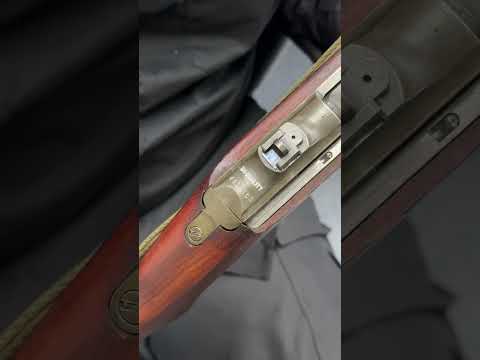
Very Rare Nazi G41(M) Rifle

Published on March 21, 2022
Duration: 14:47

This video provides a detailed comparison between the rare Mauser G41(M) and the more common Walther G41(W) semi-automatic rifles. It highlights the historical context of their development in response to the German army's need for self-loading rifles, contrasting their design philosophies, production numbers, and operational issues. The Mauser G41(M) is presented as an experimental, complex, and sensitive design that saw limited production and deployment, while the Walther G41(W) was more successful and led to the development of the G43.

Quick Summary

The Mauser G41(M) was an experimental WWII German semi-automatic rifle produced in limited numbers (12,000-15,000) and was known for its complex, sensitive Bang system gas operation. It was designed to also function as a bolt-action. In contrast, the Walther G41(W) was produced in higher quantities (around 100,000), was more reliable, and focused solely on semi-automatic operation, paving the way for the G43.

Chapters

  1. 00:08Introduction: Rare Nazi G41(M) Rifle
  2. 00:28G41(M) vs. G41(W) - Production Numbers
  3. 00:37Comparison: Mauser G41(M) and Walther G41(W)
  4. 01:38History: German Army's Need for Semi-Automatic Rifles
  5. 02:10Prototype Development: Walther and Mauser
  6. 02:26Mauser G41(M) Overview
  7. 03:00G41(M) Features: Bang System and Gas Trap
  8. 03:56G41(M) Sensitivity and Reliability Issues
  9. 04:34Walther G41(W) Receiver and Condition
  10. 05:00G41(M) Bolt Action Capability
  11. 05:34Matching Numbers on G41(M)
  12. 06:36G41(M) Bolt Hold-Open Mechanism
  13. 07:14G41(M) Downsides: Sanding and Re-varnishing
  14. 07:47G41(M) Kick Plate vs. G41(W)
  15. 08:09G41(M) Operational Failures and Soldier Preferences
  16. 08:21Walther G41(W) Design Philosophy
  17. 08:43Walther G41(W) Manufacturer and Date
  18. 09:03G41(W) Rear Sight and Shroud
  19. 09:14G41(W) Charging Handle and Bolt Hold
  20. 09:35G41(W) as a Superior Design
  21. 09:59Loading Mechanism: Internal Magazine
  22. 10:07G43/K43 Advantage: Removable Magazine
  23. 10:20G41(W) Bayonet and Frog
  24. 11:10G41(W) Scope and Case
  25. 12:05G41(W) Scope Mounting Adapter
  26. 12:48Original G41(W) Manual
  27. 13:32G41(W) Cleaning Kit
  28. 14:24Full G41(W) Assembly: Bayonet, Scope, Case
  29. 14:40Conclusion: Beautiful G41(M) Going Out

Frequently Asked Questions

What is the difference between the Mauser G41(M) and the Walther G41(W)?

The Mauser G41(M) was an experimental rifle produced in limited numbers (12,000-15,000) with a complex and sensitive Bang system, designed to also function as a bolt-action. The Walther G41(W) was produced in much larger quantities (around 100,000), was more reliable, and focused solely on semi-automatic operation, leading to its development into the G43.

Why was the Mauser G41(M) considered rare and experimental?

The Mauser G41(M) was rare due to its limited production run of only 12,000-15,000 units. It was considered experimental because its Bang system gas operation was highly sensitive to dirt and mud, and its complex design made it difficult to maintain and repair, leading to frequent malfunctions.

What were the main operational issues with the G41 rifles?

Both G41 variants, particularly the Mauser G41(M), suffered from the 'Bang system' being very sensitive to dirt and mud, causing jams. Additionally, the tight tolerances meant replacement parts often didn't work, and the Mauser version's complexity made it difficult to field strip and reassemble correctly.

How did the Walther G41(W) differ from the Mauser G41(M) in design and function?

The Walther G41(W) was a more successful design that largely ignored the requirement for bolt-action capability, focusing on reliable semi-automatic function. It held its bolt open via the follower, unlike the Mauser's more complex bar mechanism, and its overall design was less prone to the sensitivity issues that plagued the G41(M).

What historical context led to the development of the G41 rifles?

In 1939, the German army recognized the need for a self-loading or semi-automatic rifle to keep pace with technological advancements, particularly noting the US M1 Garand. This led them to solicit designs from various companies, eventually narrowing down to Walther and Mauser for prototype development.

More Reviews Videos You Might Like

More from Legacy Collectibles

View all →