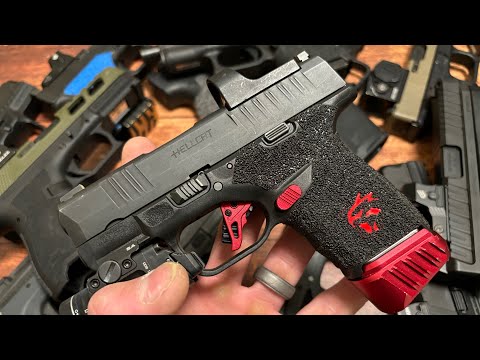
Does the Ruger Ready Dot actually work?

Published on May 29, 2023
Duration: 13:38

This guide covers the conceptual installation and zeroing approach for the Ruger Ready Dot optic. As a non-adjustable, passive optic, its effective use relies heavily on the firearm's manufacturing tolerances. Testing at typical defensive engagement distances is crucial to confirm its performance.

Quick Summary

The Ruger Ready Dot is a $99, battery-free passive optic using a fiber optic coil for illumination. It features a 15 MOA dot and the Shield RMSC footprint. Its primary drawback is its non-adjustable nature, relying entirely on firearm manufacturing tolerances for zero, making it best suited for the Ruger Max-9.

Chapters

  1. 00:00Introduction to Ruger Ready Dot
  2. 00:37Compatibility and Mounting
  3. 01:35Range Testing and Accuracy
  4. 03:14Illumination and Design
  5. 06:35Value Proposition and Drawbacks
  6. 10:07Final Verdict

Frequently Asked Questions

What is the Ruger Ready Dot optic?

The Ruger Ready Dot is a non-electronic, passive red dot sight designed primarily for the Ruger Max-9 pistol. It uses ambient light via a fiber optic coil for illumination and has a fixed 15 MOA dot size with no external adjustments.

How is the Ruger Ready Dot mounted and zeroed?

It utilizes the Shield RMSC footprint for mounting. Crucially, it is non-adjustable, meaning its point of aim is determined by the firearm's manufacturing tolerances. Proper function relies on the pistol slide being milled precisely to align the optic with the iron sights.

What are the advantages and disadvantages of the Ruger Ready Dot?

Advantages include its low $99 MSRP, battery-free operation, and simplicity. Disadvantages are the large 15 MOA dot, small window, dependence on ambient light, and the inability to zero it for different ammunition or shooter variations.

Is the Ruger Ready Dot suitable for other firearms besides the Ruger Max-9?

While it fits the Shield RMSC footprint, its non-adjustable nature makes it less ideal for other pistols unless their slide milling is exceptionally precise. Testing is recommended, as point-of-aim shifts may occur and cannot be corrected.

Related News

All News →

More Tactical & Gear Videos You Might Like

More from TFB TV

View all →